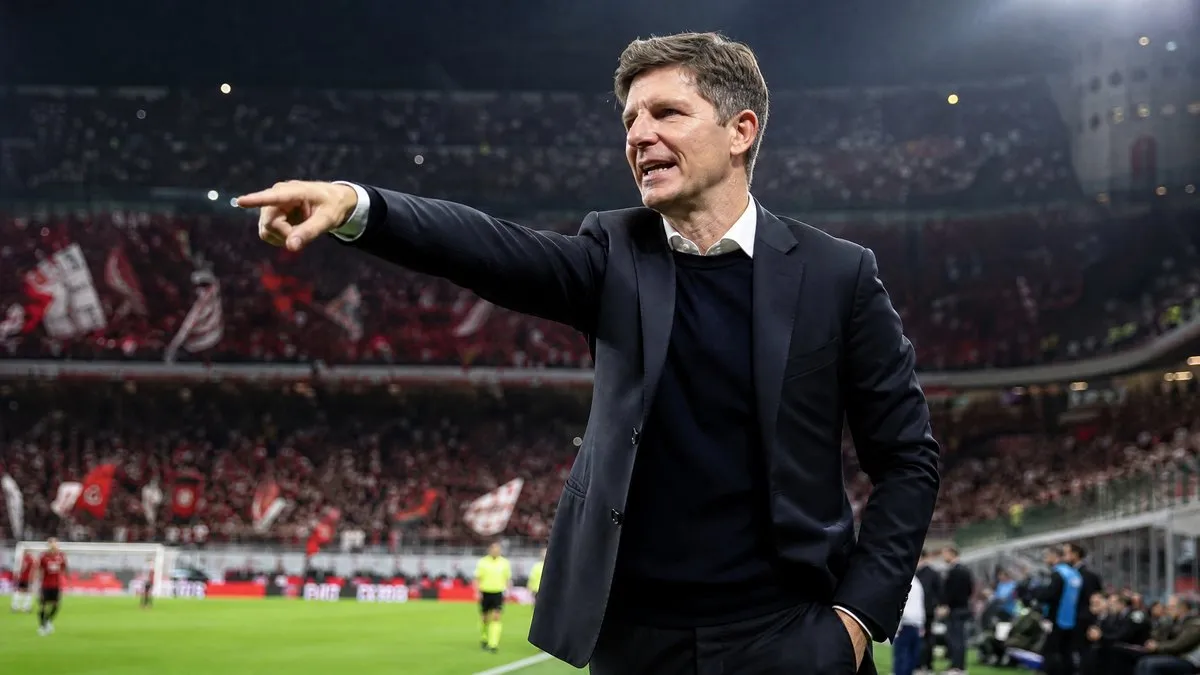
AI-generated image
AC Milan managerial search: Glasner, Amorim, Rangnick
AC Milan managerial search heats up as Cardinale weighs Oliver Glasner, Ruben Amorim, and Alvaro Arbeloa, with Rangnick key to the new plan.
AC Milan managerial search heats up as Cardinale weighs Oliver Glasner, Ruben Amorim, and Alvaro Arbeloa, with Rangnick key to the new plan.
AC Milan are living in the uncomfortable space between urgency and uncertainty, and the AC Milan managerial search has become the club’s defining storyline of the summer. Owner Gerry Cardinale is weighing a shortlist that already includes a draft agreement with Oliver Glasner, yet the Rossoneri are still scanning the market for a coach who fits a sharper technical identity. After a season that ended without Champions League football, every decision now carries financial and emotional consequences.
There is no hiding from the fact that missing the Champions League changes everything at Milan, from wage ceilings to transfer ambition. That reality is why the AC Milan managerial search is being led so directly by Gerry Cardinale, who knows the next appointment must reassure investors and supporters at the same time. A new coach has to deliver results quickly, but also speak the language of a modern project. In Serie A, that balance is brutally hard to strike.
The club’s dilemma is that “short-term fix” and “long-term rebuild” rarely come packaged together, especially under financial constraints. The AC Milan managerial search is therefore not simply about picking the best name, but picking the best fit for a specific technical vision that can survive market limitations. Milan want a coach who can improve players, not just buy solutions. That requirement narrows the field and raises the stakes.
Replacing Massimiliano Allegri is not treated like a routine change, because it touches the club’s identity and its relationship with pressure. The AC Milan managerial search is happening in a climate where fans expect a clear direction rather than another swing between styles. Allegri’s pragmatism can stabilize, but it can also leave supporters feeling disconnected from the club’s traditional idea of proactive football. The successor must win, yet also make Milan feel like Milan again.
The calendar is forcing Milan’s hand, because the summer transfer window rewards clubs that move early and punishes those who hesitate. The AC Milan managerial search must conclude in time for the coach to shape recruitment, preseason conditioning, and the tactical base for the new Serie A campaign. With 2026-27 planning also looming in the background, Milan cannot afford another year of drifting. Every week without clarity risks compounding mistakes.
Oliver Glasner sits in pole position because Milan have already worked on a draft agreement, a sign that talks have progressed beyond casual interest. In the AC Milan managerial search, that matters: it suggests the club see him as a coach who can implement structure quickly. His recent work at Crystal Palace boosted his reputation as a problem-solver who can organize a squad fast. Milan admire that blend of intensity and clarity.
Glasner’s appeal also lies in his ability to create repeatable patterns, which is crucial for a club that may not have the budget to constantly refresh the squad. The AC Milan managerial search is leaning toward coaches who can raise the floor of performance through coaching rather than spending. His teams tend to be compact without being passive, and aggressive without becoming reckless. That profile feels tailored for the weekly grind of Serie A.
Glasner is often associated with organized pressing, direct verticality, and a willingness to adjust shapes without losing principles. For the AC Milan managerial search, those traits are attractive because they promise immediate competitiveness while leaving room for evolution. Serie A opponents punish sloppy spacing, so a coach who drills distances and triggers can buy a team points quickly. Milan, however, will want assurance that his approach can handle low blocks too.
A draft agreement can create a sense of inevitability, but it can also become leverage in negotiations with other candidates. The AC Milan managerial search remains open because Milan’s leadership want to be sure the coach aligns with the broader technical department, not just the first-team needs. Glasner’s stock is high after Crystal Palace, which could raise salary demands and staff requirements. Milan must decide whether that cost matches the upside.
Ruben Amorim is the kind of name that electrifies a shortlist because he represents a coherent idea of contemporary football management. In the AC Milan managerial search, he is viewed as a potential culture-setter, someone who can impose a system and develop talent without losing competitiveness. His reputation has been built on clear automatisms, brave game plans, and a strong relationship with squad building. Milan’s scouts and analysts reportedly admire that consistency.
The complication is that Amorim rarely comes cheap, and Milan’s financial picture after missing Champions League football makes every negotiation more delicate. The AC Milan managerial search is therefore partly an exercise in economic realism: can the club afford the coach, his staff, and the players required to execute his system? Milan cannot simply copy-paste a model from another league without funding the details. That tension could decide everything.
Cardinale’s language around process, structure, and long-term value aligns neatly with the public perception of Amorim as a project coach. The AC Milan managerial search is looking for someone who can create a recognizable identity that survives player turnover. Amorim’s teams tend to understand where the next pass is before receiving the ball, which is coaching gold in a league as tactical as Serie A. That clarity would also help younger players grow faster.
Even if Milan love the idea, the mechanics can be messy, especially when a coach is under contract and protected by clauses. The AC Milan managerial search must consider not only the headline salary, but also compensation, bonuses, and the cost of building a compatible squad. Fans may demand a glamorous appointment, yet the club must avoid a deal that limits transfer flexibility. A coach who needs immediate heavy investment might be a luxury Milan can’t justify.
Alvaro Arbeloa is the wildcard who signals Milan are at least considering a development-led appointment rather than a purely established winner. In the AC Milan managerial search, his name stands out because it points toward a “coach as educator” profile, shaped by elite standards and the Real Madrid environment. Milan have often thrived when the dressing room buys into a clear culture. Arbeloa’s credibility as a former top-level professional could help him set that tone.
Yet stepping from a youth or academy setting into a club of Milan’s magnitude is a leap that can swallow even talented coaches. The AC Milan managerial search is happening under intense scrutiny, and any experiment would need robust support from the technical director, the recruitment team, and the leadership group in the squad. Milan must ask whether this is the right moment for a high-upside gamble. The margin for error after a disappointing season is small.
Arbeloa’s appeal is not about a long CV of senior trophies, but about the habits he can embed day to day. The AC Milan managerial search includes him because Milan want a coach who improves players through detail, repetition, and accountability. Coming from Real Madrid’s ecosystem, he is steeped in the idea that training intensity is non-negotiable. If Milan’s squad needs a reset in mentality, that could be valuable.
Italian football can be ruthless to coaches who are still learning the rhythm of senior management, especially in a club where every draw becomes a crisis. The AC Milan managerial search must weigh romantic ideas against the cold reality of points. Arbeloa would face weekly tactical puzzles, media storms, and high-pressure man-management moments that are hard to simulate in youth football. Without Champions League revenue, Milan also can’t easily buy time with expensive fixes.
The coaching appointment cannot be separated from the parallel hunt for a technical director, and Ralf Rangnick has emerged as the leading candidate. In the AC Milan managerial search, his presence changes the entire equation because he reportedly wants full control over the technical sector. That means influence over recruitment, analytics, youth development, and coaching methodology. Milan must decide whether they want a strong architect or a more collaborative figure.
Rangnick’s style is famously systemic: he builds organizations that can identify undervalued players and develop them into assets. The AC Milan managerial search would then become less about a single superstar coach and more about a synchronized football management model. The upside is sustainability, particularly important if Milan are operating with tighter budgets. The downside is that power struggles can emerge if ownership, executives, and coach are not aligned from day one.
If Rangnick arrives with real authority, Milan’s next coach would likely need to accept a defined structure rather than demand total autonomy. The AC Milan managerial search would then prioritize compatibility: a coach comfortable working within a multi-department model, using data and shared recruitment principles. That could favor profiles like Oliver Glasner, who are known for strong organization, though it could also attract other modern thinkers. The key is avoiding mixed messages that confuse the squad.
Granting full control can speed up decision-making, but it also concentrates responsibility in a way that makes failures louder. The AC Milan managerial search is already happening under fan pressure, so ownership must be confident they can communicate why a strong technical director is necessary. If Rangnick’s demands are met, Cardinale must be ready to defend the model publicly and stick with it through early turbulence. Milan’s recent instability makes that commitment harder, but also more necessary.
Supporters are not just watching; they are actively pushing, and protests have underlined dissatisfaction with how ownership has managed key moments. The AC Milan managerial search has therefore become a referendum on Cardinale’s leadership, not merely a sporting decision. Fans want decisive action, but they also want competence, transparency, and a sense that Milan’s history is being respected. In a club this big, atmosphere can become a competitive factor.
The financial squeeze after missing Champions League football creates a dangerous loop: less money can mean fewer options, and fewer options can mean more anger. The AC Milan managerial search must navigate that reality by selecting a coach who can maximize resources, while also convincing fans that ambition remains intact. Milan’s brand is global, but the heartbeat is local, and the San Siro mood can swing quickly. Getting the appointment wrong risks turning matchdays into constant tension.
Fans understand that recruitment is shaped by the coach’s style, and they fear another window of mismatched signings. The AC Milan managerial search must deliver a clear tactical blueprint so the club can buy players with purpose rather than opportunism. Every rumor about Oliver Glasner, Ruben Amorim, or Alvaro Arbeloa is filtered through that anxiety about coherence. Milan’s recent seasons have shown that good players can still look average in a confused structure.
Milan are approaching a stretch where the story can either reset or spiral, depending on the speed and quality of decisions. The AC Milan managerial search needs to end with a leadership team that speaks with one voice: owner, technical director, coach, and recruitment all aligned. Preseason is where habits are built, and a late appointment often means a late identity. For a club trying to re-enter the Champions League conversation, that delay is costly.
Milan’s next coach will inherit more than a squad list; he will inherit a mood, a financial reality, and a demand for direction that cannot be postponed. The AC Milan managerial search is circling Oliver Glasner with a draft agreement, flirting with the modern promise of Ruben Amorim, and even considering the bold Real Madrid pathway of Alvaro Arbeloa, all while Ralf Rangnick’s power demands loom over the structure. Cardinale now has to choose not just a manager, but a model—and Milan’s future hinges on getting both right.

Julian Mercer is a lifelong student of the game whose passion for football was sparked at an early age, after stepping onto the grass of Camp Nou as a six-year-old — a moment that left a lasting impression and set him on a permanent path into the sport. Since then, football has been both his lens on the world and his favourite language. Blending traditional fandom with a deep interest in tactics, squad building, and long-term team development, Julian has spent decades analysing the game from every angle. His fascination with football strategy was further shaped through years of immersive play in Football Manager, a series he has followed since the mid-1990s, developing a sharp eye for patterns, player profiles, and the fine margins that define success. At My World Of Football, Julian focuses on the stories beneath the surface — from tactical evolutions and managerial philosophies to the narratives that connect clubs, players, and supporters across generations. His writing aims to balance insight with accessibility, always grounded in a genuine love for the game.
Continue reading more football news