Myworldoffootball
Hugo Ekitike Injury News After Liverpool Exit to PSG
Hugo Ekitike injury news dominates Liverpool’s Champions League exit to PSG as Arne Slot weighs Isak’s return, tactics, and the path forward.
Hugo Ekitike injury news dominates Liverpool’s Champions League exit to PSG as Arne Slot weighs Isak’s return, tactics, and the path forward.
Liverpool’s Champions League night in Paris ended with the kind of double blow that haunts a season: elimination on the scoreboard and a sickening, silent moment when Hugo Ekitike went down without contact. The 2-0 defeat to Paris Saint-Germain didn’t just close the European door; it opened a new set of questions about Liverpool’s attack, depth, and resilience. With Arne Slot sounding genuinely worried, Hugo Ekitike injury news immediately became the headline that mattered most.
The PSG vs Liverpool highlights will show two goals, a roaring Parc des Princes, and a Liverpool side that never fully imposed its tempo. Yet the match felt defined as much by what Liverpool couldn’t do as by what PSG did well, with transitions blunted and final passes rushed under pressure. Liverpool’s Champions League exit arrived with a sense of inevitability after halftime, when the game’s emotional center shifted from chasing goals to coping with disruption.
Arne Slot’s team looked short of their usual fluency between the lines, and PSG’s defensive spacing forced Liverpool into lower-percentage patterns. When Liverpool did find moments to break, the finishing touch lacked conviction, and the second PSG goal drained belief from the away end. The Liverpool Champions League exit will be framed as a tactical defeat, but it also became a personnel crisis in real time. That’s why Hugo Ekitike injury news quickly eclipsed the post-match analysis.
Liverpool’s press, usually a reliable way to turn games chaotic in their favor, rarely forced PSG into the kind of panicked clearances that invite wave-after-wave attacks. PSG played through pressure with calm angles, and Liverpool’s first line often arrived a half-second late, leaving midfielders exposed to quick combinations. Ibrahima Konate had to step out repeatedly to cover, which opened pockets behind him and made Liverpool’s defensive structure feel stretched. In that context, Liverpool’s Champions League exit became a story of margins lost early.
There was a visible shift in Liverpool’s body language once Ekitike signaled he couldn’t continue, because the bench suddenly represented not just substitution options but a scramble for stability. Even before the final whistle, players looked toward the technical area for cues, as if the tactical plan had been torn up mid-page. The stadium noise rose, but it was the kind of roar that feeds on vulnerability, and Liverpool looked vulnerable. Hugo Ekitike injury news turned the final phase into damage limitation rather than a comeback narrative.
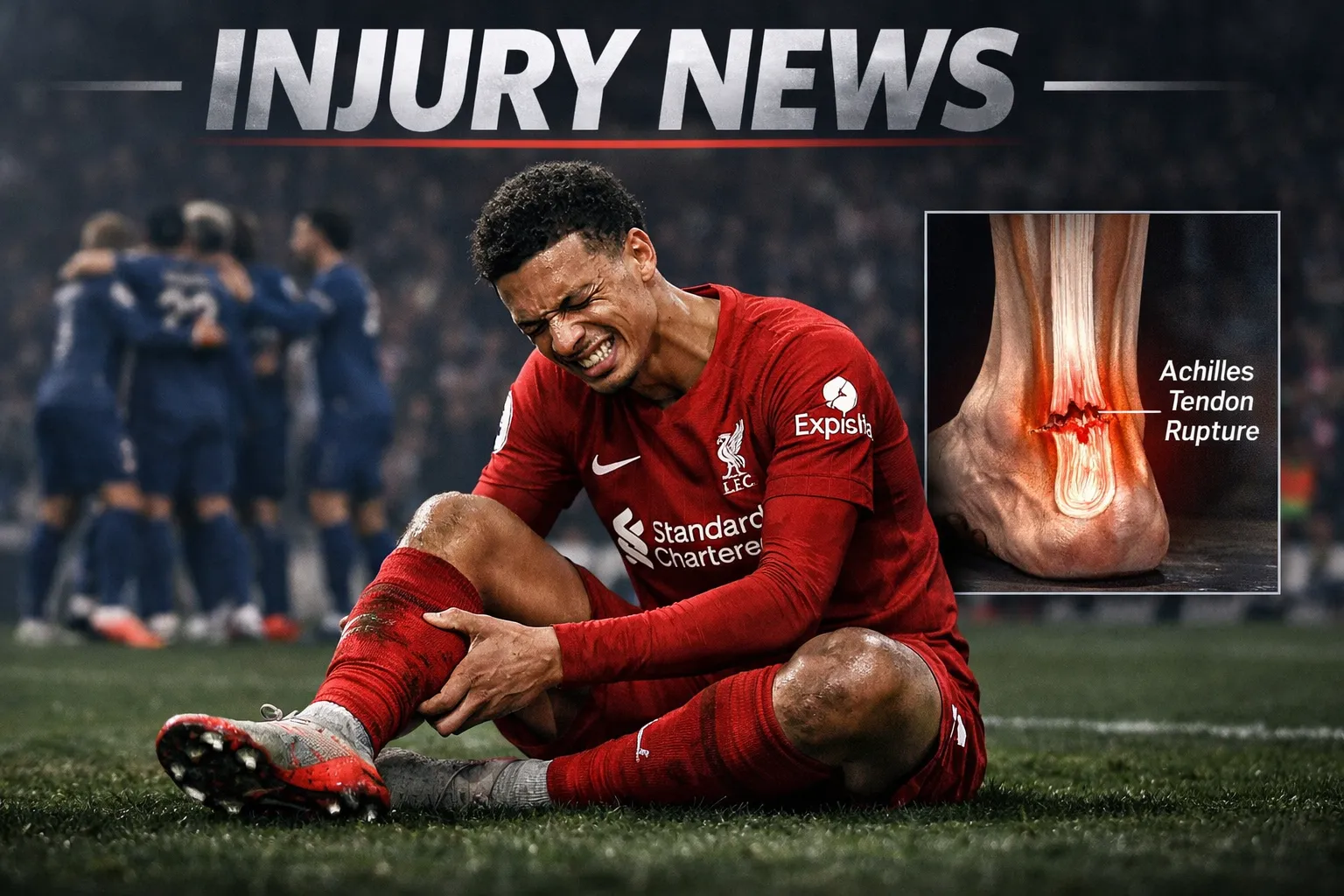
The clearest image from the night was not a PSG finish but Ekitike’s immediate reaction after the non-contact incident, the kind that makes teammates instinctively wave for help. He left the pitch in agony, and the absence of a collision only sharpened the fear around ligaments, tendons, or a significant muscular rupture. In the mixed zone, the conversation among Liverpool staff was guarded, because early assumptions can be cruelly wrong. Still, Hugo Ekitike injury news quickly carried a tone of dread.
Slot didn’t dress it up, and his face told its own story as he spoke about concern and the possibility of a long layoff. Liverpool invested €95 million to bring Ekitike from Eintracht Frankfurt, a fee that reflected not just talent but a plan to reshape the forward line for the long term. Losing him now would be more than losing goals; it would be losing a connector who can stretch and link in the same move. Hugo Ekitike injury news therefore lands as both medical update and strategic emergency.
Ekitike’s value to Liverpool has been how he changes the geometry of attacks, pulling center-backs wider and creating lanes for runners to dart through. When he drops off, he can pin a midfielder and still spin in behind, and that dual threat often forces opponents to defend with hesitation. Without him, Liverpool risk becoming easier to read, especially if opponents can focus on one primary striker option. That is why Hugo Ekitike injury news feels like a system problem, not a single-player absence.
Slot’s comments were careful, but the subtext was unmistakable: the initial signs weren’t encouraging, and the club would need scans to understand the extent. He talked about hope while acknowledging reality, the classic manager tightrope between calming supporters and respecting the seriousness of what everyone saw. The phrase “long-term” hovered without being fully confirmed, which is often how clubs communicate before imaging results. Until then, every Hugo Ekitike injury news cycle will be fueled by uncertainty and anxious interpretation.
Arne Slot comments after the match carried two distinct tones, and both mattered: worry about Ekitike and reassurance about Alexander Isak. Slot sounded like a coach who knew the immediate sporting consequences but was more focused on the human side of a player leaving in visible pain. He also understood the optics of a big European defeat, yet he didn’t deflect into clichés about learning experiences. Instead, Slot spoke like a manager already thinking about solutions to the Hugo Ekitike injury news fallout.
On Isak, Slot was firm that the halftime substitution was tactical, not physical, which matters for both player confidence and fan perception. The manager emphasized readiness and training rhythm, hinting that the bigger issue was how the team functioned around Isak rather than whether Isak could function at all. In a night where Liverpool’s attack looked disjointed, Slot chose not to single out individuals for blame. Those Arne Slot comments were as much about protecting a dressing room as they were about explaining a decision.
Managers often hide behind medical privacy, but Slot’s delivery suggested he didn’t want supporters to underestimate the potential severity. At the same time, he avoided the trap of catastrophizing before doctors had done their work, which is crucial in a high-profile case that will dominate headlines. That balance is difficult when Hugo Ekitike injury news is already racing across social media, demanding instant certainty. Slot’s measured tone was essentially a request for patience, even if football rarely grants it.
Slot’s defense of Isak wasn’t just kindness; it was practical leadership, because Liverpool may need Isak to carry a heavier load immediately. When a manager publicly backs a forward after a quiet half, he’s also signaling to teammates to keep feeding him, keep trusting the runs, keep building patterns. In the aftermath of Liverpool’s Champions League exit, confidence can evaporate quickly, especially in attacking players. With Hugo Ekitike injury news threatening to remove a key option, Slot’s backing of Isak becomes a strategic necessity.
The Alexander Isak return storyline was supposed to be a feel-good subplot, a reminder that Liverpool still had firepower even on a difficult night. His first start in months brought immediate intrigue about sharpness, timing, and whether he could stretch PSG’s back line with his movement. Instead, the first half passed with Isak largely starved of clean service, often receiving with his back to goal and two defenders tight. By halftime, the Alexander Isak return had turned into a debate about fit rather than fitness.
Slot’s decision to substitute him at the break was framed as tactical, and the match context supports that explanation. Liverpool needed different angles, more presence between PSG’s lines, and perhaps a forward who could help sustain pressure with shorter combinations. Isak’s profile is devastating when the team can release him into space, but PSG denied that space with disciplined distances. Still, if Hugo Ekitike injury news confirms a long absence, Liverpool may have to build a new attacking blueprint that maximizes Isak’s strengths.
PSG defended Isak with a clear plan: limit the first touch, prevent the turn, and force Liverpool wide before the final ball could be threaded. When Isak drifted, PSG passed him on smoothly, rarely allowing him to isolate a single defender in open grass. That made his half look quieter than it necessarily was, because a striker’s work can be invisible when the opposition’s structure is perfect. The Alexander Isak return will be judged harshly by casual viewers, but the tape shows a forward boxed in by design.
If the Hugo Ekitike injury news ends with a lengthy timeline, Isak’s role could evolve from option to centerpiece, and that requires different support. Liverpool will need runners closer to him, quicker third-man combinations, and more deliberate attempts to create the exact channels he likes to attack. Isak can be a reference point, but he’s most lethal when he’s not isolated, when he can bounce a pass and burst beyond. The Alexander Isak return, then, becomes less about minutes managed and more about a team learning his language fast.
Liverpool’s Champions League exit will sting because it arrived with a sense that the team never reached their peak level across the tie’s decisive moments. Against elite opponents, depth isn’t only about having bodies; it’s about having alternate solutions when your first plan is blocked. PSG forced Liverpool into uncomfortable choices, and the second half showed how difficult it is to chase a game when rhythm is broken. When Hugo Ekitike injury news is added to that picture, the squad depth conversation becomes unavoidable.
Even with talented forwards available, replacing Ekitike’s specific blend of hold-up play, vertical threat, and link-up instincts is not straightforward. Liverpool can shuffle roles, but shuffling roles often reduces clarity, and clarity is what you need in high-pressure knockout football. The defeat also highlighted how quickly a match can tilt when a key player goes down and the tactical structure must be rebuilt on the fly. Liverpool’s Champions League exit, therefore, reads like a warning about resilience under sudden change.
Ibrahima Konate’s night reflected the stress PSG placed on Liverpool’s spacing, because he was repeatedly asked to defend the uncomfortable zones between stepping up and dropping off. When a center-back has to make too many judgment calls, the whole line becomes reactive, and reactive teams struggle to build controlled attacks. Konate did plenty right, but the constant defending of transitional moments limited Liverpool’s ability to commit numbers forward safely. In that environment, losing Ekitike amplified the sense that Liverpool were fighting with fewer tools than planned.
PSG’s ability to slow the game, speed it up, and choose when to engage made Liverpool look like a side searching for a second script. Liverpool had moments, but they didn’t sustain pressure long enough to turn the match into a siege, and PSG were comfortable defending leads without panic. That’s where personnel and tactical variety intersect, because different forwards unlock different patterns of chance creation. If Hugo Ekitike injury news removes one of those patterns for weeks or months, the urgency to develop a Plan B becomes immediate.
In the days after the defeat, the club’s agenda will revolve around medical clarity, because an accurate Ekitike injury update will shape everything from training loads to recruitment whispers. Liverpool can’t replace a €95 million striker emotionally or tactically overnight, but they can decide how to distribute responsibility, which is often the first step toward stability. Slot will also need to manage the squad’s psychology, because players feel a teammate’s pain as a collective burden. Hugo Ekitike injury news will hang over every press conference until timelines are confirmed.
Practically, Liverpool must now lean harder on Isak and other forwards, while also extracting more goal threat from midfield and full-back zones. The risk is becoming predictable, especially if opponents can tailor their defensive plans to limit Isak’s preferred movements. Slot’s coaching will be tested in how quickly he can create new automatisms, the rehearsed patterns that make chance creation feel inevitable. Liverpool’s Champions League exit may be final, but the domestic calendar will not pause for grief. Hugo Ekitike injury news, however, will keep redefining what success looks like week to week.
The quickest fix is structural: get more players closer to the striker, shorten distances, and create more second-ball opportunities around the box. That can mean a slightly higher starting position for attacking midfielders, more aggressive underlaps from full-backs, and clearer triggers for counter-pressing to keep attacks alive. Liverpool don’t need to abandon their identity, but they may need to simplify it in the short term to regain sharpness. If Hugo Ekitike injury news confirms a long absence, these tweaks become the new normal rather than temporary patches.
European elimination can linger, but injuries linger differently, because they follow a player into the treatment room and remind teammates of fragility. Slot’s job is to turn the narrative from loss to response, and that starts by framing the next match as a chance to honor the absent rather than fear the future. Supporters will want regular Hugo Ekitike injury news, yet the squad must avoid living inside that anxiety. The best tribute is performance, and Liverpool’s next steps will show whether Paris was a breaking point or a turning point.
Liverpool left Paris with two truths that can’t be separated: the Champions League dream is over, and the squad may have lost a cornerstone forward at the worst possible time. Until scans and specialists provide certainty, Hugo Ekitike injury news will dominate the conversation, shaping expectations and forcing tactical creativity from Arne Slot. Isak’s role now feels bigger, not because of one halftime substitution, but because Liverpool need a new attacking reference point immediately. The season’s next chapter will be written in how quickly Liverpool adapt, and how bravely they respond.
Julian Mercer is a lifelong student of the game whose passion for football was sparked at an early age, after stepping onto the grass of Camp Nou as a six-year-old — a moment that left a lasting impression and set him on a permanent path into the sport. Since then, football has been both his lens on the world and his favourite language. Blending traditional fandom with a deep interest in tactics, squad building, and long-term team development, Julian has spent decades analysing the game from every angle. His fascination with football strategy was further shaped through years of immersive play in Football Manager, a series he has followed since the mid-1990s, developing a sharp eye for patterns, player profiles, and the fine margins that define success. At My World Of Football, Julian focuses on the stories beneath the surface — from tactical evolutions and managerial philosophies to the narratives that connect clubs, players, and supporters across generations. His writing aims to balance insight with accessibility, always grounded in a genuine love for the game.
Continue reading more football news