AI-generated image
Jeremy Doku World Cup role: Belgium’s new spearhead
Jeremy Doku World Cup role grows as Belgium transitions from De Bruyne and Lukaku. How City sharpened him for a fearless, underdog run.
Jeremy Doku World Cup role grows as Belgium transitions from De Bruyne and Lukaku. How City sharpened him for a fearless, underdog run.
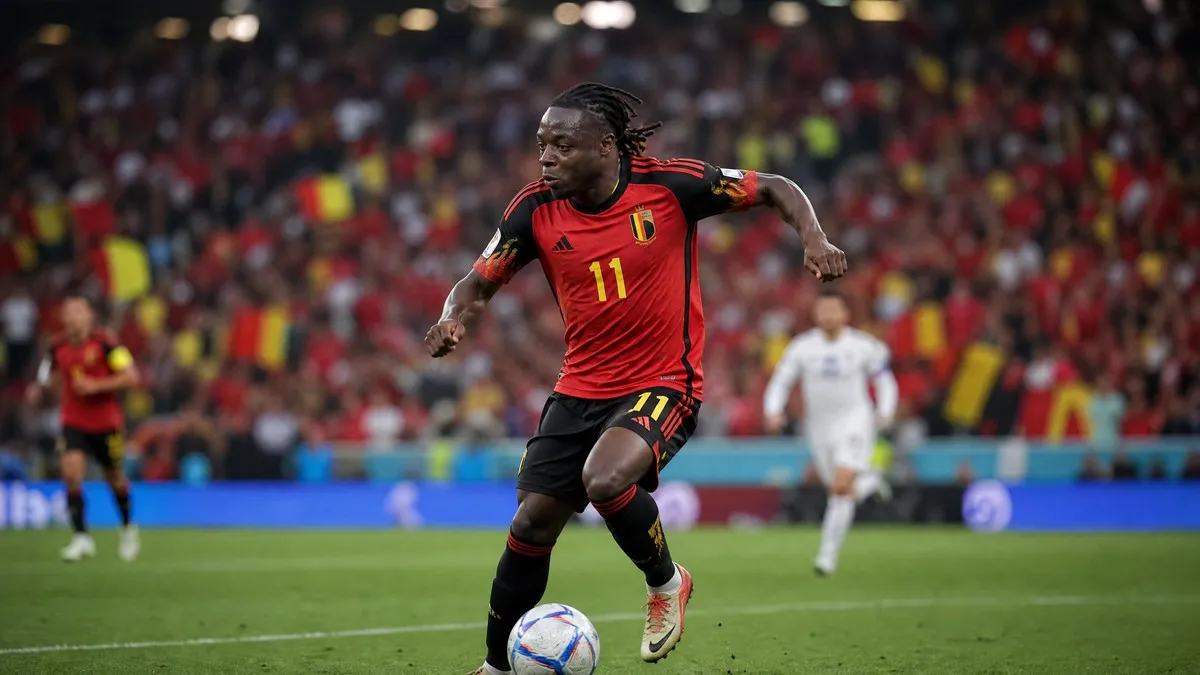
Jeremy Doku is no longer the exciting cameo winger Belgium unleash when a match needs chaos; he is preparing to be a reference point. After a £55 million move, three seasons living inside Pep Guardiola’s demanding system, and the memory of a first World Cup taste in 2022, his mindset has shifted from promise to purpose. The Jeremy Doku World Cup role now looks like a statement of leadership, especially as Kevin De Bruyne and Romelu Lukaku edge toward international farewells. Belgium may not be favorites, but Doku’s tone is clear: arrive brave, play free, leave with no regrets.
Doku’s trajectory has always been about acceleration, but the jump from Rennes to Manchester City turned speed into structure. At Rennes he was a one-man storm, asked to beat defenders and create chances in broken moments, often without the platform of sustained dominance. At City, every run is timed, every touch is evaluated, and every decision must serve the collective. That refinement is central to the Jeremy Doku World Cup role Belgium now needs.
The winger’s reflection since 2022 is telling because it isn’t about a new trick or a stronger body; it’s about a new clarity. Guardiola’s environment forces wingers to read the game like midfielders, understanding when to stretch, when to stay, and when to attack the half-space instead of the touchline. Doku has learned to repeat intensity without losing discipline, which is exactly what tournament football punishes and rewards. The Jeremy Doku World Cup role is built on reliability as much as flair.
City’s system doesn’t cage wingers, it gives them a map, and Doku has learned to exploit it. He’s encouraged to isolate full-backs, yet he must also recognize pressing triggers, counter-pressing angles, and when to recycle possession rather than force a dribble. That balance is why his confidence now feels different, less about proving he can beat a man and more about deciding which moment matters. The Jeremy Doku World Cup role demands that same maturity for Belgium.
Rennes gave Doku the raw education of carrying responsibility before he was ready, and that experience quietly matters now. He learned how to keep trying after losing the ball, how to take contact, and how to be the obvious target for opponents’ defensive plans. Those lessons are valuable when Belgium face deep blocks or hostile atmospheres, where the winger must keep knocking until a door opens. The Jeremy Doku World Cup role will require that stubbornness.
Belgium’s golden generation has been defined by De Bruyne’s control and Lukaku’s power, but international careers don’t bend to nostalgia. The closer a World Cup gets, the more every camp feels like a countdown, and younger players sense the baton being offered rather than thrown. Doku’s language about responsibility isn’t PR; it’s the reality of a squad shifting its emotional center. The Jeremy Doku World Cup role is tied to this transition.
There’s a tactical side to that handover too, because Belgium’s rhythm has often depended on De Bruyne dictating tempo and Lukaku pinning center-backs. If either influence reduces, Belgium must find new ways to create fear, and Doku’s one-on-one threat can be the quickest route. He doesn’t replace De Bruyne’s passing or Lukaku’s presence, but he can change where opponents feel danger. The Jeremy Doku World Cup role could redefine Belgium’s attacking identity.
Even in a transitional Belgium, De Bruyne still bends defenses with his positioning and early passes, and that can be Doku’s best friend. When opponents step toward De Bruyne, the space behind the full-back grows, and Doku’s first step becomes a weapon rather than a gamble. The key is communication: Doku must show for the ball at the right height and trust that the pass will arrive. The Jeremy Doku World Cup role thrives when those connections are automatic.
Playing with Lukaku changes a winger’s job because the box is never empty and the near-post run is always on. Doku’s crossing and cut-back choices become more consequential, as does his ability to win corners and free-kicks that let Belgium reset and breathe. If Lukaku is nearing the end, Doku also has to learn how to create chances without a classic target, by driving inside to shoot or combining quickly. The Jeremy Doku World Cup role must be flexible to both scenarios.
Doku’s 2022 World Cup debut was a snapshot of a player arriving on the biggest stage while still forming his identity. The talent was obvious in bursts, but tournament football is ruthless about timing, and young players often learn that one dribble too many can kill a promising move. What Doku seems to have taken from that experience is not fear, but a sharper sense of what “impact” really means. The Jeremy Doku World Cup role now is about sustained influence.
Belgium’s wider story from that tournament also matters, because the disappointment left a residue that the next generation must clean. When a team exits with a feeling of “what if,” the next cycle becomes about emotional repair as much as tactical planning. Doku’s determination to leave without regrets speaks to that, and it sounds like a player who understands legacy without being trapped by it. The Jeremy Doku World Cup role is partly about rewriting the mood around Belgium.
Wingers live in a world where clips can lie, because a great dribble is meaningless if the next action is wrong. Doku’s growth at Manchester City has been about choosing earlier passes, recognizing when to attack the byline, and when to cut inside to open a shooting lane. Those are the small decisions that win knockout games, where one clean chance can decide everything. The Jeremy Doku World Cup role will be judged by those choices, not just the noise he creates.
In 2022, Doku was often the surprise option, the player you throw on to tilt the pitch, and that comes with a different psychological weight. Now he is preparing to be part of the plan from the first whistle, which means opponents will study him, double him, and try to frustrate him early. The maturity is in accepting that reality and still playing with joy, while trusting teammates to exploit the space he creates. The Jeremy Doku World Cup role demands that calm.
Belgium not being favorites can be a gift, because it removes the obligation to dominate every match and allows a team to embrace moments. In recent tournaments, expectation has sometimes tightened Belgium’s shoulders, turning possession into pressure rather than possibility. With a younger core and a shifting hierarchy, Belgium can play with a bit more edge, trusting transitions and individual sparks. The Jeremy Doku World Cup role fits that underdog energy perfectly.
Doku is built for games where space appears suddenly and defenders must turn and chase, which is often how underdogs hurt stronger teams. If Belgium accept that some matches will be about suffering well, then striking quickly, Doku becomes the natural outlet. His ability to carry the ball 30 meters changes the geometry of a game, forcing opponents to retreat and giving Belgium time to breathe. The Jeremy Doku World Cup role can be the release valve and the dagger.
World Cups are defined by moments, and wide players often own those moments because they operate in the spaces where structure breaks. A single acceleration past a full-back can win a penalty, create a red card, or force a goalkeeping mistake, and those events change tournaments. Doku’s challenge is to keep repeating those actions without forcing them, trusting that the game will offer openings if he stays patient. The Jeremy Doku World Cup role is to hunt those decisive seconds.
When you’re not favorites, you can be honest about what you do best, and Belgium’s best route may be directness with intelligence. That doesn’t mean abandoning possession, but it does mean valuing verticality when it’s on, especially through Doku’s carries and early combinations. The clearer the plan, the less emotional turbulence Belgium will feel if they concede first or face a hostile crowd. The Jeremy Doku World Cup role becomes simpler: stretch, attack, and keep belief.
Tournament squads are built quickly, and the teams that go far often sound like they’ve been together for years. Doku has emphasized teamwork and communication, which is a sign he understands that talent alone doesn’t survive the World Cup’s compressed schedule. For a winger, communication is not just shouting for the ball; it’s learning teammates’ preferences, timing overlaps, and recognizing when a midfielder needs an outlet. The Jeremy Doku World Cup role relies on that shared language.
Belgium’s attack will also depend on how well Doku connects with the central players, whether that’s De Bruyne, a rotating set of midfielders, or Lukaku when he plays. Wingers can become isolated in international football because training time is limited, so rehearsed patterns matter even more. If Belgium can establish simple automatisms—third-man runs, underlaps, quick switches—Doku’s dribbling becomes the final layer, not the whole plan. The Jeremy Doku World Cup role is strongest when it’s integrated.
Doku’s most dangerous moments often come when a full-back’s movement pins the defender or creates a split-second of indecision. If the full-back overlaps, Doku can cut inside; if the full-back underlaps, Doku can stay wide and attack the outside shoulder. Those relationships require trust, because one wrong run can leave Belgium exposed on the counter. The Jeremy Doku World Cup role includes defensive responsibility too, especially when Belgium lose the ball high.
De Bruyne plays passes that demand anticipation, and the best way to honor that is to make decisive runs with conviction. Doku must signal his intentions early, not with gestures, but with body shape and speed, giving De Bruyne the picture he needs. When that connection clicks, Belgium can bypass pressure with one pass and one touch, instantly turning defense into attack. The Jeremy Doku World Cup role can become a partnership story as much as an individual one.
Every national team cycle eventually asks a young player to stop being “next” and start being “now,” and Doku is stepping into that moment. His comments about taking more responsibility sound like a player who has accepted the weight and decided it won’t change his style. That’s crucial, because the worst version of leadership is playing safe to avoid blame, especially for a winger whose value is risk. The Jeremy Doku World Cup role is to be brave on purpose.
Belgium’s younger talents will look to Doku not just for goals and assists, but for emotional cues during difficult spells. When a match gets tight, a winger who still demands the ball and still attacks his man sends a message to the whole team. Doku’s challenge is to combine that courage with game management, knowing when to slow the tempo, win a foul, or keep possession. The Jeremy Doku World Cup role is leadership through action, not speeches.
There’s a difference between enjoying your game and honoring the needs of a tournament, and Doku is learning to merge the two. His flair is not decoration; it’s a method Belgium can use to destabilize opponents who are organized and confident. When he commits a defender, he creates space for teammates, even if the final pass doesn’t arrive immediately. That’s why his responsibility is collective, not just personal statistics. The Jeremy Doku World Cup role is to make Belgium feel dangerous again.
Doku’s insistence on leaving the tournament without regrets is a subtle promise: to play with intent rather than caution. Belgium may not lift the trophy, but teams are remembered for how they competed, how they responded to setbacks, and whether they expressed their identity. If Doku can bring his Manchester City sharpness to international football—discipline with daring—Belgium’s ceiling rises quickly. The Jeremy Doku World Cup role is ultimately about authenticity under pressure.
Belgium’s World Cup story is entering a new chapter, and Jeremy Doku sits at the center of it, not as a headline-making youngster but as a player expected to decide games. The Jeremy Doku World Cup role is shaped by Guardiola’s demands, by the looming transition from De Bruyne and Lukaku, and by the underdog freedom that can make a team dangerous. If Belgium communicate well, share responsibility, and trust Doku’s fearless edge, they can turn uncertainty into momentum. In a tournament measured by moments, he looks ready to create them.
Julian Mercer is a lifelong student of the game whose passion for football was sparked at an early age, after stepping onto the grass of Camp Nou as a six-year-old — a moment that left a lasting impression and set him on a permanent path into the sport. Since then, football has been both his lens on the world and his favourite language. Blending traditional fandom with a deep interest in tactics, squad building, and long-term team development, Julian has spent decades analysing the game from every angle. His fascination with football strategy was further shaped through years of immersive play in Football Manager, a series he has followed since the mid-1990s, developing a sharp eye for patterns, player profiles, and the fine margins that define success. At My World Of Football, Julian focuses on the stories beneath the surface — from tactical evolutions and managerial philosophies to the narratives that connect clubs, players, and supporters across generations. His writing aims to balance insight with accessibility, always grounded in a genuine love for the game.
Continue reading more football news