Myworldoffootball
Arsenal injury concerns hit Rice and Saka title push
Arsenal injury concerns grow as Declan Rice, Bukayo Saka and Noni Madueke return early from England duty, testing Arteta’s run-in plans.
Arsenal injury concerns grow as Declan Rice, Bukayo Saka and Noni Madueke return early from England duty, testing Arteta’s run-in plans.
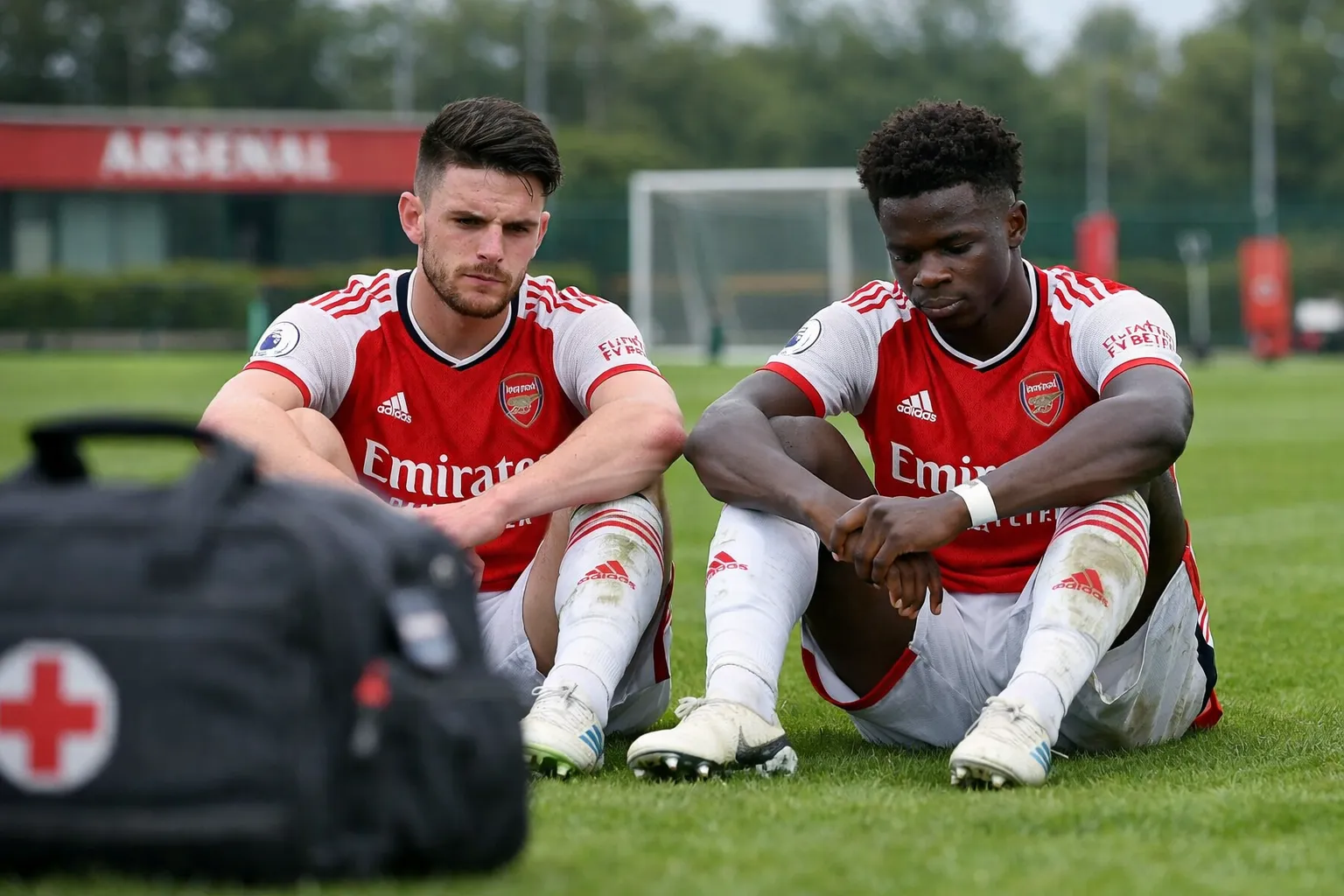
Arsenal’s spring run-in was supposed to be about momentum, not medical updates, yet Arsenal injury concerns have returned at the worst possible time. Declan Rice, Bukayo Saka, and Noni Madueke have all come back early from international duty, with England boss Thomas Tuchel admitting the trio were in “clear discomfort” and unable to push on toward the next fixtures. For Mikel Arteta, the timing is brutal: cup and European nights are looming, and the Premier League title race is tightening into a weekly stress test.
The headline is simple, but the implications are messy: Arsenal injury concerns have become the dominant subplot of a season that still has silverware written all over it. Rice, Saka, and Madueke returning early is not just a minor precaution; it is a flashing warning light about load, fatigue, and the thin line between “available” and “out for weeks.” When a manager as measured as Tuchel uses language like “clear discomfort,” clubs listen.
Tuchel’s intervention also changes the narrative around international duty, because it reframes the conversation from patriotism to protection. Arsenal injury concerns are not happening in isolation; they are part of a wider trend in which elite players are asked to sprint through club seasons, then instantly switch into national-team intensity. The result is predictable: small issues become medium issues, and medium issues become absences that can swing trophies.
Tuchel’s statement carried an unusually blunt edge, insisting player welfare must trump the temptation to “push through” for the shirt. That matters for Arsenal injury concerns because it suggests the decision was not merely club-driven caution, but a medical and coaching consensus that the risk outweighed the reward. In modern football, that kind of clarity is rare, and it effectively hands Arteta both a warning and a shield from criticism if he chooses to rest them.
Arsenal’s structure relies on repetition: automatisms in buildup, pressing triggers, and the timing of wide rotations. Arsenal injury concerns disrupt that rhythm because the replacements are not simply “next man up” in identical roles; they change the geometry of the team. Rice anchors the counter-press, Saka pins full-backs and creates the weak-side switch, and even Madueke’s profile affects how Arsenal can attack space when legs are heavy.
The Declan Rice injury question is not only about whether he can play, but about what Arsenal become without him. Rice is the stabiliser who allows Arsenal to attack with numbers while still defending transitions like a top European side. Arsenal injury concerns feel sharper when they involve the one player who can cover two positions in one phase, arriving to snuff counters and then carrying the ball to restart attacks.
Arteta’s decision-making will be shaped by the calendar, because the next few games are not the kind you can “manage through” with half intensity. Arsenal injury concerns around Rice are especially thorny because he is also the player you want most in emotional, high-stakes fixtures, where control and duels decide everything. If he is at 80 percent, Arsenal may still need him, but that is where seasons get gambled away.
If Rice sits, Arsenal lose a huge chunk of their rest-defense, the structure that stops counters before they start. Arsenal injury concerns become tactical concerns because the midfield’s spacing changes, and the back line suddenly faces more direct running. Rice also matters on set pieces at both ends, where one misjudged second ball can decide a tie. His value is not glamorous, but it is constant.
The temptation is always to roll the dice, especially when the table and the knockout brackets are unforgiving. Yet Arsenal injury concerns should push Arteta toward discipline, because a short-term “rescue” appearance can become a longer-term layoff. The smarter play is often to treat the first warning as the last warning, then trust the squad for one match rather than lose a cornerstone for three weeks.
Bukayo Saka fitness has become its own weekly storyline, because his game is built on repeated high-intensity actions: accelerations, decelerations, and contact under pressure. Arsenal injury concerns spike whenever Saka is flagged, not only due to his output but because opponents design entire defensive plans around stopping him. When he is missing or limited, Arsenal’s right side loses its most reliable source of territory and chance creation.
There is also a psychological element to Arsenal injury concerns involving Saka, because he is the barometer for how “normal” Arsenal feel. When he is on the team sheet, the Emirates relaxes; when he is not, the anxiety spreads to every pass and every duel. The run-in is where stars turn tight games into wins, and Saka’s ability to produce in low-margin moments is exactly what title races demand.
Arsenal can mimic parts of Saka’s impact through structure: earlier overlaps, quicker switches, and more aggressive underlaps from midfield. Arsenal injury concerns should encourage creativity rather than panic, because you can still create the “two-versus-one” that Saka lives for by moving pieces around him. The key is not to ask one replacement to be Saka, but to distribute his workload across combinations and patterns.
One of the cruelest aspects of Arsenal injury concerns is how they cascade: when Saka is out, others play more minutes, and then they become the next red flag. That is how squads reach April with tired legs and tight muscles everywhere. Arteta must balance short-term solutions with long-term sustainability, because the title race is not a sprint anymore; it is a sequence of finals with no recovery time.
Noni Madueke news may not dominate Arsenal headlines in the same way as Rice or Saka, but his early return underscores the same structural problem: players are breaking down under constant load. Arsenal injury concerns resonate with fans because they see the same pattern across the league, and it feels like the sport is daring bodies to fail. When Tuchel sends players home, it is a tacit admission that the calendar is winning.
Madueke’s situation also highlights how England squads are now managed with club realities in mind, even when the public conversation pretends it is purely about national priorities. Arsenal injury concerns fit into that tension, because clubs invest in elite conditioning and recovery, then watch players fly off to different camps, different demands, and different intensities. The margins are tiny, and the consequences are enormous.
International breaks are sold as breathers, but for top players they are often the opposite: travel, new tactical work, and immediate competitive stress. Arsenal injury concerns are amplified because the club’s rhythm is interrupted, then the players return needing “reloading” rather than rest. The extra minutes are not always the issue; the change in routine, surface, and intensity can be enough to trigger problems.
Tuchel is tasked with shaping England’s identity, yet he cannot ignore the ecosystem that supplies his talent. Arsenal injury concerns make his job harder, because every training session becomes a negotiation between preparation and preservation. His public stance—health over pride—signals a modern approach, but it also places responsibility back on clubs to rotate bravely. If everyone tries to win every minute, nobody wins in May.
The immediate issue is not theoretical; it is logistical. Arsenal injury concerns land right as an FA Cup quarter-final against Southampton approaches, followed by a Champions League clash with Sporting CP that could define the club’s European credibility. Arteta has to decide which competition gets priority minutes, and which gets managed risk. The uncomfortable truth is that you cannot chase everything with a patched-up core and expect the body to cooperate.
These fixtures also demand different types of readiness. Arsenal injury concerns are more damaging in Europe, where transitions are faster and mistakes are punished instantly, but cup football also has its own traps: one flat performance, one moment of fatigue, and the season loses a pathway to silverware. Arteta’s selections will be scrutinised, yet the bigger question is whether Arsenal can keep their intensity while protecting their most fragile minutes.
On paper, Arsenal should have the quality to navigate Southampton, but cup ties are rarely about paper. Arsenal injury concerns matter because rotation can dull pressing cohesion, and a slightly slower midfield can turn a comfortable game into a chase. If Rice or Saka are even slightly compromised, the smarter move may be to avoid the drama altogether and trust depth, then use the bench only if the match turns.
Against Sporting CP, control is currency, and Rice’s condition becomes a central question. Arsenal injury concerns are magnified in these ties because the opponent will target the spaces behind Arsenal’s press and test their recovery speed. If Rice cannot cover ground, Arsenal must compensate with positioning and ball retention, which is easier said than done under European pressure. One mistimed step can become a two-on-two at the back.
The Premier League does not care about context, only results, and that is why Arsenal injury concerns feel so existential. Every dropped point becomes a headline, every absence becomes a debate about squad building, and every late winner elsewhere gets amplified into dread. Arsenal Premier League title dreams are still alive, but the margin for error is shrinking, and the physical toll is starting to show in the most important positions.
Supporters understand injuries happen, yet what stings is the sense of inevitability in a congested schedule. Arsenal injury concerns now shape the way fans watch games: not just for goals, but for grimaces, heavy landings, and players rubbing hamstrings after sprints. Arteta’s job is to keep belief high while making unpopular rotation calls, because a title charge is as much about managing energy as it is about tactics.
Depth is not simply about having bodies; it is about having alternatives who preserve your identity. Arsenal injury concerns force Arteta to evaluate whether his backups can sustain the same pressing intensity and ball security. If Rice sits, Arsenal need a midfielder who can defend space and progress play under pressure; if Saka sits, they need width plus end product. Those are premium skills, not easily replicated.
Fans do not demand medical details, but they do crave coherence: a sense that decisions are made with a plan, not desperation. Arsenal injury concerns have a way of turning every lineup into a referendum on ambition, yet caution can be the most ambitious choice of all. If Arteta communicates through actions—resting when needed, rotating early, and trusting the squad—supporters will accept short-term discomfort for long-term readiness.
Arsenal injury concerns are not just a footnote; they are a defining variable in a season that could still end in glory or frustration. Rice’s status, Bukayo Saka fitness, and the broader lesson from Tuchel’s intervention all point to the same truth: the modern calendar is pushing players to the edge, and clubs must be smarter than the noise. Arteta’s next calls—who to rest, who to risk, and when to rotate—may decide whether Arsenal’s run-in becomes a celebration or a cautionary tale.

Julian Mercer is a lifelong student of the game whose passion for football was sparked at an early age, after stepping onto the grass of Camp Nou as a six-year-old — a moment that left a lasting impression and set him on a permanent path into the sport. Since then, football has been both his lens on the world and his favourite language. Blending traditional fandom with a deep interest in tactics, squad building, and long-term team development, Julian has spent decades analysing the game from every angle. His fascination with football strategy was further shaped through years of immersive play in Football Manager, a series he has followed since the mid-1990s, developing a sharp eye for patterns, player profiles, and the fine margins that define success. At My World Of Football, Julian focuses on the stories beneath the surface — from tactical evolutions and managerial philosophies to the narratives that connect clubs, players, and supporters across generations. His writing aims to balance insight with accessibility, always grounded in a genuine love for the game.
Continue reading more football news