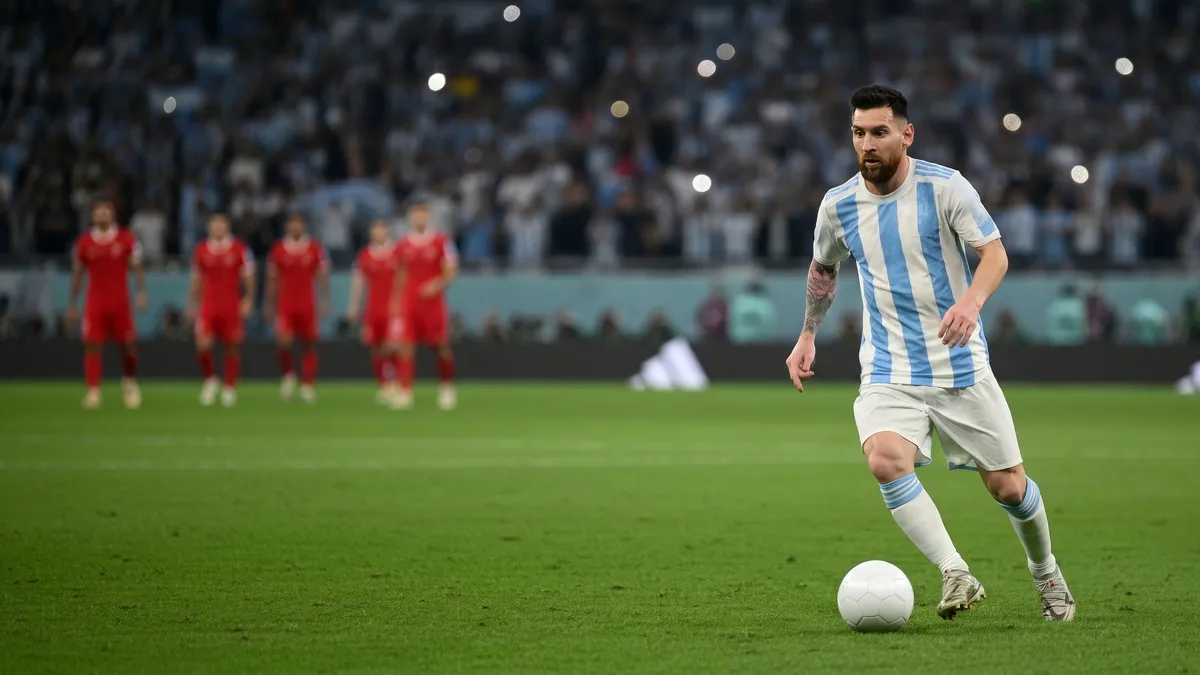
AI-generated image
Football News Today: Messi shines as World Cup final looms
Messi leads Argentina to the final against Spain while Nijstad's ambitions clash with Twente's reality. Major moves in the Premier League too.
Messi leads Argentina to the final against Spain while Nijstad's ambitions clash with Twente's reality. Major moves in the Premier League too.
Hey football fans, what a day we've got! The World Cup final is set with Argentina facing Spain, and Messi is in the spotlight once again. In the Premier League, Ruud Nijstad is dreaming big with Barcelona, but can he make it happen? Meanwhile, keeper questions are swirling around Misa Rodriguez and Arsenal. Lots to unpack today, so grab a drink and let's dive in.
Ruud Nijstad Barcelona ambitions make sense when you hear the name he keeps circling back to: Pau Cubarsi. That World Cup moment, Cubarsi standing up to Cristiano Ronaldo, is the kind of clip young centre-backs replay until it becomes a target. It is not just star-gazing either. Nijstad is talking about partnership, about learning the timings and nerve it takes to defend on the biggest stage.
The key thing is Nijstad has earned the right to dream a bit. Twenty-four appearances at 18 is not a token breakout, it is a proper season of being trusted. Twente don’t hand minutes to kids unless they can handle the boring parts: set-piece marking, recovery runs, staying switched on after a missed chance. That base is what makes Barcelona transfer news feel less like fantasy.
But the jump from Eredivisie prospects to Barcelona is brutal, especially for defenders. Barcelona’s system asks you to defend huge spaces, win duels, then play like a midfielder under pressure. It is why Cubarsi stands out. If Nijstad wants to fit that long-term defensive strategy, he needs more than highlights. He needs a full year of consistency, fewer cheap fouls, cleaner first touches, and leadership when games get messy.
That is why his tone matters. Ruud Nijstad Barcelona ambitions are framed as motivation, not an exit plan. Staying at Twente for another season could actually increase his chances of landing well, rather than arriving as a project. If Barcelona are watching, they will want to see him dominate weeks where nothing is on TV. Do it in February away at a mid-table side, then we can talk seriously.
For Twente, the best-case scenario is simple: keep him playing, keep him improving, and control the timeline. A summer move might tempt everyone, but a rushed transfer can stall a young talent. Nijstad’s smartest play is to stack another 30 games, add European minutes if possible, and show he can run a back line. Then those Ruud Nijstad Barcelona ambitions start looking like a plan.
The Misa Rodriguez Arsenal transfer links feel odd at first because Arsenal already look stacked in goal. But that’s exactly why it makes sense. Rodriguez leaves Real Madrid with 215 games and six seasons of being the clear No.1, which tells you she handles pressure and volume. Arsenal are building a squad for trophies and for chaos, and goalkeeping chaos hit them last season.
Van Domselaar is the headline name and rightly so. She’s got presence, she claims space, and she suits a team that wants to push high. Borbe is a solid option too, and the club have just added teenage talent in Isabella Damm. So why chase another senior keeper? Because depth on paper is not the same as depth you trust in big away nights, especially when injuries or form dips arrive.
Rodriguez brings something different. At Madrid she dealt with long spells of defending, then sudden moments where one save decides the match. That sharpness translates well to Champions League football where Arsenal can dominate, then get hit in transition. The Misa Rodriguez Arsenal transfer angle also hints at squad planning around international windows. A World Cup year can mess with rhythm, minutes, and confidence fast.
The knock-on question is simple: who blinks first? If Rodriguez comes in expecting to start, Arsenal either rotate aggressively or someone looks for a cleaner path to minutes. That is not drama, it is just career logic. Arsenal’s summer signings have already patched midfield and attack, so this feels like the final layer: reduce risk. If the Misa Rodriguez Arsenal transfer happens, it is less about replacing anyone and more about making sure one injury does not derail a season again.
Spain vs Argentina World Cup 2026 at MetLife feels like a proper styles clash, not just a big-name final. Luis de la Fuente has built a Spain football team that wins with control and patience, but the headline is the defending. Six clean sheets and one goal conceded is not a fluke. They squeeze space early, protect the box, and make matches feel small.
The semi-final against France was the best advert for it. Spain never looked rushed at 2-0, and that calm comes from structure. Rodri sets the tempo, but he also kills transitions before they start. That lets Spain keep their full-backs sensible and their wingers high, so they can counter without opening the door. If Argentina want chaos, Spain will try to deny it.
Argentina football team under Scaloni has lived on chaos at times, and they do not panic when the plan breaks. The comeback vibe is real, and that late win over England showed how quickly they can flip a game with one aggressive spell. Messi’s final World Cup match adds emotion, but it also adds a clear route. Get him touches in the half-spaces and let the rest run off him.
The FIFA World Cup final might swing on the Rodri versus Enzo Fernández battle more than the forwards. If Enzo can jump Rodri and force Spain to play longer, Argentina can turn it into second-ball football and keep Messi closer to goal. If Rodri wins that duel, Spain will camp in Argentina’s half and make them chase. Then it’s on Yamal to turn possession into pain.
That’s why Spain vs Argentina World Cup 2026 feels like a chess match with a few moments of street football. Spain will trust their clean-sheet machine and wait for the opening. Argentina will trust their nerve and Messi’s finishing, eight goals already says enough. Either way, whoever controls the middle will control the story on July 19.
Trump World Cup final attendance was always going to land differently because he has skipped the whole ride and is turning up for the biggest night. Heads of state showing up for finals is normal, sure, but this feels more like a statement than a tradition box tick. Spain vs Argentina sells itself. The political spotlight does not need to be part of it, yet it will be.
The FIFA angle is the real context here. Trump’s relationship with Gianni Infantino has been public and cosy, and that matters because FIFA trades in access as much as it trades in football. When you see Trump at a FIFA reception at Trump Tower before heading to New York/New Jersey Stadium, it reads like two brands sharing oxygen. It also invites the usual questions about who benefits and how.
Then you’ve got the Folarin Balogun red card episode, which turned a standard officiating debate into a soccer controversy with political edges. Trump pushing for a review is not the same as a coach complaining, and it puts pressure on institutions that already struggle with trust. Even if nothing changes, the noise can be the point. Fans do not want the ref chat politicised, especially at a World Cup.
On the pitch, the final should be about Spain’s structure against Argentina’s chaos control, with Lionel Messi still the gravitational pull even when he is not sprinting past people. The Chelsea FC cameo in this story, via Trump presenting the Club World Cup trophy to Cole Palmer’s side, just underlines how he keeps popping up around football’s photo moments. Trump World Cup final attendance will get reactions, but the game has to win the room.
The England World Cup 2023 has felt like it’s been played in airport lounges as much as on pitches. England have clocked more miles than anyone, and you can see it in the legs. That loss to Argentina was more than heartbreak, it was fatigue meeting a top side at the wrong time. Now Tuchel has to pick a team for France in Miami with bodies that look spent.
This is where Harry Kane and Declan Rice become the whole argument. Kane’s value is obvious, but he’s also the one you least want to run into the ground, especially with a long club season waiting. Rice is similar, because his game is repeated high-intensity actions, not moments. If Tuchel starts them again, he risks turning the England World Cup 2023 into a hangover that follows them into qualifying and beyond.
Glen Johnson’s point about fresh legs is the practical one. Third-place games can get scrappy fast, and energy often beats structure. A rotated England can press properly, run the channels, and actually enjoy the match instead of surviving it. It also gives Tuchel a live audition for the next cycle. That matters, because the squad has leaned on the same core for years.
But Lescott’s view is not just old-school pride. A strong XI against France is a chance to set a standard and avoid drifting into excuses. England vs France is still a big reference point for players and fans, even in a playoff. Tuchel’s best compromise might be targeted rotation: protect Kane’s minutes, manage Rice if needed, and keep enough leaders on the pitch so it does not feel like an end-of-tour friendly.
This soccer season preview feels different because the World Cup hangover is real. Players come back with new status, new scars, and managers get a shorter runway for excuses. You can already hear the chatter in every ground: who rides the momentum, who burns out, and who gets found out by October. Domestic football always returns fast, but this time it arrives with unfinished international stories attached.
Arsenal are the obvious talking point. A title after 22 years changes everything, especially the psychology. Last season they hunted, now they get hunted. The question is whether they can keep that edge when teams sit deeper and treat a draw like a win. Eberechi Eze is the kind of player who can decide tight games, and Arsenal will face more of those, home and away.
Manchester City’s angle is simpler and messier. How do they look without Pep Guardiola on the touchline? Even a short absence shifts the whole vibe, because his in-game tweaks are not theatre, they are points. City’s squad can carry anyone, but the margins in title races are brutal. This soccer season preview has to ask if their structure holds when the boss is not there to reset it every week.
Coventry’s Premier League return after 25 years is the romance, but it is also a stress test. That first month can define the whole campaign, because belief either snowballs or cracks. They will need leaders and clear plans, not just noise about “good vibes”. Kolo Toure turning up around the game adds a nice thread of experience, but Coventry’s survival will be about discipline and set pieces.
Southampton’s Spygate scandal is the other edge of modern football. Trust matters inside a squad, and it matters with opponents too. If they start slow, every touchline will needle them about it. Jermain Defoe making his management debut is a fresh subplot, and West Ham’s Upton Park nostalgia reminds you how quickly clubs change. That is why a soccer season preview is never just fixtures. It is identity.
Lukaku transfer news has taken a sharp turn with him knocking back Ajax. It is not hard to see why. Ajax can sell the project, the minutes, the spotlight, but they cannot magic away a €12m gross wage and a contract at SSC Napoli running to 2027. At 33, Lukaku is not shopping for a reset. He is shopping for the right conditions.
Ajax pivoting to Marcos Leonardo from Al-Hilal feels like smart, modern recruitment rather than a consolation prize. They need legs, resale value, and a striker who can press and repeat sprints in the Eredivisie and Europe. Lukaku is still a box monster, but you build a whole attack around him. With Ajax rebuilding, that is a big tactical and financial commitment for a club that needs flexibility.
The Napoli angle is the real knot in this Lukaku transfer news. Max Allegri is the kind of coach who can make a No.9 feel central again, but Napoli have to decide what they want: keep an expensive asset and use him properly, or take a hit to move him on. Last season’s limited minutes muddy the picture. A striker on that money needs rhythm and trust, not cameos.
Then you look at the alternatives and they all come with caveats. Besiktas can offer noise and obsession, but Lukaku is not keen on Turkey. MLS interest, including New York City FC, is real, yet he is not ready to treat that as a final chapter. AS Monaco is the intriguing middle ground. Competitive league, European chances, and a lower-pressure spotlight. After that strong World Cup showing for Belgium, he has reminded everyone he still decides games when the service is right.
MetLife Stadium gets the kind of final you talk about for years: Spain vs Argentina, and the whole thing framed as Lamine Yamal vs Lionel Messi. It is not just a kid against a legend either. It is a clash of footballing eras. Spain want control, territory, and repeatable patterns. Argentina want moments, timing, and Messi picking the lock when the game tightens.
Yamal’s story is the fun one because it still feels unfinished. At 19, the Barcelona wonderkid already plays like he expects to decide matches, but the recent injury noise matters. Finals punish anyone who is half a step short. If Spain manage his minutes, they risk losing their most direct threat. If they start him and he is not sharp, Argentina will press his first touch and bait Spain into safe passes.
Gaizka Mendieta floating the Ballon d’Or 2025 angle is not random. Big awards love a clean narrative, and a World Cup final is the loudest stage. If this becomes a Lamine Yamal vs Lionel Messi night and Yamal tips it for Spain, voters will remember the image more than the calendar. But he needs end product. Not just nice take-ons, but the pass before the goal or the shot that changes the mood.
Messi’s pull is different now. He does less, but what he does lands. Argentina can build the match around protecting his bursts, letting him drift, then feeding him in the half-spaces where Spain’s midfield screen can lose shape. Spain will try to smother service and force Messi to receive with his back turned. If he turns even twice, that might be the final right there.
So the real question in Lamine Yamal vs Lionel Messi is who bends the game toward their preferred rhythm. Yamal stretches a back line and creates chaos out wide. Messi slows it, then speeds it up with one pass. At MetLife, the winner probably will not dominate for 90 minutes. They will just win the five minutes that decide everything.
Joan Laporta framing an Argentina Spain final through Barcelona’s academy lens is classic Barça, but it is also fair. A Barcelona La Masia World Cup final is the kind of storyline the club lives for, because it turns a national-team spectacle into a referendum on a football education. With Messi on one side and a Spain squad packed with Barça habits, it is hard not to see the club’s fingerprints everywhere.
Messi is the obvious headline. Even if he is Argentina’s icon more than Barcelona’s property now, his peak years still set the template for what La Masia could produce when everything aligned: talent, patience, and a system built around the ball. If this is his last big final, it is also a reminder that Barça’s best academy graduates do not just make squads, they shape eras.
Then there’s Lamine Yamal, who changes the tone completely. He is not a nostalgic symbol, he is a live experiment under the brightest lights. In a Barcelona La Masia World Cup final, the risk is that people expect him to be “the next Messi” instead of a different kind of winger with different tools. Spain will likely protect him with structure, but finals force moments, and moments force personality.
Laporta also points to the eight Barcelona players in Spain’s group, and that matters beyond bragging rights. Spain’s best spells tend to come when their midfield and wide rotations feel club-level automatic. If Gavi is involved, you get that La Masia edge: intensity, quick support angles, and a refusal to play safe passes for long. Against Argentina’s compact defending, those habits decide whether Spain dominate or just circulate.
MetLife as the stage adds a funny twist: a global venue for a very specific Catalan idea. The Barcelona La Masia World Cup final angle is not just marketing, it is a real football argument about how players learn to read space and keep the ball under pressure. If Argentina win, Messi’s legacy grows again. If Spain win, it is the academy’s present tense, with Yamal as the face.
England vs Argentina World Cup 2026 had that familiar swing to it. England started sharp, didn’t overthink it, and Anthony Gordon’s early goal felt like the release after years of semi-final nerves. The issue was what came next. England dropped five or ten yards, the ball stopped sticking, and the game slowly turned into one long defensive set. Against Argentina, that is dangerous. Against Messi, it is basically an invitation.
Lionel Messi performance chat can get tired, but this was the purest version of his control. At 39, he didn’t need to sprint past people. He just kept finding the soft spots, pulling England’s midfield screen out of shape with one touch and a glance. The assist for Enzo Fernandez was classic Messi, a simple action that arrives half a second before anyone else sees it. England’s lead didn’t vanish in a flash, it got squeezed out.
Thomas Tuchel tactics will take the heat because England looked like they were managing a lead from the 20th minute. The pressing triggers faded, the wide outlets got pinned, and the full-backs stopped offering a way out. That meant longer clearances, more second balls for Argentina, and more time with Messi facing forward. It is not always about “negative” football, it is about giving your best players fewer touches in good zones.
England vs Argentina World Cup 2026 ended in the cruelest way, a Messi cross in stoppage time and Lautaro Martinez finishing it like it was scripted. Joleon Lescott’s comments landed because they felt honest: some players can bend a match without dominating every minute. England’s history is full of near misses, but this one will sting because the margins were tactical and emotional, not just bad luck.
The World Cup final 2026 landing at New York New Jersey Stadium feels like football leaning into the biggest stage it can find. Spain vs Argentina is the proper stuff too, not a novelty pairing. Spain chase a second star with that familiar control-first identity, while Argentina go for a fourth and a second straight title, which would put this era right up there with their greatest sides.
On the pitch, the tension is stylistic as much as emotional. Spain want to suffocate you with the ball, but Argentina have lived through enough tight knockout games to stay calm when the match gets messy. Lionel Messi still pulls gravity even when he is not sprinting past people. Sergio Ramos is the type who can turn a final into a street fight. That balance decides big nights.
Off the pitch, FIFA championship rings are the headline grabber. It is a clear Super Bowl influence, and you can see why FIFA wants it. Rings are personal, portable, and perfect for social media. But football has always been about the medal and the moment, not jewellery. The limited 2,026 run, with some sold to fans, risks turning the World Cup final 2026 into a merch drop.
Then there is the trophy presentation, with Donald Trump confirmed to hand it over. Whatever your politics, it changes the temperature of the scene. The winning captain usually owns that image forever, but this time the frame will include a figure who divides opinion instantly. In a Spain vs Argentina final, the football should be enough. FIFA seems determined to add extra noise.
The irony is the match does not need help. Put two heavyweights in a one-off game and you already have drama. If Kylian Mbappé ends up being the decisive subplot, it will be because finals often belong to the one player who breaks the script, not the side with the best branding. The World Cup final 2026 should be remembered for the football, not the accessories.
Argentina vs England World Cup nights always feel heavier than a normal semi-final, and you could sense it from the first anthem in Atlanta. The stands were basically sky blue and white, singing like it was Buenos Aires, not Georgia. England started well and went ahead, but Argentina never looked panicked. That matters. They played like a group that expects to find a way, not one that hopes.
Lionel Messi set the tone without needing a magic goal. He kept demanding the ball, kept pointing teammates into shape, and kept pulling England’s midfield around. When Argentina were behind, he stopped the game from turning into rushed crosses and hopeful shots. Enzo Fernández benefited most, getting cleaner second balls and stepping into pockets instead of chasing. That control is why the comeback felt inevitable.
The emotional edge in Argentina vs England World Cup meetings can also make players do silly things, but Argentina channelled it. You saw it in the duels and the celebrations, but not in reckless tackles. Lautaro Martínez’s presence helped too, because England’s centre-backs couldn’t just squeeze up and suffocate Messi. Even when Lautaro wasn’t finishing moves, he was pinning defenders and opening lanes for late runners.
Now Spain vs Argentina is a different problem. Spain will give you the ball in harmless areas, then punish any sloppy press with long spells of possession. Argentina cannot rely on the same chaos that rattled England. Messi will still be the reference point, but the final needs smarter rest defence, tighter spacing around Fernández, and better timing on when to jump. With Argentina fans travelling like this, belief is not the issue. The plan is.
Frenkie de Jong injury news always lands with a thud because he’s one of those rare midfielders both club and country build around. This time it’s messy. Barcelona are reportedly furious after De Jong’s knee injury worsened on Netherlands duty, with talk he carried a problem into the World Cup and kept going. If that’s true, it isn’t just bad luck. It’s a chain of decisions.
Danny Koevermans jumping in to defend him makes sense. Players aren’t robots, and international tournaments hit different. Koevermans compared it to that Argentine mindset of doing anything for the shirt, even if it costs you later. That rings true for plenty of Dutch lads too. De Jong choosing to play through pain isn’t some betrayal. It’s what elite football has trained players to do.
But Barcelona’s frustration is also understandable, because clubs pay the wages and carry the risk week after week. If De Jong needed injections to get through matches, then the conversation should have shifted from “can he play?” to “should he play?” Frenkie de Jong injury news here points to a wider issue: medical staff can advise, but the pressure from coaches, teammates, and the player himself can drown that out.
It also raises a question about where responsibility sits when a player is a national-team cornerstone. The Netherlands are not short on midfield talent, with guys like Quinten Timber pushing on, but De Jong is the tempo-setter. Losing him hurts Oranje’s ceiling and Barcelona’s control in big games. If this ends up as a long layoff, both camps will look back at those early warning signs and wonder why nobody hit pause.
Enzo Fernandez didn’t need to delete that Oasis ‘Wonderwall’ post, but you get why he did. It’s funny in the moment, then the World Cup final is staring you in the face and suddenly you want calm, not noise. The Enzo Fernandez World Cup final story is already big enough on the pitch. A social media needle just hands England fans a new angle to bite on.
The semi itself was proper World Cup drama. England go 1-0 up, start managing the game, then Argentina flip it with one spell of control. Fernandez’s equaliser mattered because it changed the temperature. He arrived at the right time, didn’t overthink it, and England’s midfield looked a step slow reacting. Then Lautaro Martinez does what he does: sharp movement, one moment, game over.
Now the chat has turned to Spain, and I get why Terry and Souness are leaning that way. Spain don’t give you the same emotional openings England did. They squeeze you with the ball, then defend like it’s personal when they lose it. For the Enzo Fernandez World Cup final to swing Argentina’s way, he has to play through Spain’s first press without forcing it, and still find Messi early.
Messi is still the whole story, even when others score. Spain will try to lock the centre and tempt Argentina wide, so Messi’s little pockets matter more than ever. That’s where Fernandez becomes a connector, not a hero. Also, Argentina can’t afford distractions if FIFA come knocking over that banner. One suspension or a fine isn’t the end, but it messes with focus before an Argentina vs Spain final.
The Ørjan Nyland Feyenoord transfer chatter feels like classic shortlist noise, but it also tells you where the club’s head is at. Feyenoord want stability in goal, not another season of rotating keepers and living on adrenaline. Nyland’s name popping up makes sense on paper: experienced, international caps, used to pressure. The problem is that paper does not face shots.
Driessen and Verweij pointing to that quarterfinal against England is harsh, but it lands because keepers get judged on the loud moments. One shaky claim, one slow set, and the whole night becomes your highlight reel. Nyland has had good spells for Norway, and Norwegian goalkeeper news around him always splits opinion. Still, Feyenoord are shopping for certainty, not a debate.
That is why Tjark Ernst Feyenoord links feel more real. At 23, he fits the club’s usual logic: upside, resale, and a keeper you can actually build with for three seasons. Hertha BSC are a selling club right now, so a deal is there if Feyenoord like the medical and the character. The risk is obvious too. Young keepers make mistakes, and De Kuip does not do quiet patience.
The emotional bit is what makes this story stick. Nyland got backed hard by Norwegian fans, partly because he’s been a loyal servant in a team that often asks its keeper to suffer. People even drag Erling Haaland performance into it, like a keeper’s night depends on whether the star striker bails everyone out. That is transfer season for you. The Ørjan Nyland Feyenoord transfer talk is really about fear: nobody wants the one position that can ruin a title chase.
If Ernst passes his medical, the shortlist talk probably fades fast. But Feyenoord transfer rumors always leave a trail, and Voetbal International will keep the pressure on. The sensible read is this: Nyland is the experienced fallback, Ernst is the targeted starter. Feyenoord just need to pick a lane and back it, because the worst option is hesitation.
Keep an eye on the World Cup final this weekend. Messi vs Spain is sure to be a classic. Plus, the transfer market is heating up. Stay tuned!

Julian Mercer is a lifelong student of the game whose passion for football was sparked at an early age, after stepping onto the grass of Camp Nou as a six-year-old — a moment that left a lasting impression and set him on a permanent path into the sport. Since then, football has been both his lens on the world and his favourite language. Blending traditional fandom with a deep interest in tactics, squad building, and long-term team development, Julian has spent decades analysing the game from every angle. His fascination with football strategy was further shaped through years of immersive play in Football Manager, a series he has followed since the mid-1990s, developing a sharp eye for patterns, player profiles, and the fine margins that define success. At My World Of Football, Julian focuses on the stories beneath the surface — from tactical evolutions and managerial philosophies to the narratives that connect clubs, players, and supporters across generations. His writing aims to balance insight with accessibility, always grounded in a genuine love for the game.
Continue reading more football news