Myworldoffootball
Arsenal Premier League title celebration: Rice leads parade
Declan Rice led Arsenal’s Premier League title celebration parade in London as 500,000 fans roared, despite Champions League final heartbreak vs PSG.
Declan Rice led Arsenal’s Premier League title celebration parade in London as 500,000 fans roared, despite Champions League final heartbreak vs PSG.
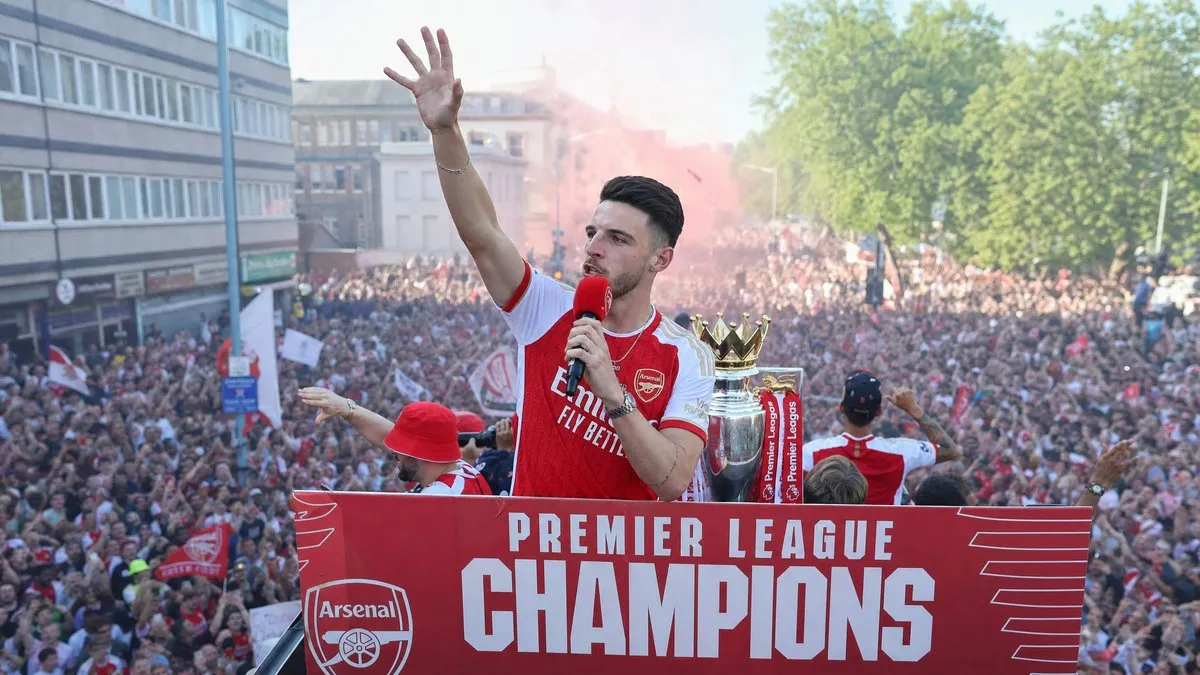
London felt painted red again as the Arsenal Premier League title celebration rolled through the streets with the kind of noise you only hear when a club has waited a lifetime. Declan Rice stood front and centre on the open-top bus, pulling teammates into chants and pointing to supporters packed onto pavements and balconies. It was Arsenal’s first league crown in 22 years, yet the joy carried an edge of defiance after a painful Champions League final loss to Paris Saint-Germain. This was release, relief, and a promise.
The headline image of the Arsenal Premier League title celebration was Rice with a microphone in hand, conducting songs like a capo in the North Bank. He didn’t look like a passenger enjoying a day out; he looked like a leader setting standards for what comes next. Every stop on the route became a mini-rally, with Rice urging the crowd louder and the squad tighter. It was a celebration, but it also sounded like a mission briefing.
What made this Arsenal Premier League title celebration different was how deliberately the players leaned into the club’s identity, rather than simply basking in the trophy glow. Rice kept referencing the work, the graft, and the togetherness that turned Arsenal from nearly-men into champions. Mikel Arteta’s fingerprints were all over the messaging, even when the manager wasn’t speaking. The bus moved slowly, but the tone was urgent: enjoy this, then chase the next one.
On an open-top bus, you can hide behind sunglasses and champagne, but Rice chose the opposite approach during the Arsenal Premier League title celebration. He leaned over the railings to slap hands, shouted out to kids perched on shoulders, and repeatedly gestured at the badge. The symbolism mattered: this title belongs to the stands as much as the dressing room. When he roared “we’re coming back for more,” it landed as belief, not bravado.
Even amid the chaos of the Arsenal Premier League title celebration, the language was pure Arteta: standards, unity, and relentless improvement. Players spoke about “earning” moments, not receiving them, and that vocabulary doesn’t happen by accident. The parade became a moving extension of the manager’s training-ground culture, with Rice and Martin Odegaard reinforcing the message. Arsenal looked like a club that has learned how to win, and just as importantly, how to stay hungry.
Estimates put the crowd at around half a million, and it felt plausible the moment you saw the sea of red stretching beyond sight. The Arsenal Premier League title celebration turned central London into a stadium concourse, with flares, flags, and songs bouncing off glass buildings. Strangers hugged like old friends, and families arrived hours early just to claim a sliver of kerb. The scale wasn’t just impressive; it was proof of a fanbase that never stopped believing.
This Arsenal Premier League title celebration also carried the emotion of time passed, because 22 years is long enough for childhoods to become adulthood. Supporters who grew up on stories of past title parades finally got their own memories, and they wanted the players to feel it. The bus crawled through bottlenecks of noise, and every time it paused, the chants swelled like a wave. It was joy, but it was also vindication for years of patience.
The route felt like a symbolic thread connecting Arsenal’s local soul to the wider stage, and the Arsenal Premier League title celebration made that connection visible. Fans lined bridges, shopfronts, and office windows, turning the city into a giant terrace. There was a sense that Arsenal weren’t merely passing through London; they were reclaiming it for a day. Every landmark became a backdrop for scarves raised high, and the players drank it in.
There have been cups and community shields, but the Arsenal Premier League title celebration had a different weight because league titles define eras. The crowd wasn’t there to applaud a good run; they were there to mark a shift in status. You could hear it in the songs, which carried less nostalgia and more certainty. Supporters chanted about the future as much as the past, as if this was the start of something, not the end of a journey.
The euphoria of the Arsenal Premier League title celebration didn’t erase the sting of losing the Champions League final to Paris Saint-Germain, and the players didn’t pretend it had. That honesty gave the parade an extra edge, because fans understood the double emotion of the season’s final weeks. There was pride in reaching the showpiece, then frustration at falling short on the biggest European night. Yet the overriding message was resilience: learn, return, and finish the job.
Rice’s “coming back for more” line became the emotional bridge between domestic glory and European hunger, threading through the Arsenal Premier League title celebration like a chorus. Arsenal have historically been judged harshly in Europe, and this squad knows it. The parade didn’t feel like a squad satisfied with one crown; it felt like a group using the title as fuel. In that sense, the European defeat was reframed as a lesson, not a scar.
It sounds contradictory, but the European defeat added intensity to the Arsenal Premier League title celebration because it reminded everyone what’s still out there. When players mentioned Paris Saint-Germain, the crowd didn’t groan; they roared, as if to say, “We’ll be back.” That reaction matters, because it turns disappointment into a shared project. Arsenal fans have always been emotionally invested, but this time they sounded strategically invested too.
In the context of the Arsenal Premier League title celebration, Rice’s vow wasn’t just a slogan for social media; it hinted at standards for next season. It means treating the Champions League final as a baseline rather than a peak, and treating the league crown as a platform rather than a finish line. It also implies recruitment and development, because Europe punishes thin margins. Arsenal’s supporters heard it as a contract: keep building, keep pushing, keep believing.
If Rice was the voice of the Arsenal Premier League title celebration, Odegaard was its steady heartbeat. The captain spent long stretches smiling quietly, scanning the crowd like he was trying to memorise the moment. When he did speak, it was measured, grateful, and pointed toward the collective rather than the individual. That balance matters in a squad full of personalities: a captain who can celebrate wildly, yet still communicate clarity about what the badge demands.
Odegaard’s presence during the Arsenal Premier League title celebration also highlighted how leadership has evolved at Arsenal under Arteta. In previous eras, captaincy sometimes felt like a burden passed around; now it looks like a role with definition. Odegaard radiated the kind of calm that keeps standards intact even when champagne is flying. He kept pulling younger players into the spotlight, ensuring the day wasn’t just about the stars, but about the entire squad’s contribution.
What stood out in the Arsenal Premier League title celebration was how naturally Odegaard interacted with supporters, as if he understood the club’s emotional rhythms. He waved to pockets of fans who had clearly travelled from far beyond London, acknowledging that this title was built on away days and long journeys too. When the bus slowed, he leaned in, listening to chants rather than talking over them. It was a captain sharing the stage, not owning it.
The best teams often have multiple leadership styles, and the Arsenal Premier League title celebration showcased that blend perfectly. Rice brought volume and edge; Odegaard brought composure and focus, and together they made the squad feel both hungry and secure. At times they stood side by side, pointing at the crowd, nodding like they were agreeing on the next target. Arsenal looked like a team with a leadership spine, not a single loud voice.
Amid the confetti and the noise, Myles Lewis-Skelly offered a perspective that grounded the Arsenal Premier League title celebration in something deeper than a single season. He spoke about the journey, the training days, and the feeling of being carried by the support. For an academy player, a parade isn’t just a party; it’s a glimpse of what the club can be when everything aligns. His reflections sounded like gratitude, but also like ambition.
Lewis-Skelly’s presence in the Arsenal Premier League title celebration mattered because Arsenal’s identity has always been tied to youth, development, and a sense of continuity. Fans don’t just want trophies; they want a recognisable Arsenal story, with young players stepping into a tradition. Seeing academy faces soaking in the moment made the title feel less like a one-off and more like a sustainable model. It hinted at a pipeline that could support the next push in Europe.
When Lewis-Skelly talked about the journey during the Arsenal Premier League title celebration, it carried the authenticity of someone who has watched standards up close. He referenced the day-to-day intensity, the small improvements, and the way senior players set the tone. Those details resonate with fans because they explain how titles are actually built. It wasn’t a fairy tale; it was repetition and discipline, finally rewarded with a parade and a medal.
Supporters love star signings, but the Arsenal Premier League title celebration showed why academy stories hit differently. They feel like proof that the club’s values are alive, not just its spending power. When a young player talks about the crowd’s role, it becomes a loop of belonging: the fans see themselves in the kid, and the kid draws strength from the fans. That bond is hard to buy and easy to build on for the next generation.
Once the streets quietened, the Arsenal Premier League title celebration left behind a clear question: how do Arsenal turn one league crown into an era? Arteta has built a team with structure and personality, but repeating is always harder than arriving. Rivals will adjust, and Europe will demand even more ruthlessness in key moments. The encouraging part is that this squad seems to understand the challenge, speaking less about basking and more about returning sharper.
The Arsenal Premier League title celebration also underlined the club’s growing expectation, because a half-million-strong parade resets the baseline. Fans will enjoy the memories, but they’ll also want the next chapter quickly, especially after the Champions League final disappointment. That’s not pressure in a negative sense; it’s the natural consequence of success. Arsenal have re-entered the room where the biggest clubs live, and staying there requires constant evolution in tactics, depth, and mentality.
To honour the emotion of the Arsenal Premier League title celebration, Arsenal must translate it into smart squad-building. The Champions League final loss to Paris Saint-Germain highlighted how tiny margins decide elite matches, often influenced by depth and experience. Arteta will need rotation options he trusts, not just bodies for the bench, and players who can change games late. The title proves the foundation is strong; the next step is adding layers without losing identity.
The most powerful image from the Arsenal Premier League title celebration wasn’t the trophy; it was the connection between players and supporters, face to face. As expectations rise, maintaining that bond will matter, because it turns pressure into energy rather than anxiety. Rice and Odegaard clearly understand the relationship, treating fans as partners rather than customers. If Arsenal can keep that emotional alignment while chasing more silverware, the stadium and the city become a competitive advantage.
The lasting feeling from this Arsenal Premier League title celebration is that Arsenal didn’t just win a trophy; they rebuilt a relationship with belief. Rice leading chants, Odegaard captaining with calm, and Lewis-Skelly speaking from the heart all pointed to a squad that understands what the badge means beyond results. The Champions League final loss to Paris Saint-Germain still hurts, but it now sits alongside a league crown that changes the club’s posture. For half a million fans, the message was simple: enjoy today, then chase tomorrow.

Julian Mercer is a lifelong student of the game whose passion for football was sparked at an early age, after stepping onto the grass of Camp Nou as a six-year-old — a moment that left a lasting impression and set him on a permanent path into the sport. Since then, football has been both his lens on the world and his favourite language. Blending traditional fandom with a deep interest in tactics, squad building, and long-term team development, Julian has spent decades analysing the game from every angle. His fascination with football strategy was further shaped through years of immersive play in Football Manager, a series he has followed since the mid-1990s, developing a sharp eye for patterns, player profiles, and the fine margins that define success. At My World Of Football, Julian focuses on the stories beneath the surface — from tactical evolutions and managerial philosophies to the narratives that connect clubs, players, and supporters across generations. His writing aims to balance insight with accessibility, always grounded in a genuine love for the game.
Continue reading more football news