Myworldoffootball
Arsenal title celebration: Rice, Madueke hit back
Arsenal title celebration turns edgy after PSG penalties. Declan Rice response, Noni Madueke Instagram, and Tottenham rivalry fuel next season.
Arsenal title celebration turns edgy after PSG penalties. Declan Rice response, Noni Madueke Instagram, and Tottenham rivalry fuel next season.
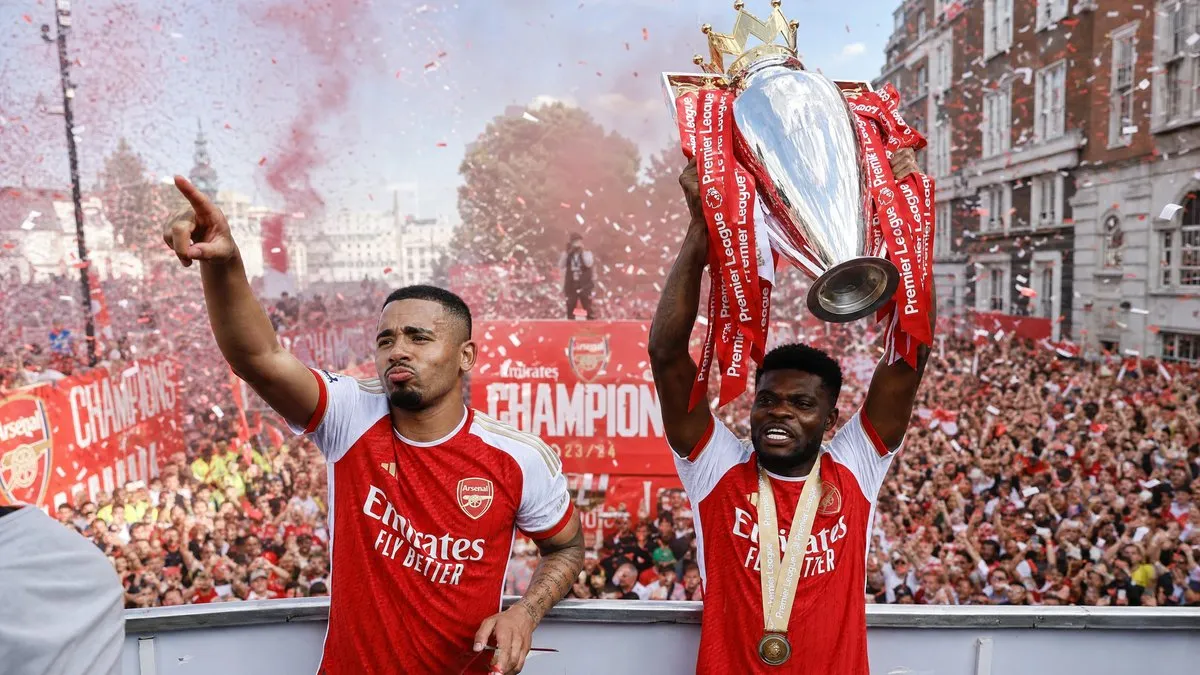
The Arsenal title celebration was supposed to be a clean exhale after 22 years of waiting, a day where red-and-white joy drowned out every old scar. Instead, it arrived with a second soundtrack: the thud of Budapest heartbreak, where Paris Saint-Germain dragged Arsenal into a shootout and won on penalties. As the confetti settled, social media kept score in its own cruel way, and two players—Declan Rice and Noni Madueke—decided they weren’t taking the noise quietly.
There was a strange electricity to the Arsenal title celebration, because everyone could feel both emotions at once. The Premier League trophy ended a 22-year drought and validated Mikel Arteta’s rebuild, yet the Champions League defeat kept tugging at the edges of every smile. Supporters sang louder as if volume could rewrite Budapest, while players tried to hold two truths: champions at home, runners-up in Europe.
That tension is why the Arsenal title celebration became more than a party; it became a statement of intent. Arsenal didn’t hide from the Champions League defeat, even if the timing felt brutally unfair, with medals collected and tears wiped away in the same week. The bus route looked like a victory lap, but it also resembled a promise that the pain would be recycled into fuel. Arteta’s group know how quickly narratives flip.
The Champions League defeat was decided in the most unforgiving way: PSG penalties after 120 minutes of tactical nerve and physical exhaustion. Arsenal’s structure held, their press still bit, but the shootout reduced months of progress to a handful of kicks and one goalkeeper’s guess. That’s why the Budapest loss lingered during the Arsenal title celebration, because penalties don’t just beat you, they leave you arguing with the universe.
Waiting 22 years for domestic glory turns any Arsenal title celebration into a cultural event, not just a club occasion. It brought out every generation: those who remembered the old dominance, and those who grew up on near-misses and memes. But that same scale magnified criticism, because the bigger the moment, the more people want to puncture it. Arsenal were champions again, so rivals hunted for any crack to exploit.
Declan Rice didn’t treat criticism like background static; he treated it like a challenge to the group’s identity. His Declan Rice response carried the edge of a player who has seen what elite standards demand and refuses to let the mood soften. During the Arsenal title celebration, he spoke with the confidence of a midfielder who sets the tempo, insisting the trophy isn’t a finish line but a baseline. Rivals were warned: this squad is built to come back.
What made the Declan Rice response resonate is that it wasn’t performative bravado. Rice has become the emotional hinge of this team, the one who can celebrate without drifting into complacency. The Arsenal title celebration was joyful, but Rice kept pointing toward the work still unfinished, especially after the Champions League defeat. He didn’t deny the hurt; he just refused to let hurt become a habit. That’s leadership in the modern spotlight.
Rice framed resilience like a tactical principle, something you train and repeat until it becomes automatic. The Declan Rice response was essentially a reminder that Arsenal’s best football came when they responded to setbacks with sharper focus, not louder complaints. In that sense, the Arsenal title celebration wasn’t a distraction, it was proof of what happens when you keep standards high. The Budapest loss is now a reference point, not a roadblock.
In a squad packed with young winners and older nearly-men, Rice’s voice matters because it bridges both worlds. The Declan Rice response gave permission to feel the Champions League defeat while still demanding the next step, which is a delicate balance. The Arsenal title celebration could have invited a week of emotional drift, but his tone pulled it back toward competition. If Arsenal want a dynasty, the mood has to stay hungry. Rice sounded hungry.
Noni Madueke’s week captured the reality of being judged in real time, with every touch clipped, captioned, and turned into a verdict. His Noni Madueke Instagram message wasn’t a meltdown; it was a defense of his role and his effort, delivered directly to the people who decided they knew his intentions. During the Arsenal title celebration, he was still being asked to account for Budapest, as if a parade required a public apology.
The Noni Madueke Instagram response also showed how footballers now manage narratives the way clubs manage transitions. Players used to rely on interviews and matchday performances to answer critics, but social media collapses that timeline into minutes. Madueke chose to speak, not to win an argument, but to protect his own headspace. The Arsenal title celebration didn’t erase the Champions League defeat, and it didn’t erase the comments either. He met them head-on.
After PSG penalties, fans tend to search for single explanations because they’re easier to digest than the messy truth of elite finals. That’s how roles become scapegoats, and why the Noni Madueke Instagram post felt necessary to him. He wasn’t claiming perfection; he was pushing back against the idea that one player defines a shootout. In the middle of the Arsenal title celebration, he reminded everyone: football is collective, for better and worse.
The Arsenal title celebration played out on phones as much as on streets, and that changes the emotional math. A clip of a player smiling can be framed as arrogance, while a clip of a player looking flat can be framed as guilt. Madueke’s Noni Madueke Instagram message acknowledged that trap without begging for sympathy. He simply asserted his perspective and moved on, which is often the healthiest play. In modern football, silence is rarely neutral.
Nothing spices up an Arsenal title celebration like the reminder that Tottenham are always watching, even when they’re not invited to the party. The Tottenham rivalry has its own economy, built on schadenfreude and selective memory, and it flared again when Djed Spence mocked Arsenal’s Champions League defeat. For Arsenal supporters, it felt like classic deflection: a rival clinging to a moment of pain because they can’t touch the trophy. The banter landed, but so did the backlash.
Spence’s swipe mattered because it tapped into a familiar North London pattern: Arsenal’s highs are treated as temporary, their lows as permanent. The Tottenham rivalry thrives on that framing, but this time Arsenal had the Premier League trophy in their hands during the Arsenal title celebration. That fact changes the power dynamic, even if Budapest stung. Rice’s tone and Madueke’s defiance both hinted at the same point: Arsenal are no longer asking for respect. They’re demanding it.
Djed Spence didn’t just needle a neighbor; he poked at the wider idea that Arsenal’s progress should be laughed at until it’s perfect. In the wake of PSG penalties, that attitude felt especially harsh, because reaching a final is itself a marker of elite status. The Tottenham rivalry encourages that kind of ridicule, but it also reveals insecurity when it arrives during an Arsenal title celebration. Arsenal fans heard it as jealousy dressed up as banter. They responded accordingly.
Rival commentary can be exhausting, but it can also be useful when a team needs fresh motivation after a painful loss. The Tottenham rivalry, amplified by Spence, gave Arsenal an external target at the exact moment they needed to refocus beyond the Arsenal title celebration. Rice’s warning to rivals sounded more believable because it was anchored in tangible success. Champions don’t need to invent slights; they simply collect them and move. Arsenal collected another one.
Arteta understood that the Arsenal title celebration wasn’t just a party, it was a relationship renewal between team and city. He repeatedly centered the fans, emphasizing that the trophy belonged to the people who carried the club through the lean years. That choice mattered because it softened the sting of the Champions League defeat without pretending it didn’t exist. Arteta’s message was essentially: we suffered together, we rise together, and we’ll return together. It was leadership through inclusion.
Managers often fear that celebrations breed complacency, but Arteta used the Arsenal title celebration as a platform to set future expectations. He praised resilience, highlighted standards, and subtly framed Budapest as unfinished business rather than trauma. That approach aligns with the Declan Rice response, which also leaned into the idea of momentum instead of mourning. Arteta knows how quickly a champion can become a target, especially with PSG and other European giants watching. He’s preparing Arsenal for that heat.
Arteta didn’t dismiss the Champions League defeat, but he refused to let it become the headline that swallowed everything else. That’s a crucial psychological move, because finals can haunt teams if they’re treated as moral judgments rather than sporting outcomes. During the Arsenal title celebration, he kept returning to the journey, the growth, and the evidence that Arsenal belong at the top. PSG penalties hurt, but they didn’t erase the league’s consistency. Arteta protected the bigger story.
Elite teams don’t just handle pressure on the pitch; they handle the emotional turbulence that follows every result. Arteta has tried to build a culture where the Arsenal title celebration is enjoyed fully, but not worshipped as an endpoint. He also wants the squad to withstand social media pile-ons, which is why players like Rice and Madueke speaking out can be seen as cultural reinforcement. The message is clear: Arsenal won’t be managed by outsiders’ moods. They’ll set their own.
The most interesting thing about this Arsenal title celebration is how quickly it shifted into a conversation about what comes next. Arsenal have ended the domestic drought, but the Champions League defeat ensures the hunger remains raw and immediate. Rice’s warning and Madueke’s pushback weren’t isolated moments; they were signals that the squad is already defending its identity. The league title brings new expectations, and expectation is the hardest trophy to carry. Arsenal will have to do it weekly.
There’s also a tactical question hiding behind the emotions: how does Arsenal evolve from champions to repeat champions while chasing Europe? PSG penalties exposed tiny margins—game management, execution under extreme stress, and the need for depth that doesn’t dilute quality. The Arsenal title celebration should be remembered as a milestone, but the club’s recruitment and pre-season planning will determine whether it becomes a springboard. Arteta’s job is to keep the joy without losing the edge. That’s the champion’s paradox.
The Declan Rice response and the Noni Madueke Instagram post both pointed toward a tougher, more confrontational Arsenal in the best sense. Not reckless, not distracted, but unwilling to be framed by rival banter or online outrage. That mindset matters when you’re defending a title, because every opponent treats you like a final. The Arsenal title celebration gave them confidence, and Budapest gave them spite. Put together, that can be combustible—in a good way.
Arsenal’s next step is to turn one Arsenal title celebration into a familiar annual routine, the way dynasties normalize winning. The Tottenham rivalry will keep providing emotional spice, but the real measuring stick is Europe, where PSG showed how cruel the margins can be. If Arsenal internalize those lessons without becoming fearful, they can return to the Champions League final with better tools and calmer minds. Rice’s message suggests they will, and Arteta’s structure supports it. The chase is on.
In the end, the Arsenal title celebration felt like a snapshot of modern football: joy and grief, pride and pushback, all happening at once and in public. Rice and Madueke didn’t pretend the criticism didn’t exist; they answered it with personality and purpose, while Arteta kept the focus on supporters who waited two decades for this day. The Champions League defeat will sting all summer, and the Tottenham rivalry will keep chirping, but Arsenal look built for the response. Next season won’t be about defending a party; it will be about defending a standard.

Julian Mercer is a lifelong student of the game whose passion for football was sparked at an early age, after stepping onto the grass of Camp Nou as a six-year-old — a moment that left a lasting impression and set him on a permanent path into the sport. Since then, football has been both his lens on the world and his favourite language. Blending traditional fandom with a deep interest in tactics, squad building, and long-term team development, Julian has spent decades analysing the game from every angle. His fascination with football strategy was further shaped through years of immersive play in Football Manager, a series he has followed since the mid-1990s, developing a sharp eye for patterns, player profiles, and the fine margins that define success. At My World Of Football, Julian focuses on the stories beneath the surface — from tactical evolutions and managerial philosophies to the narratives that connect clubs, players, and supporters across generations. His writing aims to balance insight with accessibility, always grounded in a genuine love for the game.
Continue reading more football news