Myworldoffootball
Cristian Romero injury rocks Spurs relegation fight
Cristian Romero injury ends Spurs captain’s league season. De Zerbi must reshape Tottenham’s defence as they battle Premier League relegation.
Cristian Romero injury ends Spurs captain’s league season. De Zerbi must reshape Tottenham’s defence as they battle Premier League relegation.
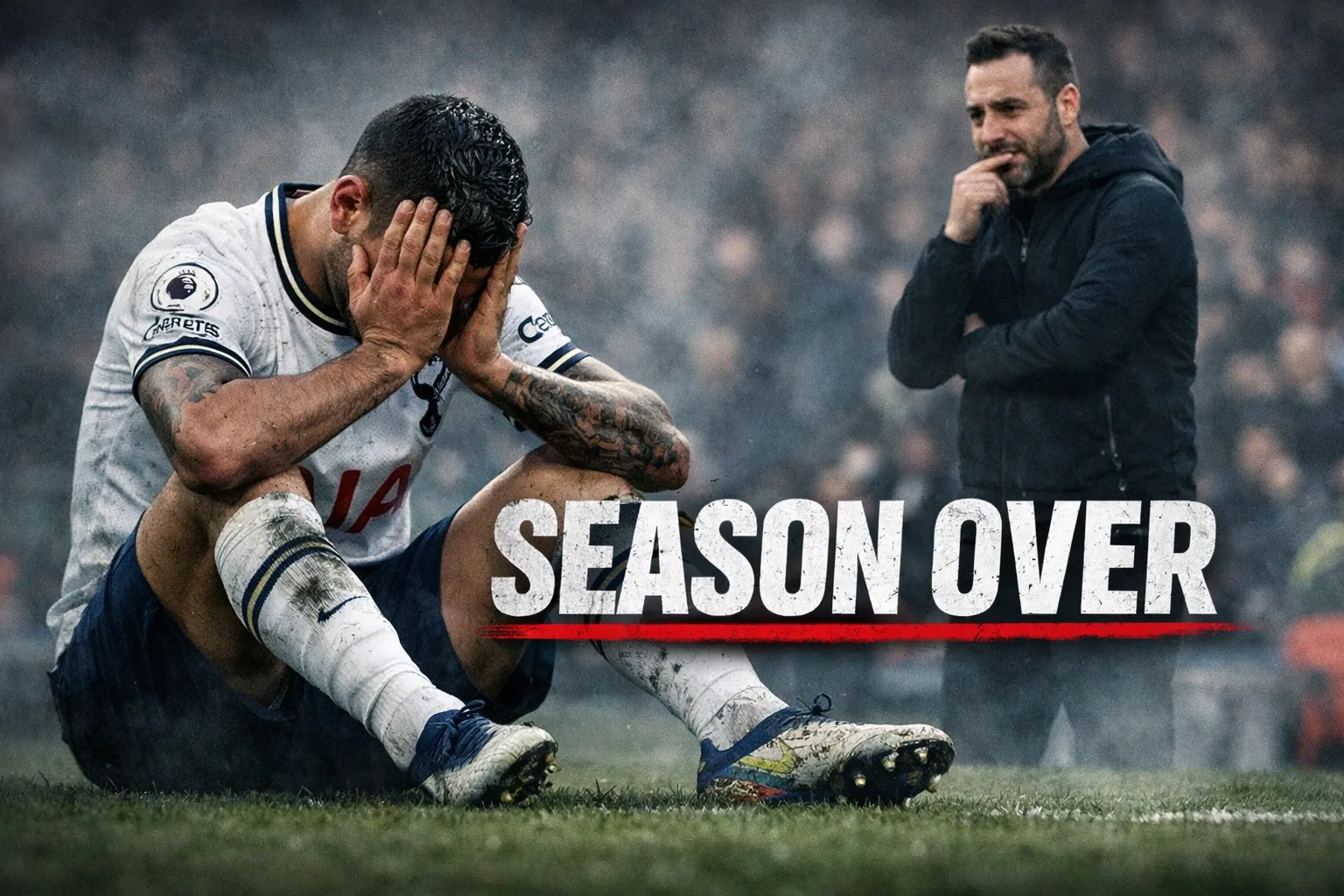
Tottenham Hotspur’s spring has turned into a grim survival story, and the Cristian Romero injury has made it feel even harsher. Spurs confirmed their captain will miss the rest of the Premier League season after damaging his knee against Sunderland, a blow that lands right as the table tightens. With Tottenham sitting 18th and two points from safety, Roberto De Zerbi inherits a dressing room needing calm, clarity, and points. Losing the side’s defensive heartbeat is the kind of setback that can define a relegation run-in.
The Cristian Romero injury is not just another line in Tottenham Hotspur news; it is a structural problem for a team already leaking confidence. Romero suffered a partial tear of his medial cruciate ligament, an issue that robs a defender of stability in duels and power when planting to turn. Spurs’ medical staff have put the recovery window at five to eight weeks, which effectively wipes out his domestic campaign. In a relegation fight, “weeks” can feel like a season.
What makes the Cristian Romero injury especially damaging is timing and role. Tottenham were building their survival plan around leadership, set-piece resilience, and a clearer defensive line, all areas where Romero’s voice and aggression set standards. Even when Spurs have been messy, he has been the organiser who drags the line up and demands contact. Now De Zerbi must sell belief without the player most associated with defiance. That is a psychological hit as much as a tactical one.
The moment that led to the Cristian Romero injury felt routine until it suddenly didn’t. Romero went into a challenge, tried to twist away under pressure, and immediately looked uncomfortable as his knee absorbed an awkward load. Players often try to run it off, but his body language suggested something deeper than impact bruising. Sunderland’s intensity forced repeated defensive actions, and one compromised movement can be enough to do damage. Spurs now face the consequences of a single unstable landing.
This knee injury update points to the kind of injury defenders hate because it affects exactly what they rely on: lateral movement and bracing for contact. A partial MCL tear can improve with rehab, but returning too early risks instability and compensations elsewhere. For Tottenham, the five-to-eight-week timeline reads like a season-ending sentence given the remaining fixtures. For Romero, it becomes a careful balance between speed and safety. The Cristian Romero injury therefore forces patience, even when Spurs cannot afford it.
Roberto De Zerbi was hired to bring structure and courage, but the Spurs captain absence immediately tests how quickly he can impose order. De Zerbi’s teams want to control space with the ball, yet survival football often demands you control it without the ball first. The Cristian Romero injury removes the defender most comfortable stepping out, winning duels, and resetting the line with authority. If Spurs cannot defend transitions, De Zerbi’s build-up principles become a risk rather than a solution. The margin for error is tiny.
In practical terms, De Zerbi now has to reassign leadership responsibilities in the back four and in the dressing room. Cristian Romero injury fallout means someone else must call the line, manage set pieces, and decide when to go long instead of forcing passes. De Zerbi’s Brighton match preparation becomes a crash course in pragmatism, because Brighton will press and bait mistakes. Tottenham’s training week will likely focus on distances between defenders, second-ball reactions, and clearer pressing triggers. Those are details Romero normally polices in real time.
Roberto De Zerbi is associated with brave possession and inviting pressure, but a Premier League relegation battle punishes bravery without precision. The Cristian Romero injury reduces Tottenham’s capacity to defend the moments when the plan breaks, which every relegation candidate experiences. If Spurs lose the ball in build-up, they need a defender who can win the first duel and the second. Without Romero, those “emergency” actions may fall to less assertive profiles. De Zerbi may have to compromise, at least temporarily.
The Spurs captain absence is not solved by simply handing the armband to another player. Romero’s leadership is physical, vocal, and confrontational, the type that steadies a team when the stadium gets tense. The Cristian Romero injury forces Tottenham to find a different kind of authority, perhaps calmer but equally decisive. De Zerbi will want leaders who communicate early, not after the chance is conceded. In a survival scrap, silence is dangerous, and hesitation is fatal.
Tottenham sitting 18th with a two-point gap to safety turns every match into a final, and the Cristian Romero injury removes a player built for finals. The Premier League relegation battle is rarely about one spectacular performance; it is about accumulating ugly points when you are not at your best. Spurs now need to manufacture stability, because chaos tends to favour opponents who are calmer. The fixture list will not offer sympathy, and the table will not care about excuses. Survival requires solutions, not stories.
In this context, Tottenham Hotspur news about Romero’s timeline reads like a countdown clock to the season’s end. Five to eight weeks might sound manageable on paper, but it covers the decisive stretch where teams either climb out or sink. The Cristian Romero injury therefore changes how Spurs approach risk, because conceding early becomes even more punishing without their best organiser. De Zerbi must decide whether to chase games aggressively or keep them tight and steal points. The wrong choice can magnify the pressure quickly.
Even without quoting exact numbers, it is clear what Tottenham lose: first-contact dominance, box defending, and the nastiness that keeps opponents honest. The Cristian Romero injury takes away the defender most likely to win a duel that looks lost, or to step in front of a pass that seems safe. Emotionally, he is also the player who turns a bad moment into a rallying point. In a Premier League relegation battle, that emotional swing can decide whether a team collapses or fights. Spurs must replace that edge collectively.
When you are 18th, you do not manage games the way mid-table teams do, and the Cristian Romero injury makes that even more pronounced. De Zerbi will have to think in terms of “next goal” rather than “perfect performance,” because protecting a point can be as valuable as chasing three. Substitutions will be about protecting the box, not just adding flair. Tottenham’s game states matter: conceding first increases panic, while scoring first allows structure. Without Romero, protecting leads becomes a new test.
The Cristian Romero injury pushes Kevin Danso and Micky van de Ven into roles with heavier responsibility, not just extra minutes. Danso offers size and aerial presence, while van de Ven brings recovery pace that can cover mistakes in a high line. But Romero’s blend of anticipation and confrontation is unique, and replacing it is more complex than swapping names on a team sheet. Tottenham must decide how to pair profiles so that weaknesses do not overlap. In a relegation fight, compatibility is everything.
Tottenham Hotspur news will now obsess over the defensive partnerships, because each choice signals a different survival strategy. If De Zerbi wants to press higher, van de Ven’s speed becomes essential to defend space behind. If Spurs expect to defend deeper, Danso’s ability to win headers and clear second balls becomes central. The Cristian Romero injury also affects set pieces at both ends, since Romero is a threat attacking corners and a reference point defending them. Spurs must find new routines quickly.
For Kevin Danso, this is an audition in the harshest environment: a Premier League relegation battle where every cross feels like a crisis. He can bring calm in the air and strength in direct duels, but the Cristian Romero injury means he must also become more vocal and proactive. Spurs will need him to command the six-yard box and make early decisions on clearances. If he hesitates, opponents will smell uncertainty. De Zerbi will demand clarity, even if the football becomes simpler.
Micky van de Ven’s pace can act like a safety net, and in the wake of the Cristian Romero injury that safety net becomes precious. Spurs have been vulnerable to balls slipped in behind, especially when midfield pressure is inconsistent. Van de Ven can rescue those moments, but he also has to judge when to step out and when to hold position. De Zerbi’s system asks defenders to be brave in space, and van de Ven’s athleticism makes that possible. Still, pace alone cannot replace Romero’s reading of danger.
The next match against Brighton arrives with an edge because it is both a tactical challenge and a narrative one for Roberto De Zerbi. Spurs need points, Brighton know how to manipulate pressing structures, and the Cristian Romero injury leaves Tottenham’s defensive timing exposed. Brighton will try to drag centre-backs into uncomfortable zones, then attack the gaps they leave. De Zerbi must prepare his new team to resist the temptation to overcommit. In a relegation fight, discipline is often more valuable than ambition.
From a fan’s perspective, this is the kind of game that can swing mood sharply. If Tottenham look organised without Romero, belief spreads and the stadium becomes an ally rather than a pressure cooker. If they look shaky early, the Cristian Romero injury will be referenced in every anxious moment, and confidence can drain fast. Tottenham Hotspur news cycles can be ruthless, but the players will feel it most on the pitch. De Zerbi’s job is to give them a plan simple enough to execute under stress.
Expect Tottenham to protect the middle more aggressively, because the Cristian Romero injury removes their best “fixer” when passing lanes open. That can mean a slightly deeper defensive line, narrower full-back positions, and clearer triggers for when midfielders drop in. Spurs may also choose to go longer at times to avoid dangerous turnovers in their own third. De Zerbi will not love abandoning build-up patterns, but survival often demands flexibility. The goal is to keep the game in controllable zones for longer.
Without Romero, Spurs must find new set-piece heroes, because relegation battles are often decided by dead balls. The Cristian Romero injury removes a prime target and a key blocker, so routines may need redesigning to free Danso or van de Ven. Game management also becomes crucial: slowing the tempo after scoring, drawing fouls, and making smart substitutions. These are the “dark arts” teams near the bottom learn quickly. Tottenham have to embrace them without losing their identity completely.
While Tottenham’s crisis dominates the headlines, the Cristian Romero injury also carries international significance. Romero is a core piece of Argentina’s defensive identity, valued for front-foot aggression and big-game temperament. A five-to-eight-week absence is serious, but it is not the kind of timeline that automatically threatens long-term availability if rehab goes well. The bigger question is rhythm: missing the end of a club season can disrupt sharpness and match conditioning. Argentina will watch his recovery closely, even from afar.
From Romero’s perspective, the priority is returning fully stable rather than rushing back for a symbolic cameo. The Cristian Romero injury must be treated with respect because knee ligaments can linger if the player compensates, and defenders rely heavily on trust in their body. If he follows the rehab plan, the timeline should still allow a proper summer build and a clean run toward international windows. Tottenham, however, will feel every day of his absence now. Club urgency and player longevity rarely align neatly.
That range matters because it reflects uncertainty in healing response and functional testing, not just calendar days. The Cristian Romero injury will require progressive loading, stability work, and careful reintroduction to change-of-direction movements that mirror match demands. A defender cannot return at 90 percent and hope adrenaline fills the gap, because the next awkward twist can worsen the damage. Spurs will likely be conservative, especially with their captain. For Romero, the goal is to return with confidence, not fear.
Argentina have depth, but Romero is the tone-setter in their back line, and the Cristian Romero injury raises contingency questions. If he needs extra time, Argentina may experiment with partnerships that prioritise control over confrontation, changing how they defend transitions. Still, with the 2026 World Cup on the horizon rather than immediate, there is room to be patient. The key is avoiding repeated setbacks that steal months, not weeks. A clean recovery keeps him central to their plans.
Tottenham’s season now hinges on how quickly De Zerbi can build a functioning defence without his captain, because the Cristian Romero injury has removed their most reliable emergency brake. Spurs must turn the narrative from bad luck into collective responsibility, with Danso and van de Ven stepping up and the midfield protecting the back line more intelligently. The Premier League relegation battle rarely rewards style points, only resilience and clarity. If Tottenham can grind out results, Romero’s absence becomes a challenge survived, not a season defined by what went wrong.
Julian Mercer is a lifelong student of the game whose passion for football was sparked at an early age, after stepping onto the grass of Camp Nou as a six-year-old — a moment that left a lasting impression and set him on a permanent path into the sport. Since then, football has been both his lens on the world and his favourite language. Blending traditional fandom with a deep interest in tactics, squad building, and long-term team development, Julian has spent decades analysing the game from every angle. His fascination with football strategy was further shaped through years of immersive play in Football Manager, a series he has followed since the mid-1990s, developing a sharp eye for patterns, player profiles, and the fine margins that define success. At My World Of Football, Julian focuses on the stories beneath the surface — from tactical evolutions and managerial philosophies to the narratives that connect clubs, players, and supporters across generations. His writing aims to balance insight with accessibility, always grounded in a genuine love for the game.
Continue reading more football news