Myworldoffootball
Liverpool PSG Champions League: Anfield exit and fallout
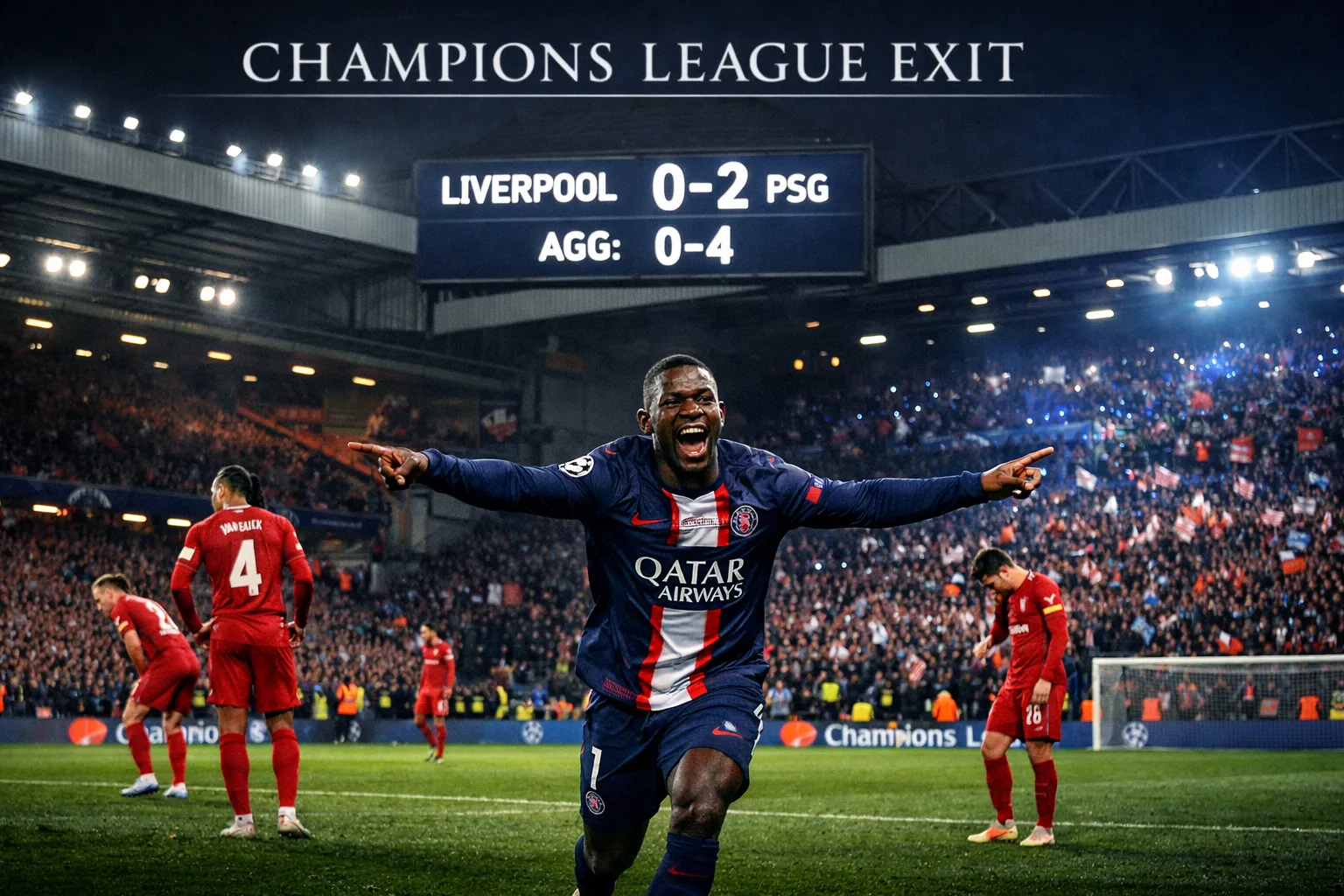
Liverpool PSG Champions League heartbreak as PSG win 2-0 at Anfield for 4-0 on aggregate. Dembele double, Slot reaction, and Everton next.
Liverpool PSG Champions League heartbreak as PSG win 2-0 at Anfield for 4-0 on aggregate. Dembele double, Slot reaction, and Everton next.
Anfield has staged comebacks that feel like folklore, but this Liverpool PSG Champions League night turned into a lesson in ruthless efficiency. Liverpool owned the ball, swarmed second balls, and fired 21 shots, yet the net never rippled for the home side. Paris Saint-Germain, calm under pressure, struck twice through Ousmane Dembele and walked out with a 2-0 win on the night and a 4-0 aggregate statement. For Arne Slot, it was pride in the intensity, and fury at the waste.
The opening stages felt scripted for a classic Liverpool PSG Champions League surge, with Liverpool pinning PSG deep and forcing hurried clearances. The tempo was ferocious, the counter-press sharp, and the crowd responded to every tackle like it was a shot on goal. Yet the more Liverpool dominated possession, the more the game began to resemble a familiar European trap. PSG were happy to suffer without panicking, waiting for moments rather than momentum.
What made this Liverpool PSG Champions League defeat sting was how quickly control turned into anxiety. Liverpool’s best spells didn’t lead to a breakthrough, and each missed chance added weight to the next attack. PSG’s back line held its shape, with midfield runners tracking just enough to prevent clear cut-backs. When Liverpool finally got shots away, they were often from crowded angles or rushed setups, the kind elite sides invite when they trust their structure.
Liverpool’s numbers screamed dominance, but the Liverpool PSG Champions League story was written in shot quality and timing. Too many efforts came after one extra touch, giving defenders the half-second needed to block or force a mishit. Crosses arrived, yet they lacked the early whip that catches a line moving backwards. PSG also defended the six-yard box with conviction, turning what looked like tap-ins into ricochets and desperate toe-pokes.
There was a cold assurance to PSG’s approach in this Liverpool PSG Champions League tie, a sense they knew exactly which storms mattered. They didn’t chase Liverpool’s full-backs recklessly, instead screening the central lanes and letting wide possession feel harmless. When Liverpool tried to speed it up through quick combinations, PSG fouled smartly or slowed restarts at key moments. It wasn’t pretty, but it was mature, and it kept the scoreboard on their side.
In a match where Liverpool had the ball and PSG had the cutting edge, Ousmane Dembele became the difference. His first goal arrived as a reminder that transitions decide modern Champions League quarter-finals, not possession charts. Liverpool’s defensive line was caught between stepping up and recovering, and Dembele attacked that hesitation like it was an invitation. In the context of the Liverpool PSG Champions League narrative, it was a punch that changed the emotional temperature of Anfield.
Dembele’s second goal made the tie feel окончательно out of reach, even as Liverpool kept throwing bodies forward. PSG didn’t need a parade of chances; they needed one more moment of clarity, and Dembele delivered it. Liverpool’s defenders were stretched by the need to chase the game, leaving channels that PSG had been teasing all night. The Liverpool PSG Champions League deficit widened, and the home crowd’s belief turned into a desperate demand for a miracle.
Dembele’s finishing wasn’t just about technique; it was about reading Liverpool’s defensive indecision in the Liverpool PSG Champions League battle. When Liverpool committed numbers to attacks, the rest defense needed perfect distances, and they weren’t always there. One step too high from a center-back, one midfielder arriving late to cover, and the lane opened. Dembele thrives in those moments, accelerating into gaps before defenders can even agree who should engage.
Luis Enrique set PSG up to absorb pressure without losing their head, and it paid off in the Liverpool PSG Champions League quarter-finals. His team rarely looked tempted into chaotic pressing, choosing instead to protect the middle and force Liverpool wide. When they won the ball, the first pass was purposeful, not hopeful, aimed at releasing runners quickly. That blend of discipline and speed turned Liverpool’s territorial control into PSG’s best weapon.
Arne Slot’s post-match mood captured the contradiction at the heart of this Liverpool PSG Champions League elimination. He praised the intensity, the commitment, and the way his side kept coming, because those were real positives in a brutal arena. But he couldn’t hide the frustration that football can be unforgiving when you don’t take your chances. Liverpool didn’t look timid or outclassed for long stretches, yet they were beaten decisively on the scoreboard.
This Liverpool PSG Champions League exit also carries a heavier consequence: it ends Liverpool’s hopes of silverware this season. In a club that measures itself by trophies and European nights, that matters, even if performances can be promising. The fact it’s a second consecutive defeat to PSG adds a psychological edge, like a recurring obstacle they haven’t solved. Slot now has to ensure disappointment doesn’t become drift, because the league schedule won’t wait.
Slot’s claim that Liverpool deserved better in the Liverpool PSG Champions League tie wasn’t empty spin; it was rooted in territory, pressing success, and chance volume. His side repeatedly forced PSG into rushed clearances and second-ball scrambles, the kind of pressure that usually produces a goal. The problem was the final action, the calm touch or decisive finish that turns dominance into numbers. In elite knockout football, “deserved” only counts if it becomes a lead.
The Champions League quarter-finals are a microscope, and this Liverpool PSG Champions League clash showed how tiny details decide reputations. A blocked shot instead of a goal changes risk levels, forcing a team to commit more and leave space behind. A slightly late run turns a tap-in into a scuffed effort, and suddenly the opponent believes they can survive. Liverpool lived in that world of near-misses, while PSG lived in the world of “one chance, one goal.”
Two consecutive exits to the same opponent become more than coincidence, and this Liverpool PSG Champions League defeat will spark uncomfortable questions. PSG have repeatedly shown they can handle Liverpool’s intensity by refusing to be dragged into end-to-end chaos. When Liverpool play at their best, they want games to become emotional and fast, but PSG have learned to slow the pulse. That’s not just tactics; it’s temperament, and it can be the hardest thing to change.
Liverpool also face a stylistic puzzle in this Liverpool PSG Champions League matchup: how to create clean chances against a team that defends central spaces and trusts its recovery speed. When the middle is blocked, Liverpool’s width becomes essential, yet crossing alone can be predictable without varied delivery. The tie exposed moments where Liverpool’s attacks became repetitive, allowing PSG to anticipate rather than react. Over two legs, predictability is a gift to an opponent with elite athletes.
PSG’s blueprint in the Liverpool PSG Champions League tie leaned on three themes: survive the first wave, spring transitions, and funnel Liverpool into lower-value shots. They set subtle wide traps, letting Liverpool advance near the touchline before collapsing with two defenders and a supporting midfielder. That created turnovers and stopped clean cut-backs, which are often Liverpool’s most dangerous weapon. When Liverpool did shoot, PSG bodies were in the way, turning power into frustration.
There’s a mental residue that lingers after repeated losses in the Liverpool PSG Champions League storyline, and Liverpool must manage it carefully. Players begin to feel the game slipping the moment a chance goes begging, because they’ve seen the movie before. Fans, too, shift from joy to nerves quicker, and that tension can seep onto the pitch. Slot’s job is to frame this as a lesson rather than a curse, because belief is a tactical tool.
With Europe gone, Liverpool’s immediate reality is domestic, and the Merseyside Derby against Everton suddenly carries extra emotional weight. The Liverpool PSG Champions League defeat will be in the legs and in the head, and derbies punish any hesitation. Anfield can turn from catharsis to impatience if the performance starts slowly, so Liverpool need a fast start and a clear plan. The biggest challenge is turning disappointment into aggression without tipping into frantic play.
Complicating everything is the absence of Hugo Ekitike, sidelined for nine months, which reshapes Liverpool’s attacking options. In the Liverpool PSG Champions League tie, the finishing problem was already glaring, and losing a star forward only amplifies the urgency for solutions. Slot will need goals from wide areas, midfield runners, and set pieces, because relying on one source is dangerous. The derby will demand efficiency, not just volume, and Liverpool have to prove they can learn quickly.
To respond after the Liverpool PSG Champions League disappointment, Liverpool may need to simplify their attacking patterns against Everton. Earlier crosses, more shots from cut-backs, and quicker switches of play can prevent a low block from settling. Slot might also demand more runners beyond the last line to stretch space vertically, even if it risks turnovers. The key is balance: keep the intensity that worked against PSG, but add clarity in the final third.
Without Ekitike, Liverpool’s goals must become a shared project, and that’s a cultural shift as much as a tactical one. The Liverpool PSG Champions League match showed how easily pressure builds when a team expects one moment to solve everything. Slot will look for midfielders arriving late, full-backs choosing smarter final balls, and forwards attacking the near post with conviction. If Liverpool spread the burden, they can avoid becoming predictable and keep opponents guessing.
For PSG, this was more than a win; it was a mature European performance that will resonate across the tournament. The Liverpool PSG Champions League tie showcased a team comfortable without constant control, confident that its quality will surface when it matters. Dembele’s goals will grab the headlines, but the bigger story is PSG’s composure in a hostile stadium. That kind of resilience travels well in Europe, especially as the margins get thinner in the later rounds.
For Liverpool, the Liverpool PSG Champions League defeat should become a blueprint for improvement rather than a scar to hide. Slot can point to the intensity and structure as foundations, then ruthlessly address the finishing and chance creation under pressure. Recruitment, coaching detail, and squad health will all matter, especially with Ekitike’s long injury absence changing planning. Liverpool are not far from being a top European side again, but “not far” is still a distance in knockout football.
Great European teams win in different ways, and PSG’s approach in the Liverpool PSG Champions League quarter-finals was a reminder of that truth. They didn’t need to dominate the ball, because they dominated the key moments. Their defensive discipline reduced Liverpool’s best attacks to crowded scrambles, and their transitions were purposeful rather than hopeful. It’s a style that won’t always thrill neutrals, but it terrifies opponents, because it’s built for knockout survival.
Slot’s Liverpool have a clear identity, and the Liverpool PSG Champions League tie proved it can trouble elite opponents. The next step is adding the cold-blooded edge that separates good performances from winning outcomes. That means better decision-making in the box, more varied chance creation, and a squad built to sustain intensity without losing control. If Liverpool treat this defeat as data rather than disaster, the pain can become progress rather than paralysis.
Liverpool will replay this Liverpool PSG Champions League night in their heads because it felt like control without reward, and football rarely forgives that. PSG took their moments through Dembele, defended with discipline, and left Anfield with a result that looked harsher than the flow of the game. Slot can be proud of the fight, but he also has to demand sharper finishing and calmer choices. With Everton next and Ekitike out long-term, the response has to be immediate, collective, and clinical.
Julian Mercer is a lifelong student of the game whose passion for football was sparked at an early age, after stepping onto the grass of Camp Nou as a six-year-old — a moment that left a lasting impression and set him on a permanent path into the sport. Since then, football has been both his lens on the world and his favourite language. Blending traditional fandom with a deep interest in tactics, squad building, and long-term team development, Julian has spent decades analysing the game from every angle. His fascination with football strategy was further shaped through years of immersive play in Football Manager, a series he has followed since the mid-1990s, developing a sharp eye for patterns, player profiles, and the fine margins that define success. At My World Of Football, Julian focuses on the stories beneath the surface — from tactical evolutions and managerial philosophies to the narratives that connect clubs, players, and supporters across generations. His writing aims to balance insight with accessibility, always grounded in a genuine love for the game.
Continue reading more football news