Myworldoffootball
PSV Sparta Rotterdam fireworks incident sparks KNVB fury
PSV Sparta Rotterdam fireworks incident halted play after 30 minutes. Fans demand KNVB punishment as questions grow over crowd control measures.
PSV Sparta Rotterdam fireworks incident halted play after 30 minutes. Fans demand KNVB punishment as questions grow over crowd control measures.
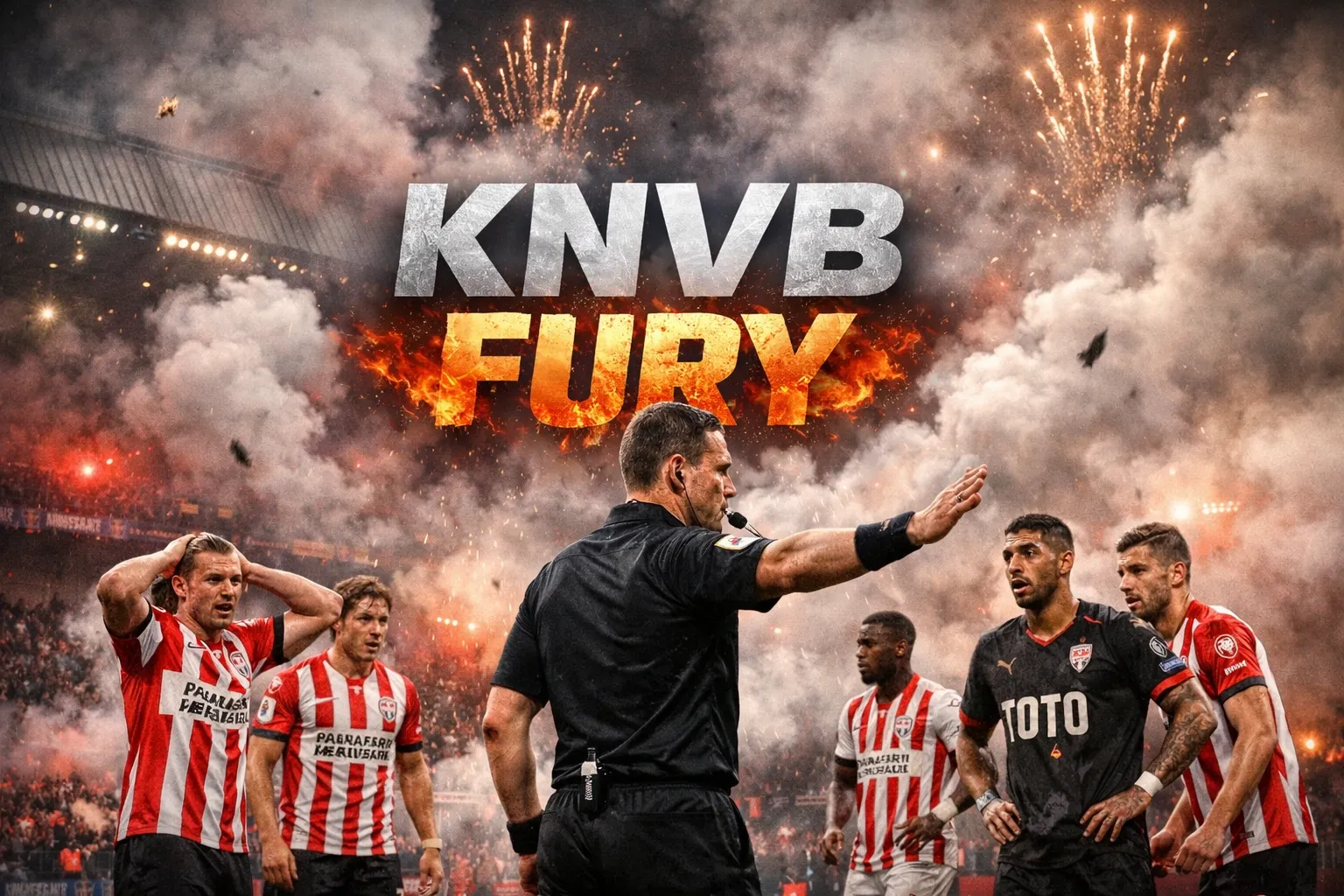
The PSV Sparta Rotterdam fireworks incident was supposed to be a loud, joyful footnote to a title party, not the headline that hijacked the evening. Instead, the Eredivisie match interruption arrived after 30 minutes when smoke drifted across the pitch, forcing referee Alex Bos to halt play. In a league proud of its atmosphere, the scene felt both familiar and alarming. Online, the mood turned sharply from celebration to accountability, with KNVB punishment demands flooding timelines.
The PSV Sparta Rotterdam fireworks incident began with a burst of noise that quickly became a blanket of haze, the kind that makes players squint and goalkeepers lose their bearings. Supporters in the stands set off fireworks, and within moments the stadium’s air looked more like a derby-day fog than a championship showcase. The Eredivisie match interruption wasn’t a dramatic overreaction; it was a basic safety call. Football can be chaotic, but visibility and breathing are non-negotiable.
When Alex Bos stopped the match, the decision carried the weight of precedent and the immediate responsibility of protecting players and staff. The PSV Sparta Rotterdam fireworks incident is not just about spectacle; it is about what happens when spectacle crosses into danger. As smoke lingered, the pause stretched long enough for frustration to bubble up in the stands and online. Once the air cleared, play resumed, but the evening’s rhythm had already been broken.
Referee Alex Bos became an unexpected central figure because the Eredivisie match interruption demanded calm authority, not theatrics. In the PSV Sparta Rotterdam fireworks incident, his job was to assess visibility, potential panic, and the risk of further pyrotechnics. He halted the game, waited for conditions to improve, and then restarted once the smoke dissipated. It was textbook procedure, yet it also highlighted how often Dutch football regulations rely on referees to manage crises created far from the pitch.
It’s easy for some fans to frame the PSV Sparta Rotterdam fireworks incident as “just a bit of smoke,” but the practical impacts are immediate. Players need clear sightlines for high balls, defensive lines, and quick transitions, while goalkeepers rely on split-second tracking. Fireworks in stadiums also introduce respiratory irritation, especially in enclosed corners where smoke pools. The Eredivisie match interruption was therefore a welfare measure, not a moral lecture, and that distinction matters.
The PSV fans controversy accelerated online because the contrast was so stark: a title-winning club trying to enjoy its moment, and a match halted by reckless behavior. The PSV Sparta Rotterdam fireworks incident quickly trended alongside calls for KNVB punishment, with supporters from across the league weighing in. Many were not rivals looking to point-score; they were ordinary fans exhausted by repeat episodes. The tone wasn’t merely angry, it was weary, as if patience had finally run out.
What fueled the backlash was the sense that a minority had commandeered an occasion meant for everyone, including families and travelling supporters. In the PSV Sparta Rotterdam fireworks incident, the loudest online voices argued that sanctions must finally bite, because warnings and small fines feel like background noise. The phrase “actions of a few” appeared again and again, a shorthand for collective punishment anxiety. Yet the same posts also demanded that the collective stop tolerating the few.
Among the most repeated proposals after the PSV Sparta Rotterdam fireworks incident were strict measures: banning PSV supporters from away games, partial stand closures, and even point deductions. The logic is blunt—if consequences aren’t painful, behavior won’t change—especially when fireworks in stadiums have become a recurring headline. Critics argue that only sporting penalties alter incentives for clubs and fan groups. Whether the KNVB punishment toolkit will go that far is uncertain, but the demand is growing louder.
Plenty of PSV supporters expressed embarrassment because the PSV Sparta Rotterdam fireworks incident overshadowed what should have been a proud, communal celebration. The frustration wasn’t aimed at Sparta Rotterdam or the officials; it was directed inward at fellow fans who treat pyrotechnics like a badge of authenticity. Many argued that the club and supporters’ groups must police themselves more aggressively. The emotion was not anti-atmosphere; it was pro-responsibility, a plea to protect the joy.
The immediate question after the PSV Sparta Rotterdam fireworks incident is procedural: what can the KNVB actually do, and how quickly? Dutch football regulations typically allow the federation to open an investigation, request reports from match officials, and assess evidence from security and broadcast footage. The Eredivisie match interruption provides a clear trigger for disciplinary review because it affected the match’s operation. However, the gap between outrage and outcome can be long, and that delay often cools deterrence.
Clubs are also part of the legal and practical chain, because sanctions can target both the organization and the individuals identified. The PSV Sparta Rotterdam fireworks incident will likely reignite debate about strict liability, where clubs are held responsible for supporter misconduct regardless of intent. Supporters argue it’s unfair, while regulators argue it’s the only mechanism that forces clubs to invest in prevention. The truth is messy: enforcement needs both accountability and precision to avoid punishing the wrong people.
In cases like the PSV Sparta Rotterdam fireworks incident, strict liability is attractive to authorities because it simplifies responsibility: the club must control its environment. Yet targeted punishment—identifying and banning individuals—feels more just to the average fan who did nothing wrong. The problem is identification can be difficult in crowded sections, especially when faces are covered and smoke clouds cameras. The KNVB punishment debate therefore becomes a test of whether Dutch football regulations can be both fair and forceful.
Point deductions are the nuclear option floated online after the PSV Sparta Rotterdam fireworks incident, but they are rare and politically explosive. The argument for them is deterrence: clubs will spend whatever it takes to prevent repeat incidents if the league table is at stake. The argument against is proportionality, especially when the match eventually resumed and the sporting contest continued. Still, the very fact the idea is mainstream shows how much faith fans have lost in softer penalties.
Fireworks in stadiums persist because they sit at the intersection of identity, adrenaline, and the desire to “make a statement.” The PSV Sparta Rotterdam fireworks incident fits a broader European pattern where pyrotechnics are framed as culture rather than contraband. Some fans romanticize the visuals and the noise, ignoring that modern stadiums are designed for comfort and safety, not smoke management. Each Eredivisie match interruption caused by fireworks reinforces the same lesson: tradition doesn’t override risk.
There’s also an uncomfortable reality that enforcement can be inconsistent, which creates a gambler’s mindset among those tempted to bring pyrotechnics. If previous incidents led to minor consequences, the next person assumes they’ll get away with it too. The PSV Sparta Rotterdam fireworks incident will be analyzed for security failures: entry checks, stewarding, and surveillance coverage. Without consistent deterrence, the cycle repeats—an incident, a debate, a promise, and then another incident when attention fades.
Every PSV Sparta Rotterdam fireworks incident-style episode invites the same question: how did the fireworks enter the ground in the first place? Stadium security is a layered system, but it only takes one weak point—an understaffed gate, a rushed search, or a hidden stash placed earlier. Some devices are small enough to evade casual checks, and coordinated groups can exploit crowd surges at turnstiles. Crowd control measures must therefore be proactive, not merely reactive once smoke appears.
Many supporters insist they want intensity without endangering anyone, and that’s where clubs can offer alternatives that still feel authentic. Light shows, coordinated flags, and sanctioned smoke effects under controlled conditions can capture the drama without triggering an Eredivisie match interruption. The PSV Sparta Rotterdam fireworks incident shows the appetite for spectacle is real; the challenge is channeling it safely. If clubs involve fan groups in designing legal displays, compliance rises because fans feel ownership rather than restriction.
The PSV Sparta Rotterdam fireworks incident is ultimately a crowd management case study, because the pitch was fine until the stands changed the environment. Clubs invest heavily in players, yet a single supporter action can jeopardize a match’s integrity and safety. Crowd control measures are not just stewards in fluorescent jackets; they include intelligence gathering, liaison officers, and clear escalation protocols. The Eredivisie match interruption underlines that the match-day operation is as crucial as tactics and form.
Sparta Rotterdam’s role matters too, because away fixtures and mixed crowds can complicate policing strategies. While the PSV Sparta Rotterdam fireworks incident occurred with PSV supporters as the focal point, the broader lesson is league-wide: every club is one incident away from scrutiny. Communication between clubs, local authorities, and the KNVB must be sharper, especially on high-emotion days like title celebrations. When the stakes are emotional, planning must be even more meticulous.
Effective crowd control measures rely on a triangle: trained stewards for immediate response, police for enforcement and public order, and supporter liaison officers who understand fan culture. The PSV Sparta Rotterdam fireworks incident suggests a breakdown somewhere in that triangle, whether in prevention or rapid identification. Liaison officers can help isolate risky groups and de-escalate before devices are lit, but only if they have trust and backing. Without coordination, everyone reacts late, and the match pays the price.
After the PSV Sparta Rotterdam fireworks incident, technology will be touted as the fix—better cameras, facial recognition debates, and stricter ID checks. These tools can help identify perpetrators, enabling targeted bans that spare the wider fanbase, but they also raise privacy concerns and require legal clarity. Dutch football regulations must define what’s permissible and how data is handled. Still, if the alternative is repeated Eredivisie match interruption episodes, many fans may accept tougher monitoring as the lesser evil.
The deepest issue raised by the PSV Sparta Rotterdam fireworks incident is cultural: what kind of match-day experience does Dutch football want to protect? The Eredivisie has long sold itself on intimacy, noise, and closeness to the pitch, but that intimacy also magnifies risk when boundaries are ignored. Soccer fan behavior is shaped by norms, and norms shift when consequences shift. If fireworks in stadiums keep stealing headlines, the league’s brand becomes “unmanageable,” not “passionate.”
There is also a generational element, with younger fans consuming football through viral clips that reward extremes. The PSV Sparta Rotterdam fireworks incident produced shareable images, and that’s part of the problem: attention becomes currency. To change soccer fan behavior, clubs and the KNVB must reduce the social payoff by increasing the personal cost and offering safer ways to be seen. Otherwise, every celebration becomes a potential flashpoint, and Dutch football regulations will keep tightening until spontaneity disappears.
One overlooked solution after the PSV Sparta Rotterdam fireworks incident is supporter-led self-regulation, where fan groups publicly set standards and enforce them socially. Peer pressure can be more effective than policing because it works before the turnstiles, in group chats and meeting points. Education campaigns sound soft, but when paired with real bans and consistent KNVB punishment, they can shift what is considered “cool.” If respected fan leaders say fireworks in stadiums are unacceptable, the message lands differently.
There’s a genuine fear that the PSV Sparta Rotterdam fireworks incident will lead to blanket restrictions that drain the colour from Dutch grounds. If the response is constant surveillance, heavy-handed policing, and sweeping bans, ordinary fans may feel treated like suspects. That resentment can backfire, making soccer fan behavior more antagonistic rather than cooperative. The challenge is to be surgical: remove the dangerous elements while protecting the choreographies, songs, and traditions that make the Eredivisie special.
The PSV Sparta Rotterdam fireworks incident should be remembered as a warning, not a template, because Dutch football can’t afford repeated nights where celebration turns into stoppage. Alex Bos did what referees must do when conditions become unsafe, but the real responsibility sits higher up the chain, with clubs, authorities, and supporter communities. KNVB punishment will matter, yet so will the everyday work of prevention and culture-setting. If the league gets this right, the next title party can be loud for the right reasons.

Julian Mercer is a lifelong student of the game whose passion for football was sparked at an early age, after stepping onto the grass of Camp Nou as a six-year-old — a moment that left a lasting impression and set him on a permanent path into the sport. Since then, football has been both his lens on the world and his favourite language. Blending traditional fandom with a deep interest in tactics, squad building, and long-term team development, Julian has spent decades analysing the game from every angle. His fascination with football strategy was further shaped through years of immersive play in Football Manager, a series he has followed since the mid-1990s, developing a sharp eye for patterns, player profiles, and the fine margins that define success. At My World Of Football, Julian focuses on the stories beneath the surface — from tactical evolutions and managerial philosophies to the narratives that connect clubs, players, and supporters across generations. His writing aims to balance insight with accessibility, always grounded in a genuine love for the game.
Continue reading more football news