Myworldoffootball
Rio Ngumoha Liverpool future after Salah exit plan
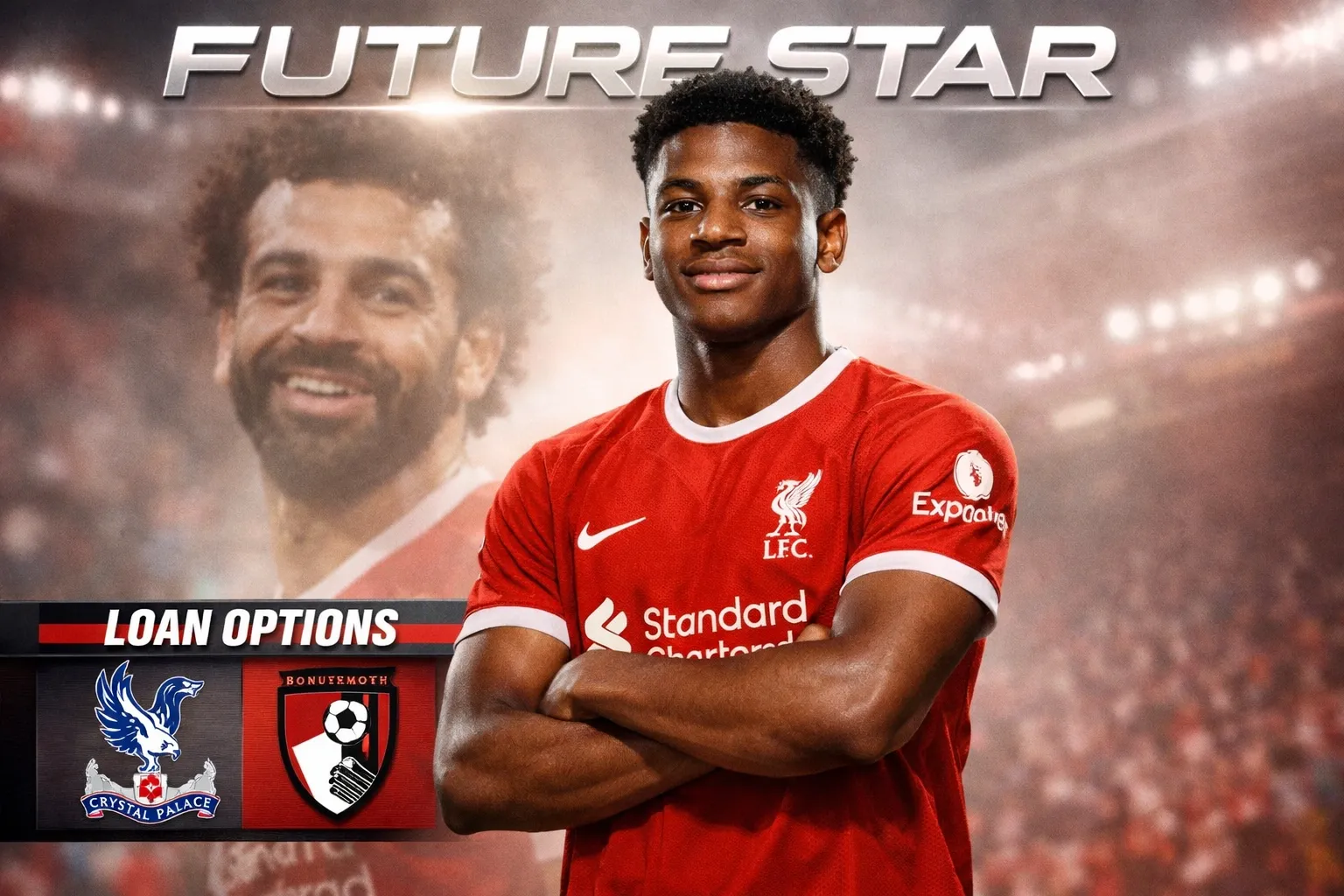
Rio Ngumoha Liverpool future in focus as Mohamed Salah’s 2026 departure nears. Loan options at Crystal Palace or Bournemouth could shape his rise.
Rio Ngumoha Liverpool future in focus as Mohamed Salah’s 2026 departure nears. Loan options at Crystal Palace or Bournemouth could shape his rise.
Liverpool supporters are already scanning the horizon for the next right-sided match-winner, because the Mohamed Salah departure is no longer a distant rumour but a date on the calendar. With Salah set to leave as a free agent in summer 2026, the club’s planning has to start now, not when the farewell banners go up. That is why the Rio Ngumoha Liverpool future has become such a live conversation, especially with a potential loan to Crystal Palace or Bournemouth on the table. For a 17-year-old, the spotlight is blinding.
The Rio Ngumoha Liverpool future is being framed by a simple, uncomfortable truth: replacing Salah is not a normal squad tweak, it is a cultural shift. Salah has been Liverpool’s weekly guarantee of goals, gravity, and fear in opponents’ back lines, and his 2026 exit will leave a tactical and emotional vacuum. In that context, Ngumoha’s progress is being read as a clue to Liverpool’s next era rather than a teenager’s learning curve.
Ngumoha’s numbers this season—23 appearances and two goals—are modest on paper, yet revealing when you consider his age and the level of competition he is tasting. Liverpool have used him in different game states, sometimes asking him to keep width and sometimes to attack the half-space, which speaks to a development plan rather than a fixed role. The Rio Ngumoha Liverpool future, then, is not just about production now, but about whether his skill set can scale to elite responsibility later.
The Mohamed Salah departure will warp expectations for anyone who plays on the right, because fans and pundits instinctively compare output, not trajectory. Salah is a two-time Premier League champion and a three-time PFA Player of the Year, which sets a standard that even established internationals struggle to match. When a teenager is mentioned in the same breath, pressure multiplies, and the Rio Ngumoha Liverpool future risks becoming a referendum on what he cannot yet be.
Ngumoha has already collected record-breaking moments, becoming Liverpool’s youngest player in the FA Cup and the Champions League, and those milestones travel fast on social media. Clips compress context, and a bright cameo can be sold as inevitability, which is dangerous for a developing winger. Liverpool know the Rio Ngumoha Liverpool future cannot be built on viral highlights alone, because the Premier League punishes young players who are rushed into being symbols instead of footballers.
Liverpool transfer plans for the post-Salah world have to balance two timelines: immediate competitiveness and long-term succession. The club cannot wait until 2026 to shop for a right winger, because integrating a new starter takes months of tactical learning and chemistry-building. That is why the Rio Ngumoha Liverpool future is being discussed alongside recruitment, not instead of it, with the idea that a senior signing could carry the load while Ngumoha grows.
Stan Collymore’s warning lands because it is rooted in how elite clubs operate when trophies are non-negotiable. He argues Liverpool should invest in a seasoned right winger, essentially buying time and stability, while letting Ngumoha develop without the weekly demand to be Salah 2.0. The Rio Ngumoha Liverpool future, in that reading, is protected by depth: the teenager becomes an option, not an obligation, which is often the difference between growth and burnout.
Collymore is not questioning Ngumoha’s talent; he is questioning the environment that talent will be asked to survive in. At Liverpool, one quiet month becomes a storyline, and one missed chance becomes a compilation, especially for young players. Managing expectations is therefore a performance tool, not a PR exercise, and it keeps the Rio Ngumoha Liverpool future aligned with development targets rather than public impatience.
A proven winger would offer Liverpool predictable output, tactical reliability in big games, and leadership in training—three things that cannot be demanded from a 17-year-old. It also creates a mentoring lane, where Ngumoha can learn timing, pressing triggers, and end-product habits from someone who has lived the weekly grind. In that structure, the Rio Ngumoha Liverpool future becomes a phased project, not a crisis response to the Mohamed Salah departure.
A Crystal Palace loan is attractive on paper because it offers Premier League exposure without the title-race microscope, and it can provide the kind of repeated 1v1 situations wingers need. Palace have historically trusted athletic wide players and given them space to attack, which could suit Ngumoha’s directness and confidence. If Liverpool choose that route, the Rio Ngumoha Liverpool future would be tested in the same division, against the same full-backs, but with a different pressure profile.
A Bournemouth loan, meanwhile, could be a more controlled stepping stone, depending on role clarity and minutes. Bournemouth’s style can encourage wide rotations and quick combinations, potentially sharpening Ngumoha’s decision-making in tight areas rather than only his ability to beat a man. The key for Liverpool is not the badge on the loan deal, but the guarantee of meaningful minutes, because the Rio Ngumoha Liverpool future cannot be advanced by cameo football and bench learning alone.
For a young talent Liverpool are trying to polish, Palace can provide a classroom in transition football: recover, explode, and punish space. That environment can improve a winger’s scanning, first touch at speed, and defensive recovery runs, all of which matter at Anfield. The Rio Ngumoha Liverpool future would benefit if he is trusted to start matches, feel the rhythm of 90 minutes, and learn how to affect games when his team is under pressure.
Bournemouth can be valuable because they often demand collective discipline and intelligent movement, which forces a winger to become more than a dribbler. If Ngumoha is asked to press on cues, tuck into pockets, and combine with overlapping full-backs, his all-round game accelerates. From Liverpool’s perspective, a Bournemouth loan could turn raw promise into functional reliability, which is the bridge the Rio Ngumoha Liverpool future must cross to become a genuine option post-Salah.
Those 23 appearances and two goals are best understood as evidence of trust, not as a final grade. Liverpool rarely hand minutes to teenagers unless they see tactical obedience and training standards that match the first-team environment. Ngumoha’s cameos have shown flashes of bravery—taking on defenders, trying ambitious passes, and demanding the ball—which are essential traits for a right-sided attacker at a club that lives in the opponent’s half. Still, the Rio Ngumoha Liverpool future needs more than bravery.
The Salah role is not only about goals; it is about how Liverpool structure attacks around a player who can create danger from nothing. Salah pins full-backs, drags centre-backs, and turns half-chances into shots, which changes how opponents defend the entire team. For Ngumoha, the question within the Rio Ngumoha Liverpool future is whether he can eventually command that same respect, or whether his ceiling is better expressed as a rotation winger with different strengths.
Wingers often learn the hardest lessons in the final third, where one extra touch turns a chance into a blocked shot. Ngumoha’s two goals hint at potential, but Liverpool will be looking for repeatable patterns: when he shoots, where he shoots from, and whether he can create high-quality chances rather than hopeful ones. The Rio Ngumoha Liverpool future will be judged by that evolution, because elite clubs win titles on decision-making as much as on flair.
The Premier League is unforgiving to teenagers because defenders are stronger, smarter, and more cynical than youth football allows for. Ngumoha will need to add resilience in duels, protect the ball under contact, and understand when to slow the game down rather than forcing the spectacular. Liverpool’s coaching staff will also demand pressing consistency, because wingers set the tone of the counter-press. If those layers arrive, the Rio Ngumoha Liverpool future becomes far more realistic.
Being the youngest Liverpool player in the FA Cup and the Champions League is a badge of honour, but it is also a magnet for noise. Every touch is clipped, every mistake is replayed, and every performance becomes a debate about whether the club has found its next superstar. That cycle can distort development, because young players start performing for reaction rather than for improvement. Liverpool’s job is to keep the Rio Ngumoha Liverpool future grounded in process, not in timelines set by fan edits.
The modern pressure is different from previous eras because criticism is not confined to match reports or phone-ins; it lives in pockets, notifications, and comment sections. A teenager can have a bad training week and still feel judged globally, which is why clubs now invest heavily in player care and mental skills coaching. For Ngumoha, protecting the Rio Ngumoha Liverpool future may involve limiting exposure, carefully selecting media moments, and ensuring his inner circle keeps football as the priority.
Insulation does not mean avoiding football; it means controlling variables that do not help performance. Liverpool can set clear objectives—like improving weak-foot delivery, tracking runners, or shot selection—and measure success internally rather than through public praise. They can also stagger his minutes so he experiences different match contexts without being overloaded. If that structure holds, the Rio Ngumoha Liverpool future can develop steadily, even as the Mohamed Salah departure narrative grows louder.
Records are snapshots, and the danger is treating them as proof of arrival rather than as signs of opportunity. Ngumoha’s historic appearances show Liverpool believe in his potential, but they do not guarantee he will become a starter, let alone a Salah successor. The club’s best academy outcomes have often involved patience, smart loans, and carefully timed breakthroughs. Framed that way, the Rio Ngumoha Liverpool future is a long race, not a sprint to satisfy a headline.
Liverpool’s smartest approach is to separate succession planning into roles rather than personalities. Salah’s goals can be replaced by committee—through a new winger, a more prolific central forward, or midfielders arriving in the box—while his right-sided occupation can be shared between different profiles. That flexibility reduces the temptation to crown a teenager too early. In that model, the Rio Ngumoha Liverpool future is to become one of several solutions, not the single answer to the Mohamed Salah departure.
A loan, if chosen, should be framed as a deliberate stage in an elite pathway, not as a sign Liverpool doubt him. The best loans are specific: a club that guarantees starts, a coach who will teach details, and a tactical system that mirrors enough of Liverpool’s demands to make the return seamless. Whether it is a Crystal Palace loan or a Bournemouth loan, the Rio Ngumoha Liverpool future depends on clarity, communication, and the courage to prioritise development over short-term optics.
Liverpool should negotiate for role clarity, position usage, and performance feedback, because a loan without structure can become wasted time. They will want Ngumoha playing primarily in his intended zones, learning pressing responsibilities, and facing top-level defenders weekly. Regular reporting, video analysis, and agreed development goals turn a loan into an extension of Liverpool’s academy. Get that right, and the Rio Ngumoha Liverpool future returns to Anfield with evidence, not just experience.
The realistic outcome is that Ngumoha gradually earns more responsibility while Liverpool add proven quality to protect standards. In 2026-27, he could be a rotation winger who starts certain fixtures, finishes others, and learns how to influence games when opponents sit deep. If he excels, the role grows organically; if not, he still becomes a valuable squad asset. Either way, the Rio Ngumoha Liverpool future is strongest when it is allowed to unfold, not forced to imitate Salah overnight.
Liverpool’s next great right winger might already be in the building, but the club’s challenge is to resist turning potential into prophecy. The Mohamed Salah departure will feel seismic, yet the best teams respond with planning, not panic, and with pathways, not pressure. Rio Ngumoha has shown enough in 23 appearances to justify excitement, and his record-breaking moments hint at a special ceiling. Still, the Rio Ngumoha Liverpool future will be decided by smart minutes, the right loan—perhaps Crystal Palace or Bournemouth—and the patience to let a teenager become a professional on his own terms.

Julian Mercer is a lifelong student of the game whose passion for football was sparked at an early age, after stepping onto the grass of Camp Nou as a six-year-old — a moment that left a lasting impression and set him on a permanent path into the sport. Since then, football has been both his lens on the world and his favourite language. Blending traditional fandom with a deep interest in tactics, squad building, and long-term team development, Julian has spent decades analysing the game from every angle. His fascination with football strategy was further shaped through years of immersive play in Football Manager, a series he has followed since the mid-1990s, developing a sharp eye for patterns, player profiles, and the fine margins that define success. At My World Of Football, Julian focuses on the stories beneath the surface — from tactical evolutions and managerial philosophies to the narratives that connect clubs, players, and supporters across generations. His writing aims to balance insight with accessibility, always grounded in a genuine love for the game.
Continue reading more football news