Myworldoffootball
World Cup 2026 qualifiers: shock upsets & new faces
World Cup 2026 qualifiers deliver Italy’s exit, Curaçao’s debut, Haiti and Iraq returns, plus co-hosts USA, Mexico, Canada outlooks.
World Cup 2026 qualifiers deliver Italy’s exit, Curaçao’s debut, Haiti and Iraq returns, plus co-hosts USA, Mexico, Canada outlooks.
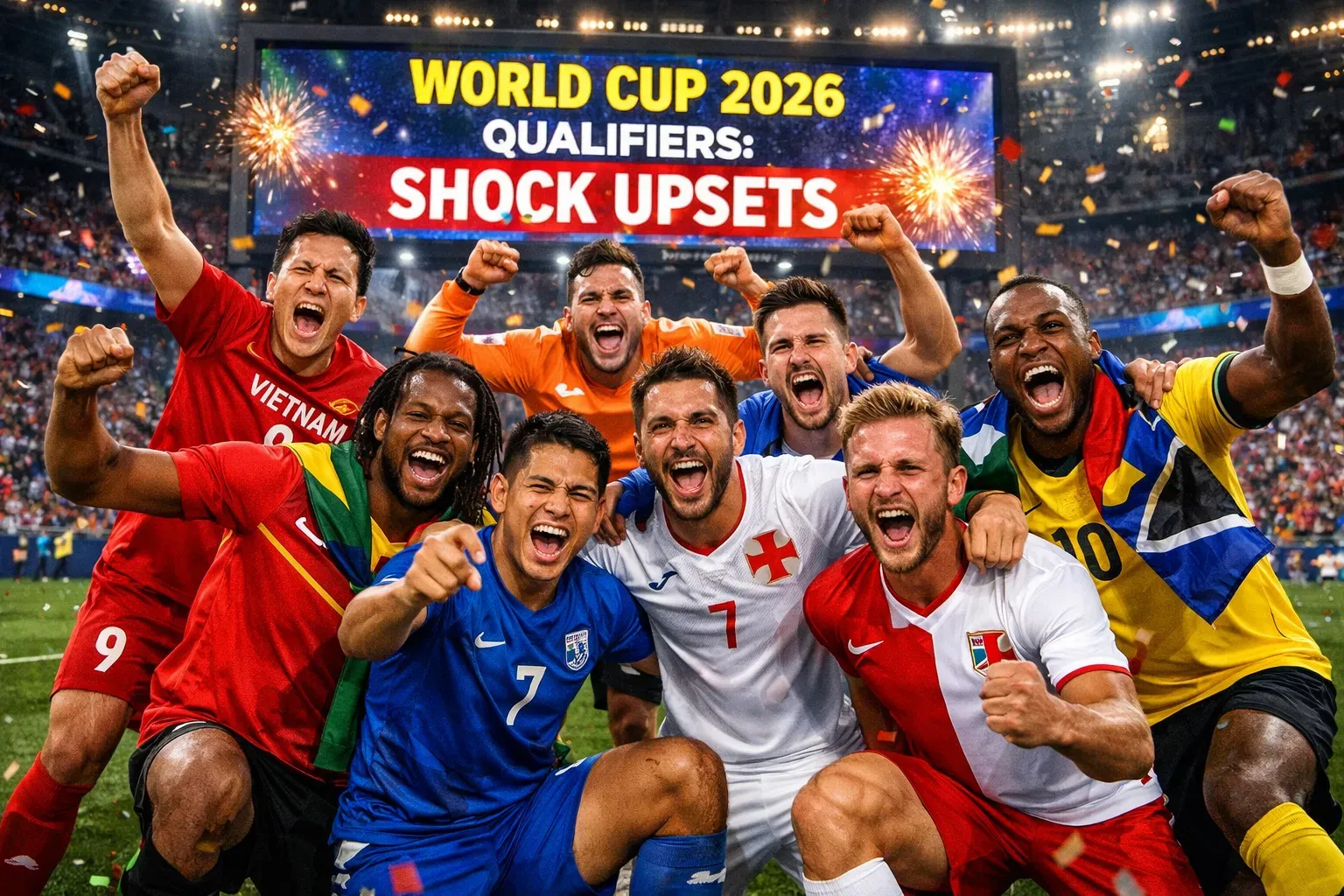
The World Cup has a way of turning ordinary international windows into collective obsession, and March’s finale to the World Cup 2026 qualifiers did exactly that. Six last tickets to North America were claimed in a blur of penalties, late goals, and history-making debuts, leaving big names bruised and smaller nations dreaming. Bosnia and Herzegovina knocked out Italy, Poland fell with Robert Lewandowski, and Curaçao became the smallest nation to qualify. With the tournament starting June 11 in Mexico City, the cast is suddenly richer—and far less predictable.
No result from the March sprint of the World Cup 2026 qualifiers landed with more force than Bosnia and Herzegovina eliminating Italy on penalties. The Azzurri arrived carrying the weight of pedigree and expectation, yet looked tight and reactive as the game stretched into the kind of anxious chess match that invites an upset. Bosnia’s discipline, especially in the middle third, kept Italy from turning possession into clean chances. When the shootout came, the underdogs didn’t blink.
For Italy, the loss wasn’t merely a bad evening; it was a third consecutive World Cup absence, a brutal line in modern World Cup history that would have sounded impossible a decade ago. The defeat felt symbolic of a broader problem: control without incision, talent without a stable attacking reference point. Bosnia, by contrast, played like a team that knew exactly what it was, absorbing pressure and striking with purpose. In the World Cup 2026 qualifiers, clarity often beats reputation.
Bosnia’s plan was conservative without being passive, a careful balance that punished Italy’s impatience. They defended the half-spaces aggressively, forcing Italy wide and turning crosses into manageable moments rather than disasters. When Bosnia did break, it was with just enough numbers to make Italy’s rest defense hesitate. That psychological edge—making a heavyweight doubt itself—has become a defining feature of the best football qualifying matches.
The soccer World Cup 2026 will be missing a familiar shade of blue, and that absence changes the tournament’s emotional texture. Italy’s nonappearance also reshuffles potential knockout paths, because their traditional role as a difficult draw disappears from the bracket. For neutrals, it’s a reminder that qualification is no longer a formality for anyone, not even former champions. The World Cup 2026 qualifiers have become a ruthless meritocracy, and Italy just failed the exam.
Poland’s exit, sealed by a loss to Sweden, delivered another gut-punch moment from the World Cup 2026 qualifiers. Robert Lewandowski, still one of Europe’s most reliable finishers, couldn’t drag a disjointed side over the line when the margins narrowed. Sweden’s approach was pragmatic, compressing space between the lines and daring Poland to create through crowded central corridors. When the decisive moments arrived, Poland looked like a team waiting for a hero rather than building solutions.
Lewandowski’s personal narrative always draws attention—especially with the Barcelona striker’s career ticking toward its later chapters—but this failure felt collective rather than individual. Poland’s chance creation depended too heavily on moments rather than patterns, and Sweden punished that with calm transitions and set-piece threat. In a tournament as expansive as North America’s, depth and adaptability matter, yet the World Cup 2026 qualifiers exposed Poland’s narrowness. Sweden, meanwhile, looked comfortable living without the ball.
Sweden didn’t need to dominate possession to dominate the match, a lesson that keeps repeating across the World Cup 2026 qualifiers. They controlled zones, not the ball, steering Poland into predictable areas and springing counters when Poland’s fullbacks overcommitted. Their midfield work rate turned second balls into an attacking weapon, and their defenders won aerial duels with authority. It wasn’t pretty, but it was tournament football in miniature: minimize risk, maximize moments.
Any set of World Cup predictions built around star power alone took a hit when Lewandowski’s Poland fell short. The modern game punishes one-dimensional dependency, even when the dependency is a world-class striker. For Lewandowski, it’s another reminder that international football rarely offers the structured chance volume he enjoys at Barcelona. For fans, it adds spice to the World Cup excitement—because it proves the door is open for new stories and new heroes.
Curaçao qualifying was the kind of outcome that makes the World Cup 2026 qualifiers feel like a global festival rather than a closed shop. As the smallest nation ever to reach the finals, they turned logistical limitations into a badge of honor, showing how smart recruitment, tactical coherence, and belief can stretch a country’s footballing footprint. Their journey carried an undercurrent of inevitability once momentum built, because opponents began to feel the pressure of being the “bigger” side.
There’s also a modern diaspora story here, with players who developed in European systems bringing professionalism and calm to high-stakes nights. Tahith Chong, with his Manchester United background, symbolizes that blend of pedigree and hunger, offering ball-carrying and tempo changes that can tilt tight matches. Curaçao’s rise underscores how the teams qualified for World Cup list is evolving, becoming more representative and unpredictable. The World Cup 2026 qualifiers didn’t just add a debutant; they added a new identity.
Chong’s value isn’t only in highlight-reel dribbles; it’s in how he connects phases, turning recovery into controlled possession rather than hopeful clearances. Curaçao often used him to escape pressure on the flank before switching play into space, forcing opponents to defend larger distances. That pattern matters in North America, where games can swing on transitions and fatigue. In the World Cup 2026 qualifiers, Curaçao learned to win ugly, and that’s a skill that travels.
Every tournament needs a newcomer that fans adopt as a second team, and Curaçao is perfectly positioned to become that story. Their qualification enriches World Cup history by reminding everyone that scale isn’t destiny, and that football’s global map keeps redrawing itself. Neutral supporters will circle their fixtures for the same reason they once circled Iceland or Costa Rica: the sense that anything can happen. The World Cup excitement starts with belief, and Curaçao has it in abundance.
Haiti’s return after 52 years carried a different emotional weight within the World Cup 2026 qualifiers, because it wasn’t just about tactics or form. It was about persistence through instability, limited resources, and the constant challenge of building continuity. Their qualification felt like a reward for generations of players who kept the dream alive without the infrastructure many rivals take for granted. When the final whistle confirmed it, the moment belonged to an entire footballing culture.
On the pitch, Haiti’s success was built on intensity and togetherness, playing with the urgency of a team that knows chances are rare. They pressed in coordinated bursts, then dropped into compact shapes to protect their lead, refusing to be drawn into chaotic end-to-end games. The World Cup 2026 qualifiers often punish emotional teams, but Haiti married emotion with discipline. That blend could make them awkward opponents once the finals begin.
Haiti’s key was learning when to slow the game down, a subtlety that separates romantic underdogs from effective ones. They managed game states with smarter fouls, calmer possession under pressure, and a willingness to defend their box with numbers. That maturity didn’t arrive overnight; it was shaped by the harsh lessons of previous campaigns. In the World Cup 2026 qualifiers, they finally looked like a side that could protect a lead without panicking.
Haiti’s presence creates tantalizing possibilities, especially against bigger CONCACAF neighbors or European sides expecting comfort. Their athleticism and direct running can stress teams that defend with high lines, while their crowd energy—especially in North American venues—could feel like a home boost. For broadcasters and neutral fans, Haiti fixtures are instant atmosphere. The World Cup 2026 qualifiers delivered them to the stage; now the World Cup excitement will test how far their belief can stretch.
Iraq ending a 40-year absence was one of the most resonant outcomes of the World Cup 2026 qualifiers, because it blended sporting achievement with national pride. Qualification campaigns are grueling under the best conditions, and Iraq’s path demanded constant adaptation, from travel challenges to the psychological toll of must-win games. Yet they arrived at the finish line with a squad that looked organized and mentally durable. Their return broadens the tournament’s cultural reach in a meaningful way.
The reward, however, is immediate difficulty: a group featuring France, a matchup that will test Iraq’s structure at an elite tempo. France’s depth and athleticism can suffocate teams that hesitate in build-up, so Iraq will need brave decisions in midfield and ruthless efficiency on counters. Still, tough groups can be liberating for underdogs, because expectations flip. The World Cup 2026 qualifiers taught Iraq to survive; the finals will ask them to compete.
Against France, Iraq’s defensive spacing will have to be immaculate, especially around the edges of the box where elite creators thrive. They’ll need to protect central lanes, force play wide, and then defend crosses with aggression rather than hope. The other crucial element is transition security, because turnovers in midfield become instant danger against teams like France. If Iraq can keep games close past the hour, the pressure shifts—and that’s where World Cup predictions start to wobble.
One underrated feature of a North American tournament is the way diverse fanbases travel and transform stadium atmospheres, and Iraq’s return will amplify that. It’s also a reminder to the World Cup co-hosts—USA, Mexico, and Canada—that the event isn’t only about their showcase. New and returning nations change the emotional geography of the competition, making every group feel like a cultural crossroads. The World Cup 2026 qualifiers didn’t just select teams; they curated stories.
Panama qualifying again confirmed their status as one of the region’s most reliable problem-solvers, a team comfortable in tight games where patience matters. They’ve learned how to manage away legs, how to win second balls, and how to turn set pieces into a steady stream of chances. In the World Cup 2026 qualifiers, those traits are often more valuable than flair. Panama won’t be anyone’s favorite, but they will be nobody’s preferred opponent.
Jordan, meanwhile, delivered pure celebration by earning a first-ever World Cup spot, instantly becoming one of the most compelling additions among the teams qualified for World Cup. Their qualification felt like a breakthrough for a program that has long flirted with the edge of the global stage. They defended with collective spirit, then attacked with purpose when openings appeared, playing like a side aware of history unfolding. The World Cup 2026 qualifiers gave them a passport; now they need a plan for the next level.
Tournaments often hinge on hybrid players who can interpret chaos, and Jean-Ricner Bellegarde fits that profile with his ability to carry, combine, and press. With Wolves sharpening his intensity and decision-making, he represents the type of club-developed engine that can swing a group match. The broader point is that modern squads are stitched together from club ecosystems, whether Barcelona’s finishing culture, Manchester United’s academy pathways, or Wolves’ transitional demands. The World Cup 2026 qualifiers showcased that blend across continents.
The World Cup co-hosts will enter with different pressures, but all three know that hosting amplifies scrutiny and expectation. Mexico will feel the emotional weight of opening in Mexico City, where every performance becomes a national referendum, while the USA will be judged on whether its talent pipeline translates into knockout maturity. Canada, buoyed by recent growth, must prove it can control games rather than merely compete. With the World Cup 2026 qualifiers complete, the spotlight shifts from survival to ambition.
The final picture from the World Cup 2026 qualifiers is a reminder that the tournament’s magic starts long before the first kickoff in June. Italy’s absence, Bosnia’s nerve, Curaçao’s historic scale-breaking debut, and the long-awaited returns of Haiti and Iraq have already rewritten expectations. Add Panama’s grit and Jordan’s first-time joy, and you have a field that feels less hierarchical and more alive. As the soccer World Cup 2026 approaches, the best advice is simple: expect surprises, and enjoy every minute.

Julian Mercer is a lifelong student of the game whose passion for football was sparked at an early age, after stepping onto the grass of Camp Nou as a six-year-old — a moment that left a lasting impression and set him on a permanent path into the sport. Since then, football has been both his lens on the world and his favourite language. Blending traditional fandom with a deep interest in tactics, squad building, and long-term team development, Julian has spent decades analysing the game from every angle. His fascination with football strategy was further shaped through years of immersive play in Football Manager, a series he has followed since the mid-1990s, developing a sharp eye for patterns, player profiles, and the fine margins that define success. At My World Of Football, Julian focuses on the stories beneath the surface — from tactical evolutions and managerial philosophies to the narratives that connect clubs, players, and supporters across generations. His writing aims to balance insight with accessibility, always grounded in a genuine love for the game.
Continue reading more football news