Myworldoffootball
Champions League refereeing controversy: Bayern-Real
Bayern Munich vs Real Madrid quarterfinal sparks Champions League refereeing controversy as VAR roles for Pol van Boekel and Dennis Higler draw backlash.
Bayern Munich vs Real Madrid quarterfinal sparks Champions League refereeing controversy as VAR roles for Pol van Boekel and Dennis Higler draw backlash.
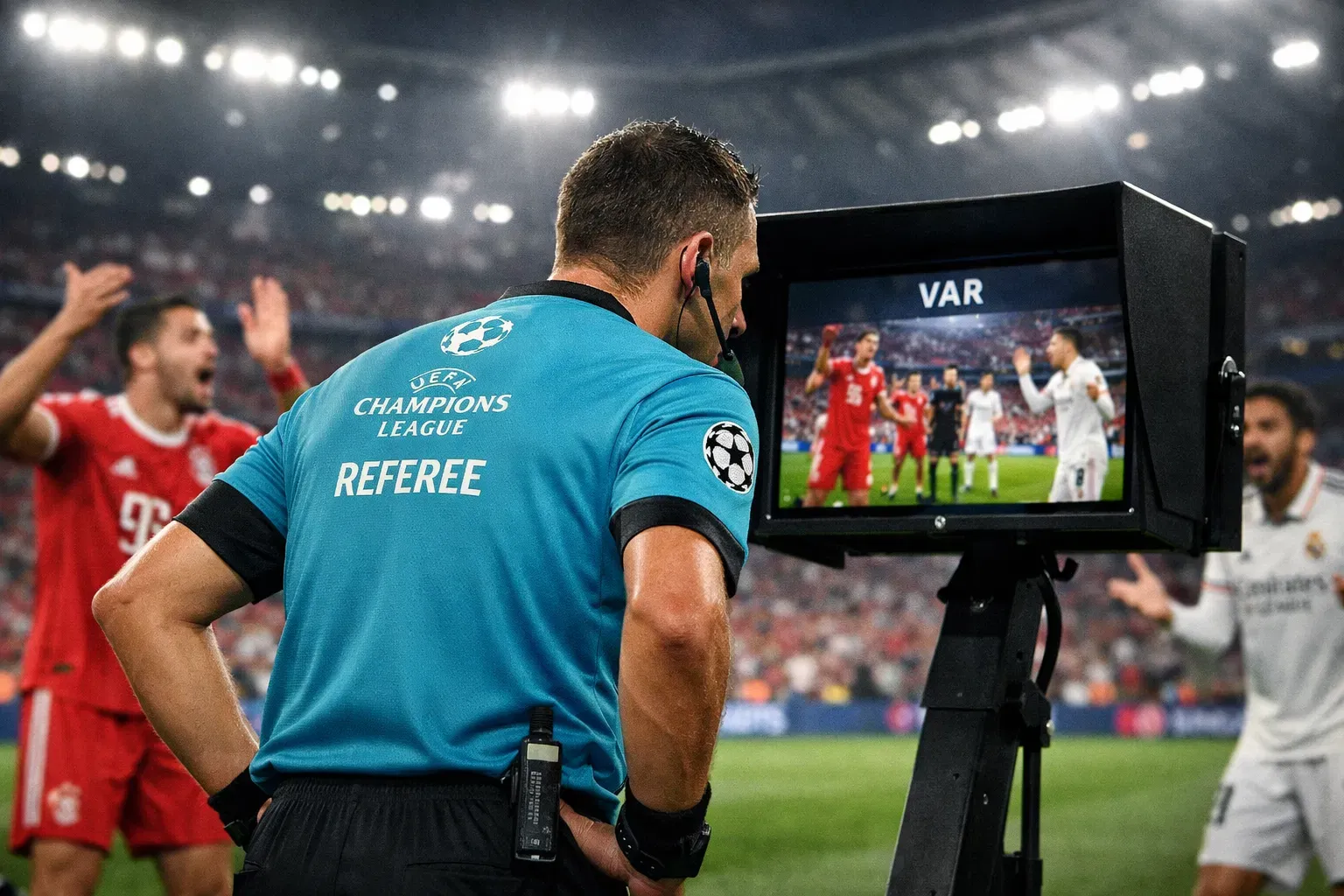
The Allianz Arena is ready for another European night, but the conversation has already swerved away from tactics and toward technology. Wednesday, April 15 at 21:00 brings Bayern Munich against Real Madrid with the Spanish giants chasing a 2-1 first-leg deficit, yet the loudest previews are about a Champions League refereeing controversy. UEFA’s appointment of Dutch officials Pol van Boekel as VAR and Dennis Higler as AVAR has triggered instant VAR criticism online. With Slavko Vincic on the pitch, the spotlight is strangely fixed on the screens.
In a tie this tight, every marginal call feels like a potential headline, which is why the Champions League refereeing controversy has landed with such force. Bayern Munich hold the advantage, Real Madrid hold the aura, and both fanbases hold receipts from domestic weekends ruined by officiating debates. The moment Pol van Boekel and Dennis Higler were confirmed in the VAR room, social media moved faster than any counterattack. It’s not just skepticism; it’s pre-emptive anxiety.
The broader issue is how modern Champions League quarterfinals are framed by trust, not just talent. Supporters don’t merely want correct decisions; they want credibility, consistency, and a sense that the biggest games are protected from avoidable noise. That’s why UEFA officiating is being questioned before a ball is kicked, and why VAR criticism is being recycled like a familiar chant. A Champions League refereeing controversy doesn’t need an error to thrive—only doubt.
The backlash is rooted in reputation, and reputation is often built on the clips that go viral rather than the calls that quietly go right. Pol van Boekel has been a lightning rod in the Eredivisie for decisions that fans felt lacked clarity, while Dennis Higler has faced similar criticism for game management and consistency. Those domestic grievances don’t automatically translate to Europe, but they travel online instantly. In this Champions League refereeing controversy, perception is already part of the match.
Slavko Vincic is experienced enough to know that elite refereeing now involves managing two games at once: the one on the grass and the one in the booth. His style tends to allow physical contests, but the VAR layer can interrupt that rhythm with forensic reviews that change a match’s emotional temperature. If Vincic is decisive, the VAR team can become a safety net; if he hesitates, they become the story. That balance is central to this Champions League refereeing controversy.
For Real Madrid, the task is simple to describe and brutally hard to execute: overturn a 2-1 deficit in Munich. That mission usually invites talk of pressing triggers, midfield control, and the famous late-game surge, but the Champions League refereeing controversy is threatening to dominate the narrative. When you’re chasing a tie, you live in the penalty area, and the penalty area is where VAR criticism is born. One tight offside line can erase ten minutes of momentum.
Carlo Ancelotti’s team will likely aim to make the game chaotic in the right moments, forcing Bayern Munich into uncomfortable transitions and second balls. Yet chaos is also where officiating becomes most influential, because the speed of incidents outpaces the human eye. That’s why Champions League quarterfinals have become as much about process as performance, and why UEFA officiating is being scrutinized like a tactical plan. In this Champions League refereeing controversy, Real’s margin for error is thin.
Expect the decisive incidents to cluster around three hotspots: penalty appeals, offside calls on quick breakaways, and the grey-zone contact that sits between “play on” and “foul.” Real Madrid’s forwards thrive on darting runs, while Bayern Munich’s wide threats force defenders into last-ditch challenges. VAR exists to correct the clear mistakes, but it also magnifies the subjective. In a Champions League refereeing controversy, the definition of “clear and obvious” becomes a battleground.
Bayern Munich’s best defense against controversy is control: longer spells of possession, fewer desperate tackles, and smarter game management when Real Madrid start chasing. Teams that dominate territory tend to reduce the number of 50-50 box incidents, which are the oxygen for VAR criticism. Bayern can also keep discipline in transitions, where cynical fouls invite cards and reviews. In Champions League quarterfinals, composure is a tactical weapon and a public-relations shield.
UEFA’s appointments are meant to reassure, but this one has done the opposite, turning a marquee night into a referendum on standards. The Champions League refereeing controversy is less about nationality and more about confidence: fans want the very top officials in the VAR room, not names associated—fairly or not—with domestic complaints. When supporters feel they’ve seen the same mistakes before, they assume history is about to repeat itself. That’s why UEFA officiating has become the pre-match storyline.
The irony is that VAR was introduced to reduce injustice, yet it has expanded the space for argument. Decisions now come with an invisible trail of communication, angles, and protocols that fans can’t fully access in real time. That opacity breeds suspicion, especially when a match already carries narrative weight like Bayern Munich vs Real Madrid. In Champions League quarterfinals, every delay feels like a plot twist. The Champions League refereeing controversy is ultimately about transparency as much as accuracy.
UEFA’s ideal VAR performance is almost boring: quick checks, minimal interruptions, and only the most obvious interventions. But football rarely cooperates, particularly when elite attackers manipulate space and defenders gamble on timing. The more complex the incident, the more likely VAR criticism will follow, even if the final call is technically correct. That’s the paradox UEFA officiating faces: precision can look like hesitation. In this Champions League refereeing controversy, the process will be judged as harshly as the outcome.
Supporters have learned that “correct” doesn’t always feel “fair,” especially when similar incidents are interpreted differently across leagues and rounds. The semi-automated offside era has reduced some disputes, but handball, contact, and “interfering with play” remain subjective and emotional. Add the delay of reviews, and the stadium’s energy turns into frustration. In Champions League quarterfinals, that frustration becomes a narrative weapon online. The Champions League refereeing controversy thrives in the gap between law and feeling.
The modern match begins on X, Instagram, and fan forums long before the teams arrive at the ground, and this appointment has been treated like a breaking-news scandal. Posts cataloguing past Eredivisie incidents—some accurate, some exaggerated—have circulated with the certainty of scouting reports. The Champions League refereeing controversy is being built in real time through screenshots, clips, and sarcasm. When fans feel unheard, they shout louder, and algorithms reward the loudest takes.
What’s striking is how quickly the focus shifts from “will they do well?” to “what will they do wrong?” That mindset creates a hostile environment for any official, because every call is interpreted through a lens of suspicion. Even routine VAR checks can be framed as evidence of incompetence or bias. In a tie involving Real Madrid and Bayern Munich, the global audience is massive, and so is the appetite for outrage. The Champions League refereeing controversy is, in part, a social-media event.
Dutch refereeing discourse is famously intense, and both Pol van Boekel and Dennis Higler have been in the crossfire of debates about consistency and communication. Whether those critiques are fully justified is almost irrelevant once they become part of a public profile. Fans in other countries adopt the narrative because it fits the broader skepticism around VAR. In Champions League quarterfinals, reputations travel faster than facts. That dynamic is fueling this Champions League refereeing controversy.
All it takes is a freeze-frame that looks wrong, even if it’s misleading, and the match becomes a courtroom. Viewers clip the moment, add a caption, and the debate is instantly international, with Bayern Munich and Real Madrid supporters arguing in parallel universes. VAR criticism often grows because fans see different angles, different broadcasts, and different explanations. Without a shared reference point, consensus is impossible. That’s why the Champions League refereeing controversy can explode from a single replay.
Strip away the noise and this is still a heavyweight tactical battle, with Bayern Munich trying to protect a lead without inviting siege, and Real Madrid needing goals without losing control. The Champions League refereeing controversy adds a subtle psychological layer: players may hesitate in challenges, attackers may exaggerate contact, and benches may lobby more aggressively. In other words, officiating becomes a tactical variable. Champions League quarterfinals are already thin-margin games; this makes them thinner.
Expect Bayern to lean on structured pressing and controlled possession phases to keep Real Madrid from building sustained waves. Real, meanwhile, may seek to isolate defenders in wide areas and force footraces toward the box, where a slight touch can become a major incident. That’s where VAR criticism becomes strategic, because teams know which situations trigger reviews. Coaches won’t say it publicly, but they plan for it. The Champions League refereeing controversy is influencing how risk is calculated.
Discipline is going to matter, because early yellow cards change how defenders engage in duels and how attackers choose their moments. If Slavko Vincic sets a strict threshold, the match can become stop-start, increasing the number of set pieces and, with them, grappling incidents that VAR loves to inspect. Bayern Munich may try to slow the tempo at key moments, while Real Madrid will push to speed it up. In this Champions League refereeing controversy, tempo control is also controversy control.
Corner kicks are where modern football’s rulebook feels most strained, with constant shirt pulls and blocks that rarely get punished consistently. VAR can advise on obvious holding, but officials are reluctant to award multiple penalties for the same behavior that happens every match. That inconsistency is a core driver of VAR criticism, because fans can always find a similar incident that was treated differently. In Champions League quarterfinals, one set-piece decision can define a season. The Champions League refereeing controversy will hover over every corner.
UEFA sells the Champions League as the sport’s most polished product, and credibility is part of the brand. When a Champions League refereeing controversy dominates the build-up, it risks undermining the sense that the competition is decided purely by excellence. That doesn’t mean the officials will perform poorly, but it does mean they are being asked to win back trust in real time. For Bayern Munich and Real Madrid, the fear is that a great tie becomes remembered for an intervention.
The stakes extend beyond this one night because Champions League quarterfinals shape legacies, budgets, and managerial futures. A controversial decision can change not only who advances, but also how the sport is discussed for weeks afterward. VAR criticism often becomes a proxy for deeper frustrations about modern football, from delays to the feeling that spontaneity is being drained. UEFA officiating is now part of the entertainment package, whether it wants to be or not. This Champions League refereeing controversy is a test of governance as much as judgment.
The ideal outcome is simple: a clean game, quick checks, and no major interventions, leaving the headlines to the goals and the tactical swings. If Pol van Boekel and Dennis Higler have a quiet night, the pre-match anger will look premature, and UEFA officiating will feel vindicated. Fans rarely praise officials, but silence can be a form of approval. In Champions League quarterfinals, “invisible” is the highest compliment. That would deflate the Champions League refereeing controversy instantly.
The nightmare scenario is also easy to imagine: a marginal offside, a disputed handball, or a penalty given after a long review, with replays that never fully settle the argument. In a tie featuring Real Madrid, every controversy becomes part of European mythology, and Bayern Munich have their own history of nights defined by fine margins. That’s how VAR criticism becomes permanent, not temporary. If it happens, UEFA officiating will face another wave of scrutiny. The Champions League refereeing controversy would outlast the season.
All of this leaves the match in a strange place, where anticipation and apprehension are sharing the same seat. Real Madrid must chase the deficit with bravery, Bayern Munich must manage the tie with intelligence, and Slavko Vincic must referee with authority while trusting Pol van Boekel and Dennis Higler to support rather than overshadow him. If the football is brilliant, the noise may fade, but the Champions League refereeing controversy has already framed how millions will watch. On a night this big, the smallest decision can feel like the loudest moment.

Julian Mercer is a lifelong student of the game whose passion for football was sparked at an early age, after stepping onto the grass of Camp Nou as a six-year-old — a moment that left a lasting impression and set him on a permanent path into the sport. Since then, football has been both his lens on the world and his favourite language. Blending traditional fandom with a deep interest in tactics, squad building, and long-term team development, Julian has spent decades analysing the game from every angle. His fascination with football strategy was further shaped through years of immersive play in Football Manager, a series he has followed since the mid-1990s, developing a sharp eye for patterns, player profiles, and the fine margins that define success. At My World Of Football, Julian focuses on the stories beneath the surface — from tactical evolutions and managerial philosophies to the narratives that connect clubs, players, and supporters across generations. His writing aims to balance insight with accessibility, always grounded in a genuine love for the game.
Continue reading more football news