Myworldoffootball
Chelsea Premier League loss hits record £262m in 2024/25
Chelsea Premier League loss reaches £262m, a record. Inside the Chelsea financial report, transfer spending, UEFA fine, and UCL qualification risk.
Chelsea Premier League loss reaches £262m, a record. Inside the Chelsea financial report, transfer spending, UEFA fine, and UCL qualification risk.
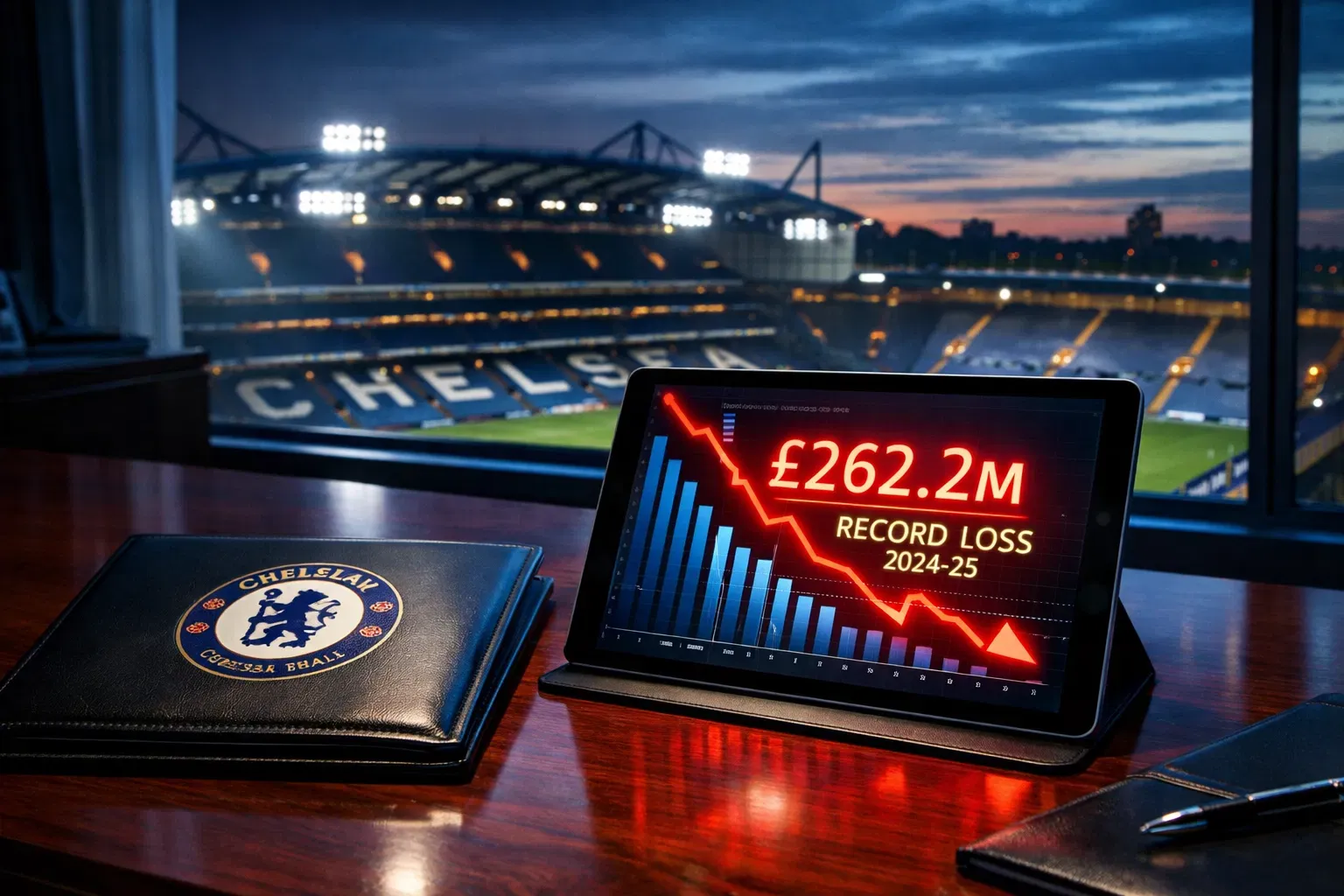
Chelsea’s latest accounts landed like a thud in the middle of a tense run-in: a Chelsea Premier League loss of £262 million for 2024/25, the biggest deficit the league has ever seen. It eclipses Manchester City’s previous record of £197.5 million from 2011, and it arrives while the team sits sixth under Liam Rosenior, eyeing a Champions League lifeline. The twist is that the Chelsea financial report also shows a huge turnover, proving the club is earning plenty even as it bleeds cash.
The scale of this Chelsea Premier League loss is not just a grim club record; it is a Premier League benchmark that resets the conversation about modern spending and sustainability. When a club can post a £262 million deficit in a single season, it forces rivals, regulators, and fans to ask what the real limits are. It also reframes the “big six” safety net, because even global brands can stumble when costs outrun revenue.
What makes the Chelsea Premier League loss particularly jarring is the contrast with the club’s commercial strength and matchday pull. Chelsea generated £490.9 million in revenue, their second-highest turnover ever, which would normally read like a success story in any Chelsea financial report. Yet wages, amortisation, agent fees, and the sheer churn of squad building can turn that income into a footnote. The result is a deficit that feels structural rather than accidental.
Manchester City’s £197.5 million loss in 2011 came during the early, chaotic acceleration of their project, when spending surged ahead of football infrastructure and commercial maturity. Chelsea’s situation is different: this Chelsea Premier League loss has arrived in an era of sophisticated revenue streams and a globalised sponsorship market. That is why it shocks, because it suggests even “mature” giants can post historic Premier League losses. It is less about infancy and more about strategy.
Supporters often treat finances as background noise until points deductions or transfer bans appear, but the Chelsea Premier League loss connects directly to squad planning and competitive rhythm. A club under pressure may sell earlier, negotiate harder, or avoid short-term fixes that once felt easy. The fear is not bankruptcy; it is drift, where constant recalibration undermines a coherent build. In a tight league, that can be the difference between fourth and sixth.
The Chelsea financial report is a reminder that revenue alone does not guarantee stability, especially when cost growth is baked into the model. Chelsea’s £490.9 million turnover underlines how strong the brand remains, from commercial deals to matchday income and media rights. Yet the Chelsea Premier League loss shows the other side of the ledger, where long contracts and high fees create fixed obligations. In simple terms, the club is earning big and spending bigger.
This is where the debate about “good losses” versus “bad losses” becomes relevant for Premier League losses in general. Some deficits are tied to one-off investments, while others signal recurring overspend that can’t be patched by a new sponsor. Chelsea’s numbers feel closer to the second category, because transfer amortisation and wage commitments repeat each year. The Chelsea Premier League loss therefore reads like a warning that the current cost base is too heavy for the performance level.
Chelsea’s revenue profile still looks like that of an elite club, with commercial income doing heavy lifting even when the team is not in a title race. That’s why the Chelsea financial report can boast a second-highest turnover while the league table feels underwhelming. Stamford Bridge remains a draw, broadcast money remains significant, and sponsor interest persists due to global visibility. But revenue growth is incremental, while costs can spike overnight.
The public often focuses on transfer fees as single events, yet the accounting reality is that big signings become long-term expenses through amortisation. When Chelsea commit huge sums to players, those costs sit on the books year after year, regardless of form or fitness. Add wages, bonuses, and agent fees, and the Chelsea Premier League loss becomes easier to understand. It is not just spending; it is spending that keeps charging rent.
Since the BlueCo takeover, Chelsea transfer spending has crossed the €1 billion mark, a figure that sounds like a flex until it becomes a burden. The club has gambled on volume, age profile, and resale logic, but the pitch still demands immediate cohesion. That is why the Chelsea Premier League loss is inseparable from recruitment choices, because each signing is both a sporting bet and an accounting commitment. When results lag, the model looks harsher.
Enzo Fernández and Moisés Caicedo embody the new-era gamble: premium fees for young midfielders expected to define a cycle. Their talent is obvious, yet the price tags create a narrow corridor where “good” seasons are not enough; they must be transformational. Wesley Fofana’s situation is even more delicate, because injuries can turn a strategic purchase into dead cost. In that context, the Chelsea Premier League loss reflects not just spending, but risk concentration.
Fernández arrived as a symbol of ambition, but statement signings carry statement expectations in both performance and optics. If the team is sixth, every sideways pass gets measured against the fee, and every financial headline becomes personal. The Chelsea Premier League loss amplifies that scrutiny, because fans connect the deficit to the player they see every week. It is unfair on the footballer, but unavoidable in modern discourse.
Caicedo was recruited to stabilise Chelsea’s midfield for years, yet the Premier League punishes bedding-in periods, especially when European places are on the line. Fofana’s injuries highlight the silent hazard: availability is value, and unavailability is a cost without return. When those risks stack up across a large squad, Premier League losses can balloon quickly. The Chelsea Premier League loss is, in part, the bill for volatility.
The €31 million UEFA fine Chelsea must pay for breaching financial regulations adds an external stamp to the internal pain of the Chelsea Premier League loss. Fines are not just about money; they are about reputation and future scrutiny, because clubs under the microscope lose flexibility. For Chelsea, it means every future accounting choice will be judged through the lens of compliance. The fine also underlines that the club’s approach has real limits set by governing bodies.
In practice, the UEFA fine Chelsea received can influence negotiations in the market, because counterparties sense urgency. Selling clubs know when a buyer needs to balance books, and agents know when a club wants to preserve wage structure. That makes it harder to execute clean exits for fringe players, which is often the quickest way to reduce costs. The Chelsea Premier League loss, combined with a UEFA sanction, creates a squeeze that demands smarter trimming.
UEFA’s modern framework is designed to stop clubs from endlessly outspending their football-generated income, even if owners are willing to cover gaps. A €31 million penalty is significant, but the more important point is that it reflects a judgment: Chelsea’s current path has crossed a line. When the Chelsea Premier League loss is already historic, the optics of being fined intensify pressure on executives. It tells everyone that the era of “we’ll fix it later” is shrinking.
Sanctions rarely force immediate squad dismantling, but they can nudge clubs toward different behaviours, like prioritising sales, lowering wage offers, or avoiding certain fee structures. Chelsea’s recruitment has leaned on long contracts, which can spread costs but also lock in obligations. With the Chelsea Premier League loss dominating the narrative, the club may need to be more ruthless about moving on expensive depth. That could mean more loans, more academy minutes, and fewer luxury signings.
The timing is brutal: the Chelsea Premier League loss arrives while the team sits sixth, meaning Champions League qualification is not guaranteed. That matters because Champions League revenue is not a bonus anymore; it is a pillar that many elite budgets quietly assume. Missing out can create a second-order deficit, where the next season starts behind before a ball is kicked. For Chelsea, the financial story and the league table are now tightly linked.
Liam Rosenior’s job becomes more complicated in this environment, because every tactical decision is judged through the lens of opportunity cost. Dropping points is no longer just a football problem; it is a revenue problem, a compliance problem, and a squad-planning problem. The Chelsea financial report is effectively a countdown clock, pushing the club toward immediate competitiveness. The Chelsea Premier League loss turns “top four race” into “top four necessity.”
Champions League qualification affects matchday income, broadcast distributions, sponsorship bonuses, and the club’s ability to attract players who want the biggest stage. It also helps justify a wage bill built for elite competition, not Thursday nights or domestic-only schedules. When a Chelsea Premier League loss is already record-setting, losing that revenue stream can force uncomfortable decisions. That might include selling a starter rather than a surplus player, which changes the sporting plan.
Rosenior is trying to build patterns and trust in a squad that has been constantly reshaped, but the league does not pause for long-term projects. He needs points quickly, yet he also needs a style that can survive pressure and travel to hostile grounds. The Chelsea Premier League loss heightens the tension, because “progress” without qualification may not pay the bills. In that sense, his tactical identity is being audited like a spreadsheet.
After a Chelsea Premier League loss of £262 million, the next steps are less about panic and more about precision. The club must decide which costs are essential to winning and which are simply legacy of an overstuffed squad. That means clearer pathways for young players, tougher choices on renewals, and a sharper approach to sales. A reset does not have to mean retreat, but it does require coherence that has often been missing.
There is also a messaging challenge, because fans can accept a plan when the plan feels honest. If the club frames the Chelsea Premier League loss as a one-off while continuing the same behaviours, trust erodes quickly. But if Chelsea show discipline—targeted recruitment, fewer gambles, smarter contract lengths—the narrative can shift from “reckless” to “recalibrated.” The Premier League is full of cautionary tales, yet it also rewards clubs that learn fast.
To respond credibly, Chelsea will need to improve player trading outcomes, turning surplus talent into real fees rather than endless loans. Wage control matters too, because wages are the most stubborn cost and the hardest to cut without sporting sacrifice. Academy minutes can help, not as a PR line but as a genuine way to lower squad costs while keeping intensity high. The Chelsea Premier League loss makes these levers non-negotiable.
It is possible to read the Chelsea Premier League loss as the bottom of a cycle, especially if the club’s revenue base remains strong and the squad contains genuine elite pieces. If Fernández and Caicedo become the spine, and if Fofana can stay fit, the on-pitch value can finally match the investment. The club also has the pull to recover quickly with Champions League qualification. But the margin for error has narrowed dramatically.
Chelsea’s accounts tell a story with two truths: the club is still a commercial heavyweight, and it has also produced the most extreme Chelsea Premier League loss the league has recorded. The next few months will decide whether this is remembered as the painful cost of a messy rebuild or the moment the model demanded change. With a UEFA fine hanging over them and Champions League qualification uncertain, Chelsea’s football now has to match its spending. For fans, the hope is simple: fewer headlines, more harmony, and wins that finally balance the books.

Julian Mercer is a lifelong student of the game whose passion for football was sparked at an early age, after stepping onto the grass of Camp Nou as a six-year-old — a moment that left a lasting impression and set him on a permanent path into the sport. Since then, football has been both his lens on the world and his favourite language. Blending traditional fandom with a deep interest in tactics, squad building, and long-term team development, Julian has spent decades analysing the game from every angle. His fascination with football strategy was further shaped through years of immersive play in Football Manager, a series he has followed since the mid-1990s, developing a sharp eye for patterns, player profiles, and the fine margins that define success. At My World Of Football, Julian focuses on the stories beneath the surface — from tactical evolutions and managerial philosophies to the narratives that connect clubs, players, and supporters across generations. His writing aims to balance insight with accessibility, always grounded in a genuine love for the game.
Continue reading more football news