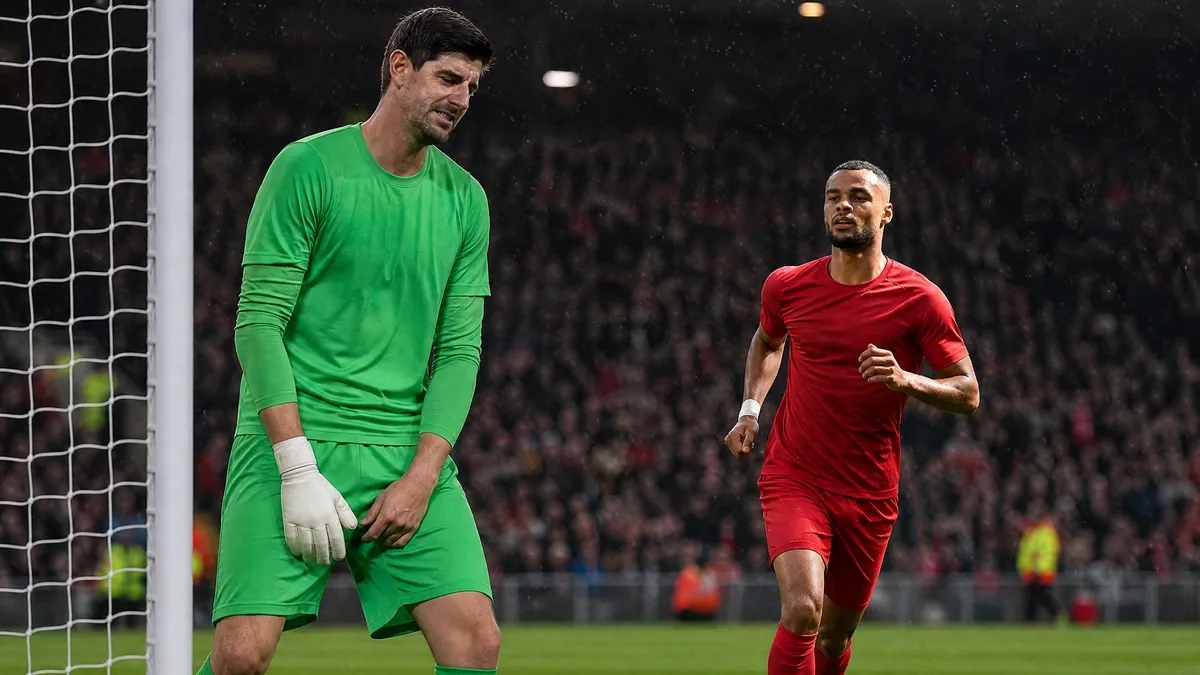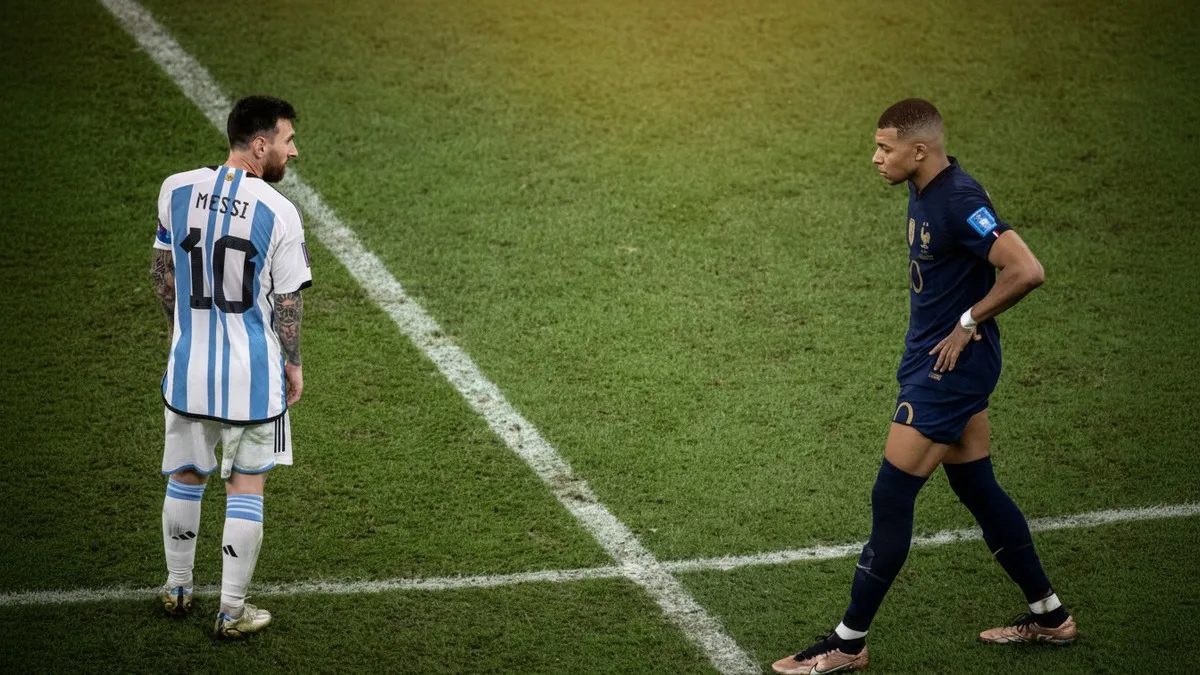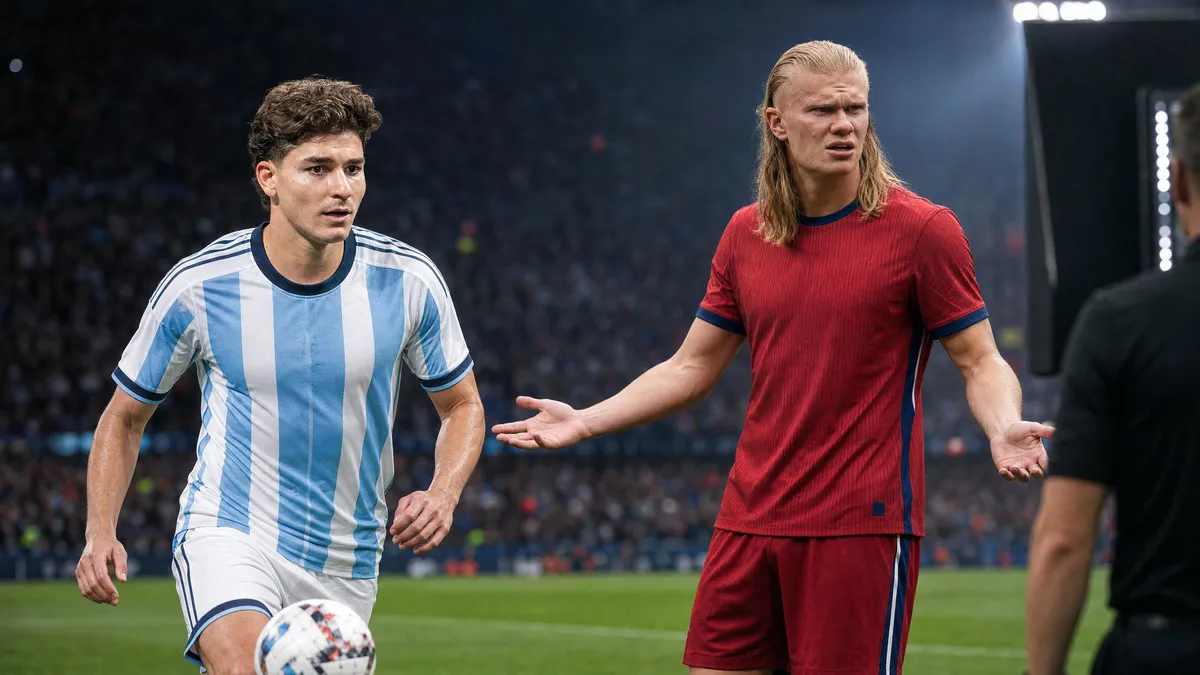
AI-generated image
Football News Today: Arsenal's Alvarez Push and Haaland
Arsenal chase Julian Alvarez, while Haaland's VAR drama leaves Norway feeling robbed. Plus, Kane's transfer updates and Messi's personal World Cup clash.
Arsenal chase Julian Alvarez, while Haaland's VAR drama leaves Norway feeling robbed. Plus, Kane's transfer updates and Messi's personal World Cup clash.
Hey there, football fans! It's a busy day in the world of football. Arsenal is making serious moves for Julian Alvarez, while Haaland is in the spotlight after a controversial VAR decision in Norway's clash with England. Over in La Liga, Lamine Yamal is shining bright, and Messi is gearing up for a massive semi-final showdown against England. Let’s dive into the latest updates from the Premier League, La Liga, and beyond.
Julian Alvarez transfer news is moving fast because Arsenal want this wrapped before pre-season, not dragged into August chaos. It makes sense. Arteta’s attack needs another top-level finisher who can play through the middle or off a striker, and Alvarez ticks both boxes. Atletico shutting the door on Barcelona and Real Madrid also changes the market. It funnels serious bidders toward the Premier League.
The World Cup stuff matters too, not just for the highlight reel. That extra-time winner against Switzerland was a proper pressure moment, and you could see how he handles tight games when legs are gone and brains are fried. Arsenal have had spells where they dominate but do not land the killer blow. Alvarez is the type who keeps his shot selection simple and stays involved when the game gets messy.
The problem is the price. Atletico asking for over £100m is classic “we don’t need to sell” positioning, and Arsenal’s reluctance to go past £90m is sensible given PSR and the rest of the squad build. The gap is not huge in modern terms, but it is big in principle. Add-ons tied to trophies and appearances feels like the obvious bridge, especially if Atletico want cash up front.
Andrea Berta leading talks is the interesting twist in the Arsenal transfer news cycle. He knows how Atletico negotiate because he’s lived it, and that can save weeks of posturing. He’ll also know which levers matter there: timing, replacement planning, and face-saving language. The World Cup schedule complicates logistics and medicals, and it also explains why Arsenal are looking at Morgan Rogers as a separate move. Depth deals can’t wait for one superstar saga to end.
If Arsenal get Alvarez in early, it changes the whole pre-season. Arteta can build patterns with him from day one, not bolt him on later. But Atletico won’t blink easily, and Arsenal should not panic-buy. The best outcome is a deal that lands just under that nine-figure line, with incentives that only hurt if Alvarez fires them to titles. That’s the point.
Norway going out 2-1 to England in a World Cup quarter-final should have felt like a proper coming-of-age moment. Instead it’s got that sour taste, because the talking point isn’t Jude Bellingham’s control or England’s game management. It’s the Haaland VAR controversy, and how one decision can flip a night from heroic to hollow for a whole squad.
The disallowed Torbjorn Lysaker Heggem goal is the kind that drives players mad because it’s not a clear “got it wrong” or “got it right” moment. It lives in that grey area VAR was meant to clean up, but often just magnifies. Haaland’s contact on Elliot Anderson looked like normal box traffic, especially in a knockout game where you expect a higher bar for intervention.
That’s why Haaland’s “bitterness and emptiness” line lands. He carried Norway with seven goals across the tournament and still ended up talking about refereeing instead of football. That’s brutal for a striker. You can accept missing chances. You can accept getting outplayed. It’s harder when you feel the rulebook changes depending on the minute, the shirt, or the referee’s mood.
Sander Berge’s point about criteria matters too. If that’s a foul in a World Cup quarter-final, then defenders and keepers are going to have a field day winning cheap frees and pens back in the Premier League. The Haaland VAR controversy also highlights a bigger issue: VAR isn’t just about accuracy, it’s about consistency. Norway can be proud of the run, first time back at this stage since 1998, but this exit will sting for years.
Erling Haaland giving Jude Bellingham his flowers after England’s 2-1 win over Norway landed because it felt honest, not polite. When the best striker on the planet is watching you knock his country out, you know the Jude Bellingham World Cup performance has hit a different level. Two goals in a quarter-final is a loud answer to anyone still questioning his end product.
The fun part was how those goals came from a proper all-round game, not just a couple of moments. Bellingham played like England’s tempo-setter, arriving late, nicking second balls, then bursting into the box with that Madrid timing. Thomas Tuchel’s tactics helped too, keeping him close enough to goal without killing his freedom. It turned the England vs Norway highlights into a Bellingham show.
Haaland’s comments also underline something England have not always had in tournament football: a midfielder who can decide matches without needing everything built around him. That is why this Jude Bellingham World Cup performance matters beyond the brace. He is doing the hard stuff and the headline stuff. And he did it while staying disciplined, managing the ref and avoiding the booking that would have ruled him out next.
Now it’s Argentina in the semis, and that is where the Real Madrid star reputation meets proper tournament pressure. Argentina will try to clog the middle and bait him into cheap fouls, because they know his running breaks their shape. If Bellingham keeps the same balance between aggression and control, England’s ceiling rises. Haaland might be out, but his verdict stands: world-class players tilt knockout games.
Harry Kane transfer news always lands with a thud because it is never just about goals. Sir Jim Ratcliffe being keen makes it feel more real, too. United still look like a side building the house before choosing the front door, but Kane is the one striker who changes the whole shape of the conversation. He gives you reliability, leadership, and a game plan.
The Bayern numbers are ridiculous. 146 goals in 147 games is not a hot streak, it is a lifestyle. He has slotted into a new league, new dressing room, new pressure, and made it look like a Sunday kickabout. Add the England World Cup run with six goals and you are talking about a player who delivers when the air gets thin, not just against mid-table sides.
Here is the catch. His contract expires in a year, and that is when the Harry Kane transfer news machine goes into overdrive. Bayern are calm because they think they will extend. They can sell the project, the trophies, and the comfort of a team built to feed him chances. But one year left also means the fee drops and the player holds more cards.
For Manchester United, it is as much about timing as money. Ratcliffe can bankroll a deal, but United also need a coherent attack around him. Kane is not a pure sprinter in behind. He wants runners, wide players who hit the box, and midfielders who can find him early. Get that wrong and you waste a season of elite output.
Tottenham watching from the side is the emotional subplot. A return sounds romantic, but it only works if Spurs are ready to win now and if Kane wants to reopen that chapter. Bayern will push hard for a contract extension, because replacing a striker like this is basically impossible. Next summer feels like the pressure point where everyone shows their hand.
Noussair Mazraoui transfer news is starting to feel like more than idle gossip, mainly because Matteo Moretto has put his name on it. Milan’s interest makes sense in a summer where they need certainty out wide, not another project. United tied Mazraoui down to 2028 with an option, so this only moves if Milan are serious and United are open.
The Amorim angle is the tell. Coaches chase players they trust when they are changing a system, and Milan are expected to lean into a 3-4-2-1. In that shape, wingbacks decide your ceiling. Mazraoui can play as a proper wingback, tuck in as the right-sided centre-back, or just run a back four when games get messy. That flexibility is gold.
From United’s side, this is where squad maths meets style. If they see Mazraoui as a rotation piece rather than a nailed-on starter, a good offer becomes tempting, especially with wages and PSR talk always hovering. But selling him also means replacing two profiles at once: a right-back and a system-proof defender. That is never cheap, and it risks turning Noussair Mazraoui transfer news into a bigger headache.
Milan, though, can sell him a clean role and a clearer league rhythm. Serie A suits defenders who read danger early and can win duels without living on recovery pace. Add his Morocco pedigree and that World Cup run, and you get a player who does not spook on big nights. For now it is still transfer rumors, but the logic is strong enough to watch closely.
Cody Gakpo transfer news is getting louder because it touches two separate truths at Liverpool. One is football logic. He is a high-end forward with a long contract, so he is one of the few assets you can sell without looking like you are panicking. The other is human. The dressing room has been through it, and form dips after tragedy are real, not just a talking point.
The numbers make the market interest easy to understand. Gakpo’s output at Liverpool FC has been strong across different roles, from left wing to a central option when the squad has needed it. That versatility is exactly why a £70m price tag gets floated. He is not a pure touchline winger, not a classic nine, but he can cover both. That matters in a long Premier League season.
Arne Slot also changes the context. Slot wants structure, pressing discipline, and forwards who make repeatable runs rather than living on moments. Gakpo fits parts of that, but he also needs rhythm and confidence to look his best. If Liverpool see him as slightly awkward in the new attacking balance, that is when the transfer market starts to feel like an opportunity rather than a risk.
Tottenham Hotspur being linked makes sense on the pitch. Spurs have looked for a forward who can play off the left, arrive in the box, and still link play when the game gets messy. Gakpo can do that, and his PSV Eindhoven background suggests he can handle coaching detail. But Spurs would be paying for certainty. With a deal to 2030, Liverpool can hold their nerve, and that is why Cody Gakpo transfer news could drag on.
The Diogo Jota factor is the part people need to treat carefully. If Gakpo’s level dipped after losing a teammate, that is not a weakness to exploit in negotiations. It is a reminder that players are people first. Any move, whether it happens this summer or not, has to be about a clean reset and a stable plan, not just a big fee headline.
The funny thing about Lamine Yamal motivation is that it can come from anywhere. This time it is a nudge from Ines Garcia on Instagram, with a cheeky Justin Bieber hook: win the semi, get to the final, see Bieber perform. It sounds light, but big tournaments run on little sparks. Spain are close enough to smell it, and every edge matters now.
Spain v France on July 19 is not about vibes, though. It is about whether Spain can keep their nerve when France start landing those heavy counterpunches. Yamal is still the release valve. When Spain get pinned in, he is the one who can turn a dull pass into a sprinting attack. That is why Lamine Yamal motivation becomes a talking point. He carries a lot for a teenager.
The Euro 2024 memory adds spice. Yamal’s goal against France was not just a highlight, it was a statement that he can decide games against elite blocks. France will have learned. They will show him two bodies, force him inside, and try to make Spain play in front of them. Spain’s midfield has to keep feeding him early, before the trap closes. That is the tactical key.
Then there is FIFA’s new halftime show angle. A Super Bowl-style break with Bieber at the final, plus names like Shakira and Madonna, is FIFA leaning hard into pop culture in soccer. It will grab casual viewers, sure, but it also risks turning the final into an event that distracts from the match. For Spain, the best response is simple: make it about football.
If Spain do reach the final, it is hard not to see Yamal as the face of it, even with older leaders around him. Lamine Yamal motivation from Garcia is a fun headline, but the real fuel is history. Spain have not lifted it since 2010. Beat France, and the whole country starts believing again.
Spain beating Belgium 2-1 felt like one of those nights where the scoreline barely explains the mood. Lamine Yamal performance was the story even without the easy headline numbers. He kept Spain on the front foot, dragging defenders wide, forcing cover shifts, and making Belgium defend facing their own goal. Man of the Match made sense if you watched the patterns, not just the box score.
The stats back up the eye test. Four completed dribbles is not just flair, it is territory and stress on a back line. His 0.33xA tells you he created a couple of proper chances, the kind that should turn into goals if the final touch is cleaner. Spain’s right side looked more alive whenever he received early and drove inside, pinning full-backs and opening the half-space for runners.
Still, Azpilicueta’s comments hit the truth that always follows a winger like this. Influence is great, but tournaments get decided by moments. Lamine Yamal performance is now being judged like a senior star, not a kid, because Spain are relying on him to tilt games. If he beats his man and the move dies with a safe pass, it feels like a missed opportunity, even if the structure stays intact.
France in the semi-final is the perfect storm for that debate. They will likely defend deeper, with quicker recovery runs and fewer cheap transitions to run into. That means Yamal’s dribbling skills have to come with ruthless choices: early release when the lane opens, or the final ball that actually cuts the line. Another big Lamine Yamal performance without goals or assists might not be enough when margins tighten and one chance decides everything.
The Kylian Mbappe injury update is basically the difference between France feeling like favourites and France feeling like they are hanging on. Seeing him come off against Morocco with ice on his ankle set off all the usual alarms, because his game is built on that first five metres. The new clips of him laughing with the group matter, not as proof he is 100%, but as a sign he is moving freely.
Deschamps sounded relieved, and that is telling. He is normally careful with wording, especially this deep in a tournament, so any hint of comfort is news. Still, a positive Kylian Mbappe injury update does not mean France will throw him into every sprint duel from minute one. Spain will try to overload his side, force him to track runners, and make that ankle work in awkward angles rather than straight-line bursts.
There is also the wider context: eight goals, level with Messi in the Golden Boot race, and he is sniffing a 21st World Cup goal. That chase is real, but France cannot play like it is a personal tally. Spain’s structure punishes impatience. If Mbappe is even slightly limited, France may need more combination play, more underlaps, and more set-piece threat, so he can pick moments instead of living on transitions.
Thierry Henry turning up at the hotel is a smart lift because it frames the moment properly. Henry can talk about pressure without dressing it up, and he knows what it feels like when a semi-final becomes the whole story. The France vs Spain semi-final is about control as much as talent. If this Kylian Mbappe injury update holds, France can still dream of a third straight final, but they will need discipline to match the mood.
The Marcos Leonardo Ajax transfer feels like a proper statement after a season where everything looked a bit small and reactive in Amsterdam. Fabrizio Romano saying it is basically lined up tells you this is not just agent noise. Jordi Cruijff clearly wants a striker you can build around, not another short-term patch. A deal to 2031 screams plan, not panic.
The fee talk matters because Ajax have to win twice here: on the pitch and on the balance sheet. If it lands closer to €19m, it is classic Ajax value hunting. If it is €25m, it is still defensible if they think he is a Champions League-level finisher. Either way, this is a bet that goal output will travel, not just highlights.
Leonardo’s numbers are the hook, but the context is what makes it interesting. He has scored everywhere, and he is still young enough to improve his movement and decision-making in a more structured league. Ajax will ask him to press, link, and live with fewer transition chances than he might have had. If he buys into that, the upside is huge.
The timing also fits the squad churn. With Wout Weghorst gone, Ajax needed a focal point, not another stopgap. Kasper Dolberg’s situation stays murky and Don-Angelo Konadu is still more promise than guarantee, so the Marcos Leonardo Ajax transfer plugs a very real hole. The medical is the last box, but the bigger test is whether Ajax can finally build a stable attack around him.
Jude Bellingham World Cup performance is starting to feel like England’s safety net and their spark, all at once. Two goals to beat Norway 2-1 in the quarter-finals is the headline, but the bigger point is how he keeps showing up when games get sticky. England did not cruise. They had to dig in, suffer a bit, then trust their best player to tilt it.
Thomas Tuchel’s post-match tone mattered. He praised the effort, but he was right to flag the technical level. England still go through spells where the ball sticks, the first touch gets heavy, and attacks turn into hopeful moments rather than controlled pressure. Against Norway you can survive that if you have Bellingham bailing you out. Against Argentina, those loose phases become turnovers and counters.
The other number that jumps off the page is Bellingham and Harry Kane combining for 12 of England’s 13 tournament goals. That is brilliant and slightly worrying. It tells you the big lads are delivering, but it also screams dependency. If Kane gets boxed in or Bellingham gets man-marked, where does the next wave come from? England need runners from wide areas and midfielders arriving on time, not just watching.
Bellingham’s Instagram post, nodding to Ted Lasso’s “Believe”, landed because it matched what we saw. This team has had to win ugly at times, stay calm late, and keep trusting the plan. Jude Bellingham World Cup performance has become the emotional cue as well as the tactical one. The semi-final feels like the real exam. Argentina will press smarter, manage moments better, and they will punish sloppy touches.
Messi calling this “special” lands because the Messi Argentina vs England semi-final is weirdly new territory for him. He has done everything, but somehow never faced England in a competitive international match. Now it happens in Atlanta, with a World Cup 2026 final on the line and the old rivalry humming in the background. It is not nostalgia for its own sake. It is a proper football moment.
Argentina’s 3-1 over Switzerland looked comfortable on the scoreline, but it was one of those games where the tempo keeps snapping back at you. Messi’s eight goals have come with that familiar mix of patience and sudden cruelty, but the bigger thing is how Argentina spread the damage. Julián Álvarez and Lautaro Martínez scoring again matters. It means teams cannot just build a cage around Messi and hope.
England’s 2-1 against Norway felt more like a survival test. They gave up phases of control, then found clarity when it counted. Jude Bellingham is the headline because he drags games into his rhythm, even when England look a bit stuck. The question for the Messi Argentina vs England semi-final is whether England can keep him facing his own goal, or if he gets to turn and run at Argentina’s midfield screen.
History always creeps in with Argentina and England. Maradona in 1986 still sits in the room, even if nobody wants to talk like it decides anything. Messi is not chasing that exact myth, but he is chasing the feeling of owning a stage that used to belong to someone else. If England make it physical and messy, Argentina must stay calm. If it opens up, Messi vs England could become the tournament’s defining image.
Jude Bellingham World Cup performance has gone past “talented kid” territory and into proper leadership, and not just because he’s piling up goals. Two against Norway to take him to six, level with Harry Kane, is the easy bit to clock. The interesting bit is how he’s managing games: when to slow it down, when to carry it, when to bite his tongue.
That yellow-card detail matters more than people think. Knockout football turns on tiny swings, and Bellingham plays in the zone where refs love to make statements. His mum drilling discipline into him sounds simple, but it’s basically risk management. England need him available and calm, because he’s the one who can switch a messy spell into a 30-yard surge or a clever third-man run.
Thomas Tuchel having a moan after a win is classic tournament management. He’s not wrong either. England have looked a bit stretched when the press breaks, and the midfield can get pulled into sprints they do not want. That’s where Jude Bellingham World Cup performance becomes a barometer. If he starts chasing fights, England’s shape goes. If he stays composed, he drags everyone back into structure.
Now it’s England vs Argentina, and the whole thing gets spikier. Argentina will try to provoke, slow the tempo, and make it about moments and nerves. Bellingham’s mental resilience is not a fluffy talking point here, it’s the difference between playing your football and playing the occasion. If he keeps picking smart duels and arriving in the box like he did versus Norway, he’s a Golden Ball contender, simple as.
Argentina’s 3-1 extra-time victory over Switzerland felt like a proper World Cup quarter-final, the kind where the temperature rises with every stoppage. The Messi referee confrontation with Joao Pedro Pinheiro summed up the mood. It was not theatre for the cameras. It was a captain telling a match to settle down and be taken seriously, because fine margins decide titles.
The flashpoint came at a set-piece, with Switzerland doing the usual dark arts: nudges, delayed distances, little chats around the ball. Messi stepped in and demanded respect, and Pinheiro looked like he did not love being challenged. That Messi referee confrontation mattered because it changed the dynamic. Argentina stopped waiting for protection and started imposing themselves, quicker restarts, sharper movement, less pleading.
On the pitch, this was also about Argentina’s depth and clarity when the game got messy. Julian Alvarez’s goal was classic pressure football, sniffing out the second ball and finishing before Switzerland could reset. Lautaro Martinez then did what elite strikers do in extra time: attack the space when legs go heavy, make the run early, and finish without overthinking. That’s how you turn tension into separation.
Messi’s leadership is not just the passes and the pauses anymore. It’s the way he manages moments, even when it risks a booking. You could see younger players take cues from him after the Messi referee confrontation, playing on the front foot rather than waiting for the whistle. That edge is useful now, because the semi-final against England will be a battle of control, not chaos.
England will watch this and note two things. First, Argentina can suffer and still find goals late, which is a nightmare in knockout football. Second, if the referee line feels soft, Messi will test it early. Pinheiro did not break the match, but he did get dragged into it. In the next one, Argentina will try to set the tone again.
Gianni Infantino saying FIFA will explore a 64-team World Cup proposal for 2030 lands with a thud because we have not even seen 48 teams yet. 2026 is already a big structural change, with more games, more logistics, and more chances for uneven groups. So pushing again feels less like a football decision and more like FIFA testing how far the dial can turn.
The sales pitch is simple: more nations qualify, more governments invest, and football spreads. That part is not fake. Qualification can be brutal in Africa and Asia, and a first World Cup can genuinely change a federation’s funding and attention at home. But the 64-team World Cup proposal risks turning the finals into a second qualification phase, where half the matches feel like warm-ups.
UEFA’s Aleksander Ceferin and others worry about quality, and they have a point, but it is not just snobbery. Tournament prestige comes from scarcity and jeopardy. Add too many teams and you stretch the gap between elite and developing sides across more fixtures. You also create more dead rubbers, more cautious football, and more opportunities for big teams to rotate through early rounds without breaking sweat.
2030 complicates everything because it is the centenary edition, with Morocco, Portugal, and Spain hosting most of it, plus CONMEBOL nations staging opening matches. That is already a travel puzzle for players and fans. A 64-team World Cup proposal would pile on extra stadium demands, longer schedules, and bigger strain on domestic calendars. Clubs will not say it politely, but they will fight it.
If FIFA really wants inclusivity, there are smarter levers than swelling the finals again. Put money into coaching, pitches, and youth competitions, and protect international windows so smaller nations get meaningful matches. A 48-team World Cup is already a huge compromise between growth and quality. Jumping to 64 in 2030 feels like chasing symbolism and scale, not a better tournament.
Stay tuned for more transfer news and World Cup excitement. The next few days are going to be thrilling, so don't miss out on any of the action!

Julian Mercer is a lifelong student of the game whose passion for football was sparked at an early age, after stepping onto the grass of Camp Nou as a six-year-old — a moment that left a lasting impression and set him on a permanent path into the sport. Since then, football has been both his lens on the world and his favourite language. Blending traditional fandom with a deep interest in tactics, squad building, and long-term team development, Julian has spent decades analysing the game from every angle. His fascination with football strategy was further shaped through years of immersive play in Football Manager, a series he has followed since the mid-1990s, developing a sharp eye for patterns, player profiles, and the fine margins that define success. At My World Of Football, Julian focuses on the stories beneath the surface — from tactical evolutions and managerial philosophies to the narratives that connect clubs, players, and supporters across generations. His writing aims to balance insight with accessibility, always grounded in a genuine love for the game.
Continue reading more football news