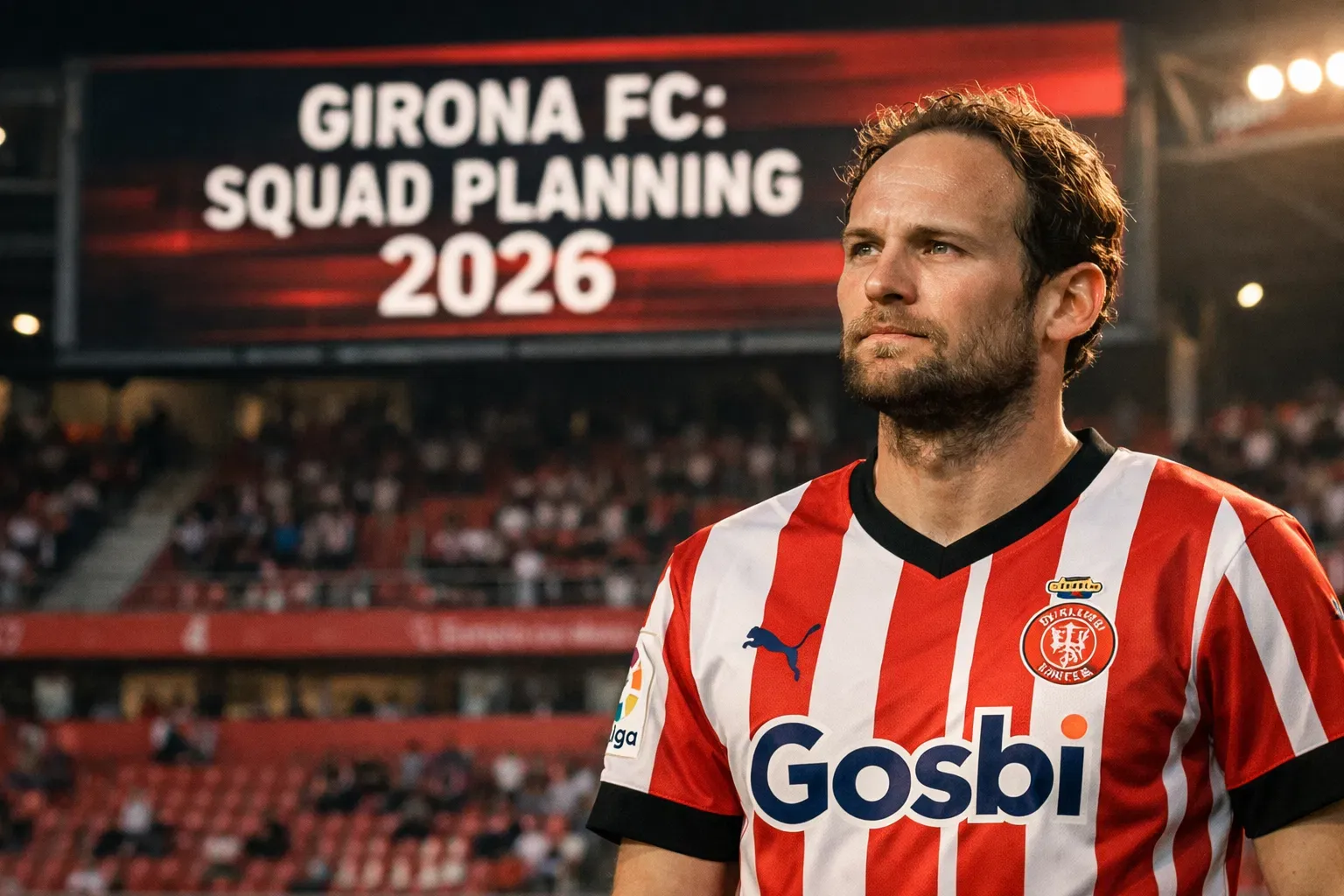
Myworldoffootball
Daley Blind Ajax transfer: free move reshapes defense
Daley Blind Ajax transfer nears as Girona deal expires. Tim van Duijn explains why Blind’s IQ could transform Ajax defense on a free.
Daley Blind Ajax transfer nears as Girona deal expires. Tim van Duijn explains why Blind’s IQ could transform Ajax defense on a free.
Ajax are lining up a move that feels both nostalgic and ruthlessly practical: the Daley Blind Ajax transfer on a free after his Girona contract expired. In a summer where budgets matter as much as tactics, the idea of adding a proven organiser without a fee is exactly the kind of edge smart clubs chase. Journalist Tim van Duijn has framed Blind as a “gap-filler” in the best sense, a player who makes everyone else play clearer football. If this lands, it could be the simplest solution to Ajax’s most complicated problem.
There’s a reason the Daley Blind Ajax transfer is being discussed like a market inefficiency rather than a sentimental reunion. Ajax have spent recent windows juggling ambition with financial reality, and that has often meant compromising on experience in the spine. A free transfer changes the whole equation, because wages become the main lever rather than an upfront fee. For a club needing immediate defensive competence, that’s a rare win.
Blind arriving after his Girona deal ends also fits the timing of Ajax’s reset, where the squad needs leaders as much as legs. The Daley Blind Ajax transfer offers a ready-made organiser who understands the club’s demands and the Eredivisie’s rhythms. When you’re rebuilding, you can’t only buy potential; you need certainty in key zones. Blind is not a mystery signing, and that predictability is valuable.
Ajax’s previous hesitation around paying transfer fees for older defenders wasn’t stubbornness, it was arithmetic. Investing millions in a short-term fix can block pathways for younger players and strain a wage structure that already needs discipline. The Daley Blind Ajax transfer avoids that trap while still improving the XI, which is the whole point of “creative solutions.” It’s the kind of deal that lets Ajax spend elsewhere without leaving the defense exposed.
The Daley Blind Girona situation is the key detail that makes everything feel suddenly possible. With his contract expired, there’s no negotiation with Girona, no bidding war over a fee, and no need to sell the move internally as a big outlay. That freedom matters for Ajax, because it reduces risk and increases speed. In a window where delays can derail a season, a clean free transfer is priceless.
Tim van Duijn’s read on Blind is less about romance and more about function, and that’s why it’s resonating across Ajax news. He points to tactical intelligence: the ability to anticipate, to close passing lanes early, and to make the first decision before the opponent finishes the last touch. In LaLiga, where spacing and tempo punish slow thinkers, Blind built a reputation for “seeing” danger early. That kind of brain-speed doesn’t decline like sprint speed.
For Ajax, the appeal is that the Daley Blind Ajax transfer doesn’t just add a defender, it adds a defensive coach on the pitch. When a back line is shaky, the smallest errors become contagious: one player steps late, another overcovers, and suddenly the structure collapses. Blind’s value is that he reduces chaos by choosing the boring, correct option at the right moment. Ajax have missed that calming influence.
Blind’s LaLiga analysis profile is built on positioning rather than duels, and that’s why the Daley Blind Ajax transfer can still be “game-changing” even if he’s not dominating highlights. He wins time by arriving early, and he wins space by standing in the right corridor before the pass is played. Girona asked him to manage transitions with his head, not his feet, and he consistently did. That translates well to Ajax’s possession-heavy identity.
One underrated aspect of Blind’s game is how his first pass prevents the next defensive action. If you can find the six, the fullback, or the far-side winger quickly, you stop the opponent from resetting their press and you keep your own shape intact. The Daley Blind Ajax transfer would bring back that “metronome defender” role Ajax fans remember, where the center-back isn’t just clearing danger but dictating the rhythm. It’s control disguised as simplicity.
The bold claim around the Daley Blind Ajax transfer is that he could become Ajax’s best central defender immediately. On paper, that sounds provocative because age and pace are the obvious counterarguments. But “best” at center-back is often about organisation, spacing, and decision-making under pressure, especially for a team that pushes high and invites counters. If Ajax’s current options are talented but inconsistent, Blind’s reliability can look elite.
Ajax’s defensive issues have rarely been about a lack of effort; they’ve been about timing and relationships. When the press is half a second late, the back line needs perfect distances, and that’s where communication becomes everything. The Daley Blind Ajax transfer would add a defender who talks, points, and adjusts others constantly, which is a skill set as real as tackling. In a young squad, that guidance can turn messy games into controlled ones.
Ko Itakura has been discussed in Ajax news as a possible answer because he offers athleticism, duel security, and experience in structured defending. Yet the Daley Blind Ajax transfer offers a different profile: less about winning every race, more about preventing the race from happening. If Ajax want to dominate territory, they need defenders who can hold a high line and still manage space behind them intelligently. Blind can do that with positioning and anticipation rather than raw speed.
Youri Baas represents the long-term logic Ajax never want to lose, which is why any veteran signing sparks debate. The Daley Blind Ajax transfer doesn’t have to block Baas if the club uses it as a mentorship bridge rather than a permanent ceiling. Blind can start the biggest matches, stabilise the team, and still leave room for Baas to develop through rotation and specific tactical roles. If managed well, it’s acceleration, not obstruction.
To understand why the Daley Blind Ajax transfer makes tactical sense, you have to look at how Ajax want to attack. The buildup often asks a center-back to step in, attract pressure, and then break lines with a pass into midfield or the half-space. Blind has done this across multiple systems, and he’s comfortable receiving under pressure with a plan already formed. That alone can make Ajax’s first phase cleaner and braver.
Defensively, Ajax’s high line is only as strong as its “rest defense,” the structure left behind when the team attacks. Blind’s experience helps here because he recognises when the fullback has gone too high or when the pivot is late covering the central lane. The Daley Blind Ajax transfer could reduce the number of panicked sprints back toward goal, because the team’s spacing becomes more deliberate. It’s fewer emergencies, more prevention.
Blind’s left-footedness matters in a way that’s easy to overlook until it’s missing. Passing angles from the left center-back can open the pitch faster, especially when opponents try to lock Ajax to one side with a curved press. The Daley Blind Ajax transfer restores natural balance, allowing quicker switches and cleaner access to the left-back and left winger. Those tiny geometric advantages often decide whether you dominate or merely circulate possession.
Ajax have dropped points in seasons where the margins were defined by set pieces and late-game management. Blind’s presence can improve both, not necessarily by scoring headers, but by organising markers, managing zones, and keeping the line connected. The Daley Blind Ajax transfer also adds a late-game brain, someone who knows when to slow the game, when to take a foul, and when to keep the ball. Those are “adult” skills that win titles.
Blind’s stint in Spain wasn’t a retirement tour; it was a different examination. LaLiga forced him to defend wider spaces, handle clever rotations, and respect opponents who punish the smallest positional error. The Daley Blind Girona chapter showed he can adapt without losing his identity, which is exactly what Ajax need from a veteran. He didn’t become a different player, but he refined the parts that age tends to sharpen: reading, timing, and calm.
Another takeaway from the Daley Blind Girona period is that he remained dependable across a long season, which is often the first concern with older signings. Ajax don’t just need a defender for the best matches; they need someone who can carry the weekly responsibility of maintaining standards. The Daley Blind Ajax transfer is attractive because it’s low-fee, but it’s also high-trust, and trust is what a shaky defense lacks. Stability becomes contagious when leaders are consistent.
Players who rely on pace can look like different athletes year to year, but players who rely on scanning and angles can remain effective across leagues. Blind’s Spanish experience reinforced that his core strengths are portable, which supports the logic behind the Daley Blind Ajax transfer. He doesn’t need Ajax to change their identity to accommodate him; he needs Ajax to be organised enough to let his organisation shine. That’s a subtle but important distinction.
Ajax games can become chaotic when opponents break the first press, leaving huge spaces behind the midfield. Blind’s LaLiga analysis highlights how he learned to manage those moments by delaying rather than diving in, guiding attackers toward less dangerous zones. The Daley Blind Ajax transfer could help Ajax concede fewer “one pass and in” chances, because he understands when to step and when to hold. Transition defending is often decision-making, not tackling.
In Ajax news, signings are never just about the pitch; they’re about what the club is trying to be. The Daley Blind Ajax transfer signals a willingness to blend academy ideals with pragmatic leadership, especially when money is tight. Fans often demand both beauty and results, but rebuilding requires a few stabilisers who make the system functional again. Blind’s return would be a statement that Ajax are serious about fixing the foundations, not just decorating the roof.
Financial constraints can create paralysis, yet they can also sharpen decision-making. Ajax can’t always win bidding wars, so they must win on fit, timing, and creativity, and the Daley Blind Ajax transfer checks all three boxes. It’s also a move that can raise standards in training, because younger defenders see what professional preparation looks like. When a squad lacks direction, a veteran’s habits can become a tactical tool.
The fear with any veteran is that the club starts chasing yesterday, but the Daley Blind Ajax transfer doesn’t have to be that. If Ajax treat Blind as a one- to two-year stabiliser while they recruit or develop the next starting center-back, the move becomes a bridge rather than a detour. That’s where smart sporting management matters: clear roles, planned minutes, and succession built into the strategy. Done right, everyone benefits.
If Blind becomes Ajax’s best central defender, it won’t necessarily be because he wins every duel; it will be because Ajax stop gifting opponents easy chances. Success for the Daley Blind Ajax transfer looks like fewer frantic clearances, fewer mismatched distances between lines, and a calmer buildup that keeps the team in control. It also looks like Baas and others improving through clearer instruction and better structure. The best defenders often make the whole defense look smarter.
Ultimately, the Daley Blind Ajax transfer feels like one of those moves that can change a season without changing the club’s identity. Ajax don’t need a miracle; they need coherence, and coherence starts at center-back with players who see the game early and communicate it loudly. Blind’s Girona exit and free-agent status make the deal financially sensible, but it’s the football logic that makes it exciting. If Ajax pair his brain with the right legs around him, the defense can finally breathe again.

Julian Mercer is a lifelong student of the game whose passion for football was sparked at an early age, after stepping onto the grass of Camp Nou as a six-year-old — a moment that left a lasting impression and set him on a permanent path into the sport. Since then, football has been both his lens on the world and his favourite language. Blending traditional fandom with a deep interest in tactics, squad building, and long-term team development, Julian has spent decades analysing the game from every angle. His fascination with football strategy was further shaped through years of immersive play in Football Manager, a series he has followed since the mid-1990s, developing a sharp eye for patterns, player profiles, and the fine margins that define success. At My World Of Football, Julian focuses on the stories beneath the surface — from tactical evolutions and managerial philosophies to the narratives that connect clubs, players, and supporters across generations. His writing aims to balance insight with accessibility, always grounded in a genuine love for the game.
Continue reading more football news