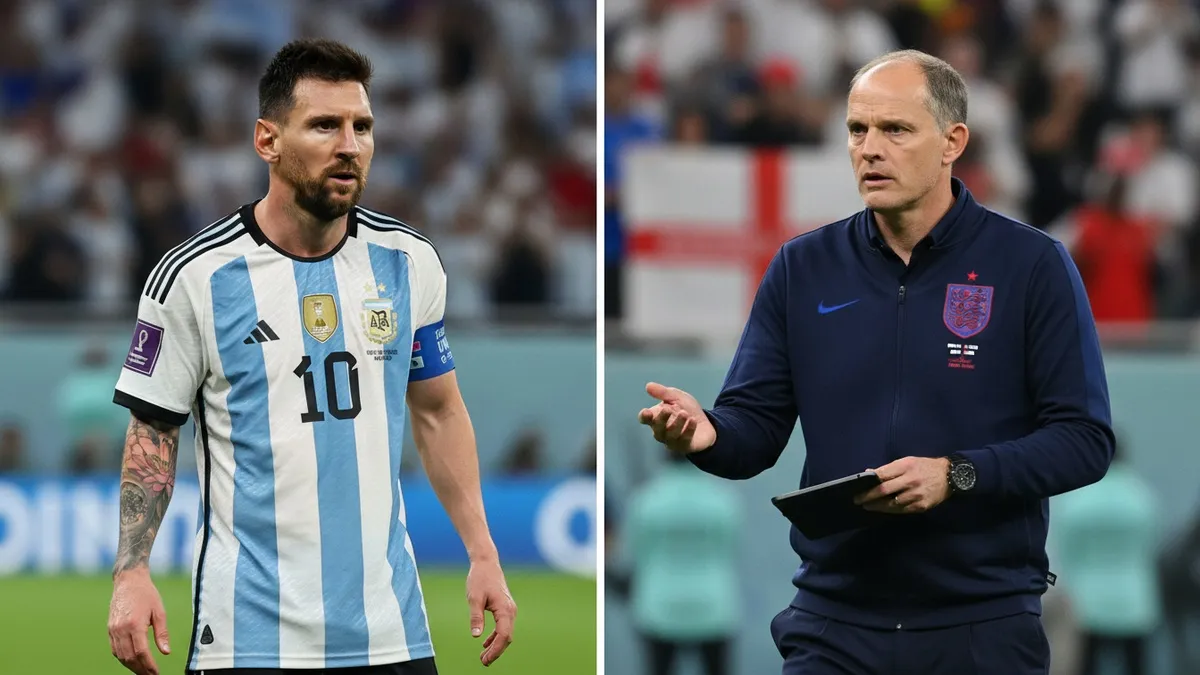
England World Cup squad 2026: Tuchel picks ignite row
England World Cup squad 2026 sparks debate as Thomas Tuchel omits Trent Alexander-Arnold, Phil Foden and Harry Maguire but recalls Jordan Henderson.
England World Cup squad 2026 sparks debate as Thomas Tuchel omits Trent Alexander-Arnold, Phil Foden and Harry Maguire but recalls Jordan Henderson.
The England World Cup squad 2026 conversation has exploded long before a ball is kicked at the tournament itself, because Thomas Tuchel’s first major selection has landed like a thunderclap. The omissions of Trent Alexander-Arnold, Phil Foden and Harry Maguire have left fans squinting at the list and wondering what the manager is trying to build. In their place, the inclusion of Jordan Henderson has added a second layer of intrigue. With Kyle Walker and Wayne Rooney both weighing in, England football news has rarely felt this combustible.
Tuchel’s choices read less like conservative tournament planning and more like a manifesto about standards, roles and control. The England World Cup squad 2026 is being framed as a team that must win specific moments rather than simply collect famous names. That approach can be refreshing, but it also invites scrutiny when the excluded players are match-winners at the highest level. Selection, after all, is a message to the dressing room as much as it is a list for supporters.
In England football news, the early Tuchel era is already being defined by who is not there, which is rarely a comfortable narrative for any manager. The England World Cup squad 2026 debate is not merely about talent, but about identity: do you pick the best individuals, or the best-fitting parts? Tuchel’s history at Chelsea suggests he prizes tactical obedience and compactness, sometimes at the expense of star freedom. That context makes the omissions feel deliberate rather than accidental.
Supporters tend to accept tough calls when the logic is clear, but Tuchel’s logic is still emerging in public. The England World Cup squad 2026 needs clarity on what “non-negotiables” look like: pressing triggers, defensive spacing, and who owns buildup responsibility. Without that explanation, every omission becomes a referendum on personality and preference. It is why the reaction has been emotional, with people interpreting the list as either brave modern coaching or needless provocation.
Tuchel’s Chelsea peak was built on a system that protected defenders and created repeatable attacking patterns, even if it occasionally dulled individual expression. That memory shapes how people read the England World Cup squad 2026, especially regarding creative players like Phil Foden and specialist passers like Trent Alexander-Arnold. If Tuchel believes the international game is about minimizing chaos, he may be prioritizing controllable profiles. The risk is that England lose the very chaos that wins tight knockout ties.
There are omissions, and then there is leaving out Trent Alexander-Arnold, a player whose passing range can change the geometry of a match. Even after his move to Real Madrid, his profile remains rare: a right-back who can playmake like a midfielder and create goals with one disguised ball. The England World Cup squad 2026 is suddenly short of that specific superpower. Fans are not just upset; they are confused about how England intend to progress the ball under pressure.
International football often comes down to breaking well-organized blocks with limited training time, which is precisely where Alexander-Arnold’s delivery and switches of play can be decisive. The England World Cup squad 2026 may still have creators, but few can replicate his ability to hit the far-side winger early or thread a pass between lines from deep. If Tuchel wants control, he might worry about defensive transitions, yet control also comes from keeping the ball in dangerous areas.
Kyle Walker’s public defense carried extra weight because it came from a direct rival for the same position, not a friend offering empty praise. Walker essentially argued that Alexander-Arnold’s best-in-class qualities should travel to any tournament, regardless of system, because they offer solutions when plans stall. In England football news, that sort of player-to-player backing is rare and revealing. It also frames the England World Cup squad 2026 as a group potentially missing a specialist problem-solver.
Moving to Real Madrid changes the spotlight as much as the football, and every performance becomes magnified. If Tuchel believes Alexander-Arnold is still adapting to new defensive demands, he may see risk where others see growth. Yet the England World Cup squad 2026 is meant to assemble the highest-ceiling options, not the safest ones. Madrid players are usually selected on reputation and pedigree, so this omission feels like Tuchel deliberately resisting that gravitational pull.
Phil Foden’s absence is the kind that makes people re-check the squad graphic, because he is widely viewed as England’s most natural technician in tight spaces. For Manchester City, he has been a connector, a finisher and an improviser, often within the same move. The England World Cup squad 2026 therefore looks lighter on spontaneous combination play around the box. Tuchel might have concerns about role clarity, but tournaments are frequently won by players who can blur roles.
Foden’s international story has sometimes been complicated by where to place him, especially when England also want to accommodate other creators. Still, leaving him out of the England World Cup squad 2026 suggests Tuchel is prioritizing balance over brilliance, at least in this window. That can work if the team becomes more stable and direct, but it can also remove the player most capable of turning a sterile spell into a goal. England football news has treated it as a warning shot to the entire creative group.
Tuchel has always been a coach who asks players to serve the structure, not the other way around, and Foden’s best moments often arrive when he is allowed to roam and interpret. The England World Cup squad 2026 might be built around fixed lanes, with wide players holding width and midfielders protecting rest defense. If that is the plan, Tuchel may fear Foden’s freedom creates gaps. The counterargument is that elite teams build systems that amplify, not constrain, elite talent.
City’s dominance has raised expectations that their key players will translate club rhythm into international efficiency, even though the contexts are wildly different. Foden’s omission from the England World Cup squad 2026 therefore feels like Tuchel rejecting a popular assumption: that City automation equals England success. It is a bold stance, but it adds pressure to Tuchel’s alternatives to produce goals quickly. If England struggle for chance creation, this decision will be the first clip replayed on every debate show.
Harry Maguire’s exclusion is loaded because it touches on more than defending; it touches on hierarchy. For years, Maguire has been a trusted tournament operator for England, often better in a national shirt than in the weekly churn of club football. Removing him from the England World Cup squad 2026 signals that Tuchel is willing to sever old loyalties. It may also indicate a shift toward a higher defensive line or different build-up profiles from center-backs.
Defenders are judged harshly because their mistakes are loud, but international tournaments reward familiarity and resilience as much as pace. The England World Cup squad 2026 could be faster without Maguire, yet potentially less battle-tested in the unique stress of knockout football. England football news has framed the decision as either overdue evolution or unnecessary disruption. Either way, Tuchel has effectively told the squad that past service does not guarantee future selection, even for established leaders.
Wayne Rooney’s comments landed because he recognized a familiar managerial move: change the pecking order early to establish authority. Rooney suggested Maguire’s omission reflects Tuchel’s style, implying the manager is setting a tone about performance, intensity and suitability. In the England World Cup squad 2026 context, it is a reminder that national-team management is as much politics as tactics. Tuchel may be betting that a sharper edge now leads to a more competitive environment later.
Maguire’s value has often been most visible on set pieces, where England have historically found crucial margins. Without him, the England World Cup squad 2026 must replace not just a defender, but a reliable aerial target and a player comfortable in chaotic penalty-box moments. Tuchel may believe other options can replicate that output, yet those goals and clearances are not easily replaced by theory. If England face a tight quarterfinal, the absence of that specific weapon could be felt.
Jordan Henderson’s inclusion is the selection that has split the room most sharply, because it asks fans to choose between present-day performance and intangible value. As a former Ajax player, his recent club narrative has been uneven, making his return feel surprising. Yet Tuchel may see Henderson as a stabilizer who can transmit instructions and standards quickly. The England World Cup squad 2026, in this reading, is being built with a leadership spine that survives stressful tournament swings.
There is also a tactical argument: Henderson can play as a controlling midfielder, covering full-backs and managing tempo when matches become frantic. In international football, where rhythm can evaporate, that skill is useful. Still, the England World Cup squad 2026 must also be about athletic intensity, and critics question whether Henderson can cover ground at the required level. England football news has turned it into a generational debate about when to move on from trusted lieutenants.
Managers often talk about “good trainers” and “culture-setters,” and Henderson has long been viewed as exactly that type. Tuchel may believe the England World Cup squad 2026 needs players who keep standards high in short camps, where preparation time is limited. The problem is that leadership is easiest to celebrate when results are good; when results dip, it is quickly dismissed as nostalgia. Henderson’s presence will therefore be judged relentlessly on whether England look calmer or simply older.
If Henderson is used as a deeper controller, Tuchel might free other midfielders to press higher and arrive in the box, creating a more staggered shape. That could help the England World Cup squad 2026 become more compact defensively, especially against elite counterattacking sides. But it can also slow ball progression if the passing becomes too safe and predictable. The key will be whether Henderson can still play forward early, rather than recycling possession until the opponent resets.
The immediate reaction has been loud because England supporters carry the memory of near-misses, and every selection feels like it nudges the country closer to glory or back into regret. The England World Cup squad 2026 is now being discussed as a psychological experiment: can Tuchel withstand the noise while building something coherent? Social media has amplified every hot take, but the core anxiety is traditional. England fans want a team that can impose itself, not one that overthinks its own talent.
Pundits are split between those who admire Tuchel’s ruthlessness and those who see self-inflicted drama. The England World Cup squad 2026 will be measured against the simplest metric: do results improve, and do performances look scalable to tournament conditions? England football news cycles can be unforgiving, and the manager’s reputation for intensity means every press conference will be mined for tension. If early matches are shaky, the omitted names will become a weekly chant rather than a one-time debate.
When you omit stars, you are implicitly claiming your ideas are stronger than their reputations. That is the wager Tuchel has made with the England World Cup squad 2026, and it raises the stakes for every tactical tweak. If England look blunt without Foden, or predictable without Alexander-Arnold’s passing, the criticism will be brutal and specific. Conversely, if the team looks more cohesive and harder to counter, Tuchel will be credited for seeing what others missed.
England’s ceiling remains high because the player pool is deep, but ceilings are only reached when selections and roles align under pressure. The England World Cup squad 2026 controversy matters because it hints at a broader identity shift, one that could either sharpen England’s edge or dilute their creativity. Tuchel’s job is to turn these debates into fuel rather than fractures, and to ensure the squad feels chosen for a clear purpose. Until that purpose is obvious on the pitch, every omission will feel like a gamble.
The truth is that the England World Cup squad 2026 will not be judged by online arguments in June, but by moments in July when a single pass, header, or defensive decision decides a knockout tie. Tuchel has chosen to start his reign by challenging assumptions, leaving out Trent Alexander-Arnold, Phil Foden and Harry Maguire while trusting Jordan Henderson’s experience. Kyle Walker’s disbelief and Wayne Rooney’s interpretation have only raised the temperature. If England win, Tuchel looks visionary; if they wobble, this selection becomes the origin story of a preventable storm.

Julian Mercer is a lifelong student of the game whose passion for football was sparked at an early age, after stepping onto the grass of Camp Nou as a six-year-old — a moment that left a lasting impression and set him on a permanent path into the sport. Since then, football has been both his lens on the world and his favourite language. Blending traditional fandom with a deep interest in tactics, squad building, and long-term team development, Julian has spent decades analysing the game from every angle. His fascination with football strategy was further shaped through years of immersive play in Football Manager, a series he has followed since the mid-1990s, developing a sharp eye for patterns, player profiles, and the fine margins that define success. At My World Of Football, Julian focuses on the stories beneath the surface — from tactical evolutions and managerial philosophies to the narratives that connect clubs, players, and supporters across generations. His writing aims to balance insight with accessibility, always grounded in a genuine love for the game.
Continue reading more football news