Myworldoffootball
Feyenoord Ajax penalty controversy fuels 1-1 draw
Eredivisie match report as Feyenoord and Ajax draw 1-1 amid Feyenoord Ajax penalty controversy, Danny Makkelie calls, VAR debate, and fan outrage.
Eredivisie match report as Feyenoord and Ajax draw 1-1 amid Feyenoord Ajax penalty controversy, Danny Makkelie calls, VAR debate, and fan outrage.
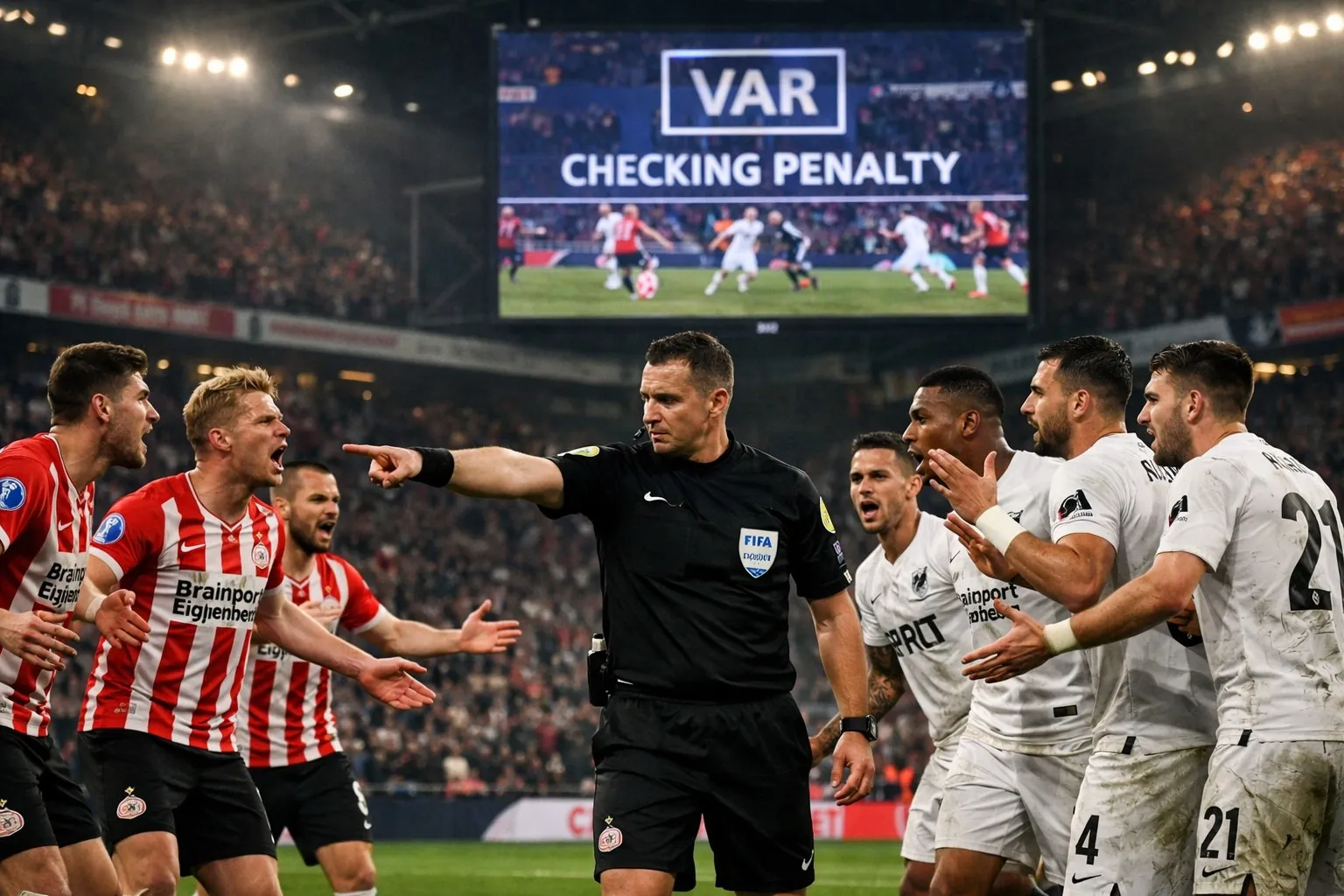
Sunday’s De Klassieker delivered the kind of edge-of-your-seat drama Dutch football sells to the world, yet it was the whistle rather than the finishing that dominated the post-match conversation. Feyenoord and Ajax ended 1-1, with the hosts clawing back via a penalty and then feeling they were denied a second spot-kick that could have flipped the script. The Feyenoord Ajax penalty controversy centered on referee Danny Makkelie, VAR’s silence, and a yellow card for Anis Hadj Moussa that supporters insist punished contact as if it were theater.
The Eredivisie match report reads like a classic: early tension, tactical sparring, a breakthrough, and the inevitable surge from the team chasing the game. Yet the Feyenoord Ajax penalty controversy ensured the draw felt less like a shared point and more like two competing realities. Feyenoord believed momentum and territory should have been rewarded twice from the spot, while Ajax saw a referee trying to keep control in a match built on provocation.
From the stands and living rooms, the match became a case study in how one decision can re-color every duel that follows. The equaliser from 12 yards brought Feyenoord back and raised the temperature, but it also sharpened the scrutiny on every subsequent contact in the box. By the final whistle, the Feyenoord Ajax penalty controversy had become the headline, eclipsing the footballing detail that usually defines this rivalry.
A Feyenoord Ajax draw rarely lands softly, especially when both sets of fans can point to moments that might have decided it. Feyenoord saw the 1-1 as two points dropped because their late pressure felt like it deserved a decisive moment. Ajax, meanwhile, took encouragement from surviving a hostile spell and leaving with something tangible. The Feyenoord Ajax penalty controversy amplified the sense that the table might be shaped by refereeing as much as by finishing.
There are games where the referee fades into the background, and then there are games where every replay becomes a referendum on officiating standards. This was the latter, and the Feyenoord Ajax penalty controversy gave it a clear focal point: a penalty given, and another not given, with a yellow card added for emphasis. In Dutch football news cycles, that combination is combustible. It invites accusations of inconsistency, and it turns VAR decisions into the real post-match “highlights.”
Danny Makkelie entered the afternoon with the reputation of a big-game operator, the kind of official trusted to manage emotion without losing authority. But authority is only persuasive when players and supporters believe the thresholds are stable, and this match challenged that perception. The Feyenoord Ajax penalty controversy did not hinge solely on one call; it grew from the feeling that similar contacts were being judged differently. Once that suspicion takes hold, every whistle sounds louder.
In the second half, Feyenoord’s appeals became more urgent, and Ajax’s defenders became more demonstrative in their innocence. Makkelie’s body language, his quickness to signal play on, and the confidence of the yellow card for simulation created a narrative of certainty. Yet certainty is not the same as correctness, and that gap is where the Feyenoord Ajax penalty controversy lives. For fans, the question wasn’t just “was there contact,” but “why was this contact treated as a dive?”
The moment Anis Hadj Moussa went down after contact from Godts, Feyenoord’s bench and end of the stadium reacted as if they had seen a penalty in real time. Instead, the winger was booked, and the decision landed like an accusation of dishonesty. That single action gave the Feyenoord Ajax penalty controversy a moral edge, because it wasn’t merely a missed penalty; it was a public reprimand. In a rivalry this raw, that kind of judgment inflames everything.
Referees often balance two priorities in high-stakes games: keeping the lid on, and keeping the calls right. Makkelie appeared to prioritize control, using cards and firm gestures to discourage swarming and exaggeration. However, credibility is earned through transparent consistency, and the Feyenoord Ajax penalty controversy suggests many viewers felt the balance tilted too far toward performance management. When supporters believe an official is “sending messages,” they start questioning whether the laws are applied or interpreted.
Anis Hadj Moussa’s role in the Feyenoord Ajax penalty controversy is fascinating because it sits at the intersection of modern wing play and modern refereeing skepticism. Wingers are coached to attack the box, invite contact, and force defenders into desperate lunges, and Hadj Moussa did exactly that. When he shifted his body and tried to burst past Godts, the contact looked real enough to trigger a collective intake of breath. The yellow card, then, felt like a verdict on his reputation rather than the incident.
From Ajax’s perspective, Godts will argue he stayed close, made a fair challenge, and that any fall was exaggerated to win a decision. That is the defender’s eternal defense, especially in an era where attackers know how to “sell” contact. Yet the Feyenoord Ajax penalty controversy is fueled by the visible touch that many fans saw on replay, the kind of clip that usually leads to at least a VAR check. When the check doesn’t produce an on-field review, suspicion grows.
Replays can be misleading, but they can also clarify the basic question of whether a defender impeded an attacker’s stride. In this case, many viewers felt Godts’ leg or body made enough contact to disrupt Hadj Moussa, even if it wasn’t a scything tackle. That is exactly the grey area that breeds the Feyenoord Ajax penalty controversy, because “enough” is subjective. When subjectivity is paired with a yellow card for diving, the debate becomes sharper and more personal.
Hadj Moussa plays with a winger’s bravado: quick feet, sudden stops, and a willingness to initiate duels in tight spaces. That style is thrilling, but it also invites referees to look for embellishment, especially when the player goes down in a high-leverage area. The Feyenoord Ajax penalty controversy highlights how attackers can be penalized not for what happens, but for what officials suspect might be happening. In a league trying to protect flair, that’s a tricky message.
The loudest question after the final whistle was not simply why Makkelie waved play on, but why VAR didn’t insist on a second look. In theory, VAR is designed to catch “clear and obvious” errors, yet penalties live in a world of interpretation and thresholds. That makes the Feyenoord Ajax penalty controversy a perfect storm, because fans expect technology to deliver certainty where the human eye struggles. When the technology stays quiet, it feels like complicity rather than restraint.
There is also a psychological effect at play: once one penalty has been awarded in a match, supporters expect similar incidents to be judged with similar generosity. If the first spot-kick is given for contact, the second incident is measured against it, and any mismatch feels like injustice. The Feyenoord Ajax penalty controversy became a referendum on consistency across the same 90 minutes, not on abstract rules. VAR’s role, or perceived lack of role, only intensified that comparison.
Supporters often frame penalties as binary—contact equals foul, no contact equals play on—because that feels intuitive. VAR, however, is supposed to intervene only when the on-field decision is clearly wrong, not merely debatable. The Feyenoord Ajax penalty controversy sits in that uncomfortable middle, where many fans believe the contact is obvious but the foul is arguable. That gap between what people see and what the protocol demands is why VAR decisions so often frustrate rather than reassure.
One reason controversies linger is that viewers rarely hear the logic in real time, and the silence becomes a canvas for conspiracy. Dutch football news coverage repeatedly returns to the same complaint: if VAR checked and cleared the incident, explain why it didn’t meet the threshold. The Feyenoord Ajax penalty controversy would cool faster with clearer communication, even if fans still disagreed. In the absence of that, social media fills the void with certainty, anger, and accusations.
Within minutes, clips of the incident were circulating with captions that ranged from disbelief to outright fury. Feyenoord supporters questioned whether Danny Makkelie was applying a different standard to Ajax, while Ajax fans countered that the winger was looking for the penalty and got caught. The Feyenoord Ajax penalty controversy became less about one match and more about long-held grievances, because fans carry memory like a suitcase. Every old call, every old grievance, gets unpacked when a new one arrives.
It is tempting to dismiss online outrage as the usual post-match noise, but it matters because it shapes the public legitimacy of the competition. When large sections of supporters believe football officiating issues are systemic, they watch with suspicion rather than joy. The Feyenoord Ajax penalty controversy tapped into that mood, making the draw feel like evidence instead of coincidence. In a rivalry as high-profile as this, the Eredivisie cannot afford a narrative where the referee is the main character.
Bias is a powerful accusation because it offers a simple story in a complicated sport, and social media rewards simple stories. A slowed-down clip, a freeze-frame, and a sarcastic caption can travel further than a nuanced breakdown of positioning and thresholds. The Feyenoord Ajax penalty controversy was tailor-made for this ecosystem, because the yellow card added emotional fuel. Once fans feel their player has been branded a cheat, they don’t want protocol; they want vindication.
Even neutral viewers have begun to treat refereeing as a weekly subplot in the Eredivisie, and that’s a dangerous normal. Players adapt by appealing more, coaches adapt by pre-loading press conferences with grievances, and supporters adapt by expecting disappointment. The Feyenoord Ajax penalty controversy is therefore not an isolated flare-up, but part of a pattern that many believe is worsening. If the league wants the football to lead, it must address how these incidents are handled and explained.
On the pitch, the 1-1 leaves both clubs with reasons to believe and reasons to regret, which is exactly the emotional mix that defines De Klassieker. Feyenoord will point to their response, their ability to force the issue, and the penalty that brought them level. Ajax will highlight resilience, game management, and the ability to withstand a second-half storm. Yet the Feyenoord Ajax penalty controversy ensures the tactical lessons are being discussed through the prism of officiating rather than shape and structure.
Looking ahead, the next meeting will arrive with extra baggage, because players remember how they were treated in key moments. Feyenoord’s attackers may feel they need to stay on their feet at all costs to avoid another booking, even when contact is real. Ajax defenders may feel emboldened that borderline challenges will be waved away, at least in this interpretation. That is how the Feyenoord Ajax penalty controversy can influence future behavior, subtly changing the risk calculus in the box.
In the modern game, coaches speak to referees through the media as much as they speak to them in private. Expect Feyenoord to emphasize “consistency” and “respect for attackers,” while Ajax will stress “not rewarding simulation” and “letting the game flow.” The Feyenoord Ajax penalty controversy provides ready-made talking points, and both sides will use them to frame expectations. That framing matters because it can raise the pressure on officials before a ball is even kicked.
De Klassieker is not just another match; it is the Eredivisie’s flagship export, the game that draws casual viewers into the league’s drama. When the Feyenoord Ajax penalty controversy becomes the main takeaway, it risks turning the product into a weekly argument rather than a weekly spectacle. The solution is not perfection, which is impossible, but clarity and accountability around VAR decisions and thresholds. If supporters understand why something was not a penalty, they may still be angry, but they won’t feel gaslit.
The final score will be filed away as a Feyenoord Ajax draw, but the emotional residue will linger far longer than the points distribution. Feyenoord will feel they earned more than one penalty and were punished for asking the question a second time, while Ajax will feel they survived a hostile environment and didn’t get pulled into a refereeing circus. Still, the Feyenoord Ajax penalty controversy has already become a reference point in Dutch football news, and it will shadow the next big call. Until VAR decisions are communicated with more clarity, every tight moment in the box will feel like the start of another argument.

Julian Mercer is a lifelong student of the game whose passion for football was sparked at an early age, after stepping onto the grass of Camp Nou as a six-year-old — a moment that left a lasting impression and set him on a permanent path into the sport. Since then, football has been both his lens on the world and his favourite language. Blending traditional fandom with a deep interest in tactics, squad building, and long-term team development, Julian has spent decades analysing the game from every angle. His fascination with football strategy was further shaped through years of immersive play in Football Manager, a series he has followed since the mid-1990s, developing a sharp eye for patterns, player profiles, and the fine margins that define success. At My World Of Football, Julian focuses on the stories beneath the surface — from tactical evolutions and managerial philosophies to the narratives that connect clubs, players, and supporters across generations. His writing aims to balance insight with accessibility, always grounded in a genuine love for the game.
Continue reading more football news