Myworldoffootball
Feyenoord summer transfer targets to keep UCL spot
Feyenoord summer transfer targets take shape as second place, Champions League money, and exits for Read, Hadj Moussa, and Ueda drive planning.
Feyenoord summer transfer targets take shape as second place, Champions League money, and exits for Read, Hadj Moussa, and Ueda drive planning.
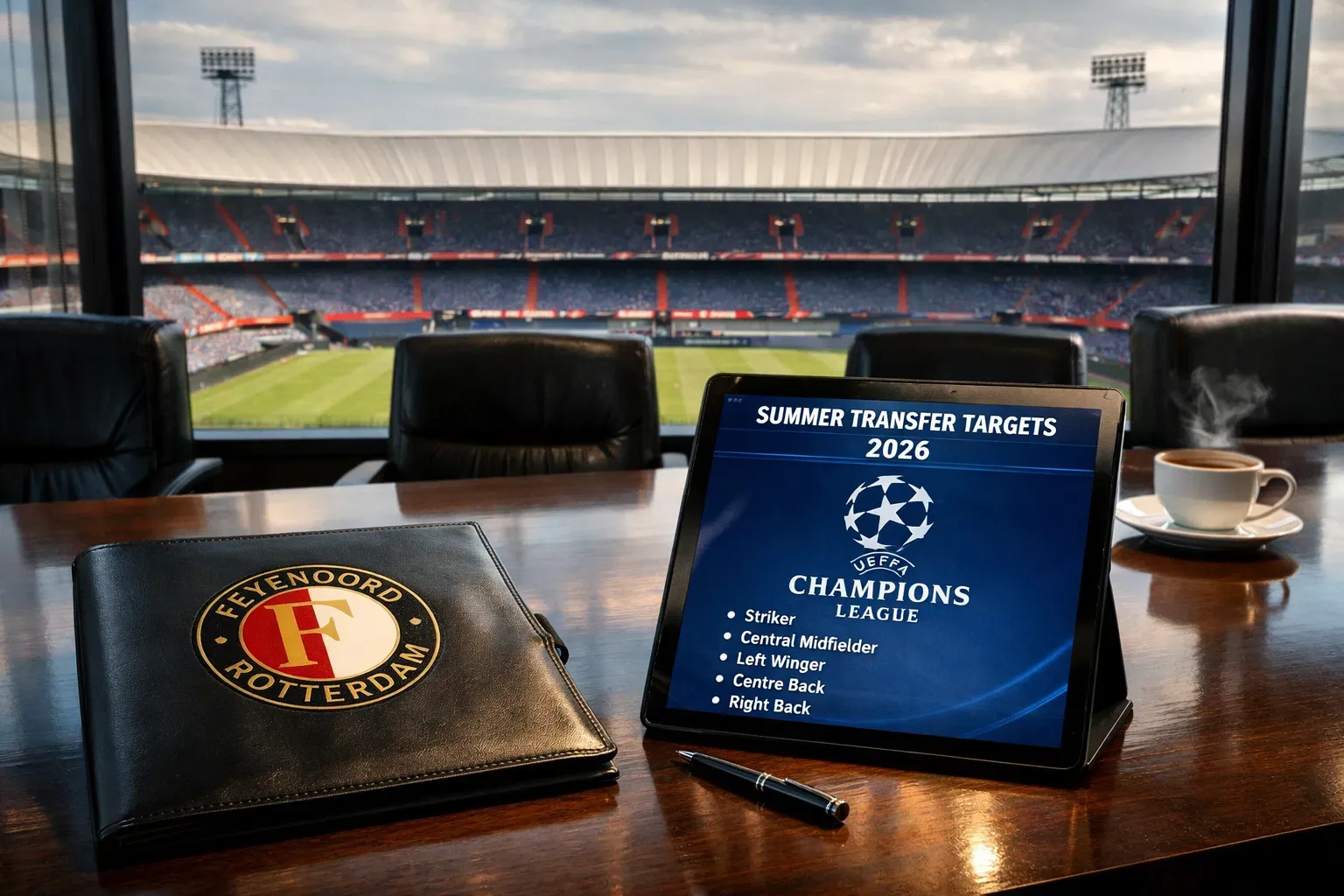
Feyenoord’s run-in is suddenly about more than three points at a time; it’s about protecting a Champions League future and the leverage that comes with it. Sitting second in the Eredivisie, the club knows that one wobble can turn a stable season into a summer of compromises. That is why Feyenoord summer transfer targets are already being mapped, even while the fixtures still bite. With expected exits and injury concerns, Dennis te Kloese is building next season’s spine now.
Second in the Eredivisie is not a vanity position in Rotterdam; it’s a business plan with floodlights. Champions League qualification changes wage ceilings, makes contracts easier to extend, and turns “maybe” signings into realistic ones. That’s why Feyenoord summer transfer targets are being discussed with urgency rather than curiosity. Te Kloese understands that waiting for the final whistle of May risks paying a premium in June.
The squad’s current balance also explains the early movement, because several roles feel one transfer away from fragile. A stable league finish doesn’t automatically mean a stable squad, especially when scouts from bigger leagues circle your breakout players. Feyenoord summer transfer targets therefore have to cover both quality and continuity, replacing likely departures while also upgrading the “good enough” positions. The aim is simple: start next season with fewer question marks than this one.
Recruitment isn’t happening in a vacuum; the run-in is a live audition for depth players and a stress test for the medical room. If Feyenoord limp over the line, it exposes which backups can’t be trusted for Champions League intensity. That feedback loops directly into Feyenoord summer transfer targets, because the club can’t afford to buy twice in the same position. Te Kloese will be watching minutes, duels, and recovery times as closely as goals.
There’s a temptation to treat Champions League qualification as a moment to splash cash, but Feyenoord’s smarter play is timing. Deals done early reduce competition, and early clarity helps the coach plan a pre-season with defined roles. Feyenoord summer transfer targets, then, are about being decisive rather than dramatic. The club’s best summers have been the ones where key signings arrived before the first friendly, not after the playoffs.
The right-back situation has become a quiet source of tension, because reliability is a skill as valuable as crossing. Bart Nieuwkoop’s injury issues have limited continuity, and that affects everything from pressing triggers to the timing of overlaps. When a full-back can’t string weeks together, the winger in front of him plays differently and the centre-backs defend wider. That’s why Feyenoord summer transfer targets place the right-back slot near the top of the board.
Feyenoord don’t just need a body; they need a profile that fits their identity. The modern right-back in Rotterdam must defend one-on-one, sprint into space, and still have the composure to play through pressure. If Nieuwkoop can’t be counted on for 35-plus appearances, the club must either recruit a starter or recruit a high-ceiling challenger. In either case, Feyenoord summer transfer targets at full-back are about certainty, not hope.
In possession, Feyenoord’s right-back has to be a passing outlet who can step into midfield without panicking. In transition, he must recover quickly enough to stop counters before they become emergencies. That dual demand narrows Feyenoord summer transfer targets to players with athletic repeatability and clean technique under pressure. The club will also look for availability history, because the best tactical plan collapses if the player is in the treatment room.
Champions League weeks punish thin squads, especially in high-running roles like full-back where sprints stack up. Feyenoord have learned that rotating the back line isn’t a luxury; it’s a necessity to preserve intensity in the Eredivisie. This is why Feyenoord summer transfer targets at right-back should ideally include two-way value: someone who can start big games and still accept rotation when the calendar turns brutal. Smart depth prevents crisis signings in January.
When a young player pops, the market reacts faster than fans can process, and Givairo Read looks like the next one to test Feyenoord’s resolve. If Read is expected to leave, the club must replace not only his minutes but his trajectory, because the system often relies on energy and daring from that side. Feyenoord summer transfer targets therefore need to anticipate a sale, not merely respond to it. The best recruitment is the kind that makes a departure feel survivable.
Succession planning also protects the dressing room from the psychological dip that follows a big exit. Players notice when a club is prepared, and preparation keeps standards from slipping. If Read goes, the replacement has to arrive with a clear role and a tactical fit, not as a late-window compromise. That’s why Feyenoord summer transfer targets are likely being narrowed now, with shortlists built around specific attributes rather than generic “talent.”
Feyenoord’s reputation as a development club is a selling point, but it only works if the pathway doesn’t become a revolving door. Replacing Read with another young, coachable option can keep that identity intact, while still protecting results. Feyenoord summer transfer targets in this lane will include players who can grow into the role, but also have enough baseline quality to handle Champions League nights. The club needs upside without sacrificing stability.
Once bigger clubs sniff value, negotiations become about timing, add-ons, and the reality that the player’s head can turn. Bayern München are the kind of name that changes the temperature of any conversation, even if only indirectly through market inflation. That’s another reason Feyenoord summer transfer targets must be active early, because the moment a sale is agreed, selling clubs raise prices. Getting ahead of that curve can save millions and weeks of uncertainty.
Anis Hadj Moussa has offered the kind of right-wing unpredictability that makes defenders backpedal and stadiums buzz. If he is expected to leave, Feyenoord lose more than a dribbler; they lose a release valve when the build-up gets stuck. That places extra weight on Feyenoord summer transfer targets for the right flank, because replacing “chaos” is harder than replacing a simple pass-and-run winger. The new option must keep the attack from becoming too predictable.
The right wing is also where tactical differences show up quickly, because a winger’s decision-making shapes the full-back behind him and the striker ahead of him. Feyenoord need someone who can hold width, attack the half-space, and still work back in the press. If Hadj Moussa departs, the recruitment team must decide whether to buy a like-for-like dribbler or a more efficient creator. Either way, Feyenoord summer transfer targets here will define the team’s personality.
At De Kuip, a winger who doesn’t run back will get noticed, and not in a good way. Feyenoord’s pressing depends on wide players who can trigger pressure, track runners, and recover into shape after turnovers. That’s why Feyenoord summer transfer targets for the right wing will be judged on more than highlights; duels, counter-press actions, and sprint repeatability matter. The club can’t afford a luxury winger if they want to stay second in the Eredivisie.
The recruitment debate often comes down to whether you buy chance creation or goal threat, because few players deliver both consistently at this level. Feyenoord may prioritize a winger who can decide games with goals if the striker situation changes, or a creator if they expect to control matches. That strategic choice will shape Feyenoord summer transfer targets and the types of leagues they shop in. The key is to avoid replacing Hadj Moussa with a player who needs the same spaces but offers less output.
The potential exit of Ayase Ueda adds urgency because strikers aren’t plug-and-play; chemistry takes time and finishing confidence is fragile. If Ueda leaves, Feyenoord must replace goals, pressing angles, and the ability to occupy centre-backs so midfield runners can arrive. That makes striker one of the most sensitive Feyenoord summer transfer targets, especially with Champions League ambition demanding a forward who can survive elite defending. Waiting too long risks entering August with an unfinished attack.
Feyenoord’s striker role is also tactical: sometimes the nine is a wall-pass option, sometimes a runner behind, and often the first defender. The club must decide what version of the team they want next season before picking the player. If they expect more possession, they need a striker comfortable with back-to-goal play; if they expect more transition, they need pace and verticality. Feyenoord summer transfer targets at number nine will therefore be linked directly to the coach’s preferred game model.
It’s tempting to say “just buy 15 goals,” but goals come from context: service quality, chance volume, and confidence. Ueda’s departure would change how opponents defend Feyenoord, and the replacement must be able to handle the extra attention. That’s why Feyenoord summer transfer targets at striker should include psychological robustness as well as technical traits. A forward who can miss, reset, and score again is worth as much as a forward with a pretty highlight reel.
Even if Feyenoord sign a new starter, the Champions League calendar often forces rotation, and injuries are inevitable in high-contact positions. A credible second striker prevents the tactical system from collapsing when the first choice is unavailable. That’s an underappreciated part of Feyenoord summer transfer targets: building redundancy in the most volatile role on the pitch. If Ueda goes, the club may need two forwards with complementary styles, not one expensive solution.
Dennis te Kloese’s job is to make change feel controlled, and that requires a blueprint that survives both sales and setbacks. With Read and Hadj Moussa likely leaving and Ueda uncertain, the club is staring at a summer where three attacking and defensive lanes could shift at once. Feyenoord summer transfer targets must therefore be coordinated, not isolated, so the right-back, right winger, and striker additions complement each other. A coherent rebuild is cheaper and faster than three separate fixes.
There is also a wider squad-management challenge: wage structure, resale value, and the balance between ready-made starters and development bets. Feyenoord can’t operate like a superclub, but they can operate like a smart one, selling at the right time and buying before the market spikes. That’s why Feyenoord summer transfer targets will likely lean toward players with clear roles, strong availability records, and upside that keeps the club financially healthy. The goal is to compete now without mortgaging the next window.
Availability is the first filter because the club has already felt the cost of injury disruption, especially around Nieuwkoop’s situation. Adaptability matters because Eredivisie matches and Champions League matches demand different rhythms, and players must adjust quickly. Resale value keeps the model sustainable, ensuring that the next big sale doesn’t force a reset. Put together, those principles shape Feyenoord summer transfer targets into a disciplined list rather than a scatter of names.
A successful summer isn’t measured by headlines; it’s measured by whether Feyenoord enter September with a settled right side and a clear plan up front. If the club have replaced Read and Hadj Moussa with players who can start immediately, and if the striker situation is resolved before qualifiers bite, the squad will feel calmer. That is the practical endpoint of Feyenoord summer transfer targets: fewer emergency lineups, more continuity, and a team built to defend second place rather than chase it.
Feyenoord’s supporters can handle sales; what they struggle with is the feeling of being unprepared for them. With the Eredivisie table still tight and Champions League money on the line, te Kloese’s early work on Feyenoord summer transfer targets is a signal that the club wants control, not chaos. If right-back stability is secured, the right wing is refreshed, and the Ueda question is answered decisively, Rotterdam can look forward with confidence. The next season starts now, even if the last one isn’t finished yet.

Julian Mercer is a lifelong student of the game whose passion for football was sparked at an early age, after stepping onto the grass of Camp Nou as a six-year-old — a moment that left a lasting impression and set him on a permanent path into the sport. Since then, football has been both his lens on the world and his favourite language. Blending traditional fandom with a deep interest in tactics, squad building, and long-term team development, Julian has spent decades analysing the game from every angle. His fascination with football strategy was further shaped through years of immersive play in Football Manager, a series he has followed since the mid-1990s, developing a sharp eye for patterns, player profiles, and the fine margins that define success. At My World Of Football, Julian focuses on the stories beneath the surface — from tactical evolutions and managerial philosophies to the narratives that connect clubs, players, and supporters across generations. His writing aims to balance insight with accessibility, always grounded in a genuine love for the game.
Continue reading more football news