Myworldoffootball
FIFA World Cup commercialization and Infantino’s Ronaldo push
Gianni Infantino’s Ronaldo World Cup push spotlights FIFA World Cup commercialization, rising costs, politics, and fading accessibility for working-class fans.
Gianni Infantino’s Ronaldo World Cup push spotlights FIFA World Cup commercialization, rising costs, politics, and fading accessibility for working-class fans.
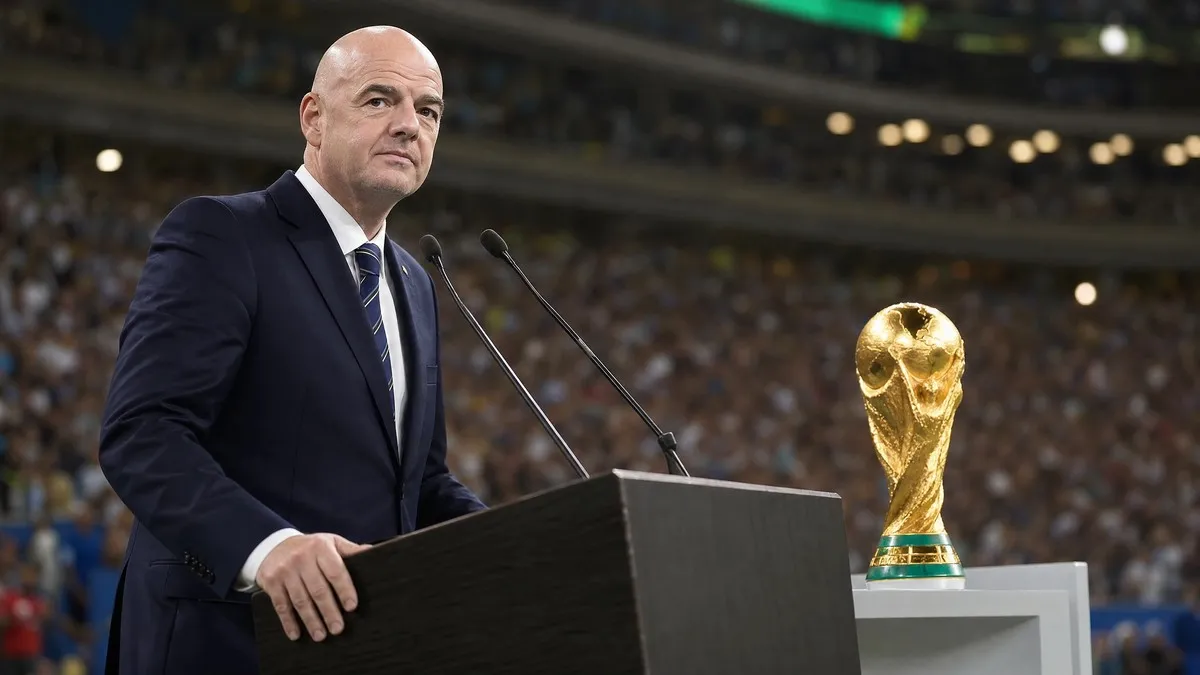
Gianni Infantino’s latest charm offensive about getting Cristiano Ronaldo onto the next World Cup stage is being sold as romance: one last dance, one last global roar. Yet it lands in a moment when many supporters feel the sport’s soul is being auctioned off, seat by seat, package by package. The louder the pitch, the more it exposes the real story: FIFA World Cup commercialization is no longer a side effect, but the main event. And the fans who built the tournament’s mythology are paying for it.
Infantino understands modern attention economics better than most administrators, and the Ronaldo World Cup storyline is attention economics in its purest form. A superstar’s presence can smooth over awkward questions about scheduling, formats, and host selection, because celebrity makes everything feel inevitable. In that sense, FIFA World Cup commercialization isn’t simply about sponsors; it’s about using icons as human billboards for a product that must always expand. The message is clear: the tournament is bigger than any nation, but it needs faces.
For supporters, the discomfort isn’t that Ronaldo remains compelling—he does—but that the conversation feels engineered. International football used to be about collective identity, about a country’s best representing a shared culture, whether you were watching from a bar or a back garden. Now it often sounds like a streaming service deciding which “content” will convert best in which market. FIFA World Cup commercialization turns the player into a marketing asset first, and a national symbol second.
There’s a thin line between leadership and salesmanship, and Infantino has been striding over it for years with a grin. Every new expansion, every new competition, every new partnership is framed as “growth,” as if football were a tech start-up chasing users. The Ronaldo World Cup chatter fits that pattern: a familiar hook to keep the spotlight fixed on FIFA’s product. FIFA World Cup commercialization thrives when governance looks like PR.
Ronaldo’s brand power is undeniable, and that’s precisely why he’s useful to the current system. He can dominate headlines without needing a single policy explained, and he can pull casual audiences toward a tournament that now asks a lot—money, time, travel, and moral compromise. In a celebrity-driven marketplace, international football becomes a stage for global personalities rather than a meeting of football cultures. FIFA World Cup commercialization turns “legacy” into a monetizable campaign.
The biggest betrayal, felt quietly and then all at once, is how the World Cup has drifted away from the working-class fans who once treated it like a civic holiday. Tickets, flights, accommodation, and the hidden costs of “official” everything now add up to a figure that makes the trip feel like a luxury cruise. Even watching at home can be fragmented by paywalls and subscriptions in some markets. FIFA World Cup commercialization has made the tournament feel less like a festival and more like a premium product.
And it’s not only the price; it’s the posture. Fans are increasingly managed like consumers to be routed, scanned, and upsold, rather than welcomed like the lifeblood of the sport. Traditional supporter culture—spontaneity, cheap seats, last-minute plans—doesn’t fit neatly into corporate hospitality models. When FIFA talks about “fan experience,” it often means branded zones and curated moments. FIFA World Cup commercialization redefines belonging as something you purchase.
World Cup accessibility used to mean you could find a way—sleep on a friend’s floor, take a night bus, queue early, and still feel part of the story. Now, the official ecosystem nudges you toward packages that bundle seats with hotels and perks you never asked for. That shift doesn’t just raise costs; it changes the crowd, filtering out the people who bring edge and noise. FIFA World Cup commercialization sanitizes the stands.
For many, the World Cup’s magic was that it belonged to everyone, even those who couldn’t travel. But broadcast rights inflation and platform fragmentation have chipped away at that universal access, depending on the country. The result is a tournament that can feel distant even from your sofa, especially when kick-off times are shaped by global markets rather than local rhythms. FIFA World Cup commercialization makes the simplest act—watching—feel conditional.
Italia 90 lives in memory not because it was perfect, but because it felt human-sized. The tournament had flaws, cautious football, and tense matches, yet it carried a warmth that’s hard to replicate: city squares, sun-faded flags, and a sense that the World Cup was a shared public space. Football nostalgia isn’t just sepia-tinted longing; it’s a recognition of intimacy. FIFA World Cup commercialization struggles to sell intimacy because intimacy can’t be scaled.
Back then, the World Cup still felt like a cultural event that happened to include sponsors, rather than a sponsorship platform that happened to include football. The branding existed, but it didn’t dominate every camera angle, every fan zone, every social clip. You remember moments, not activations. Today, even nostalgia is monetized, packaged into anniversary content and retro drops. FIFA World Cup commercialization turns memory into merchandise.
Part of the Italia 90 glow comes from how accessible it seemed for ordinary supporters, both in travel and in spirit. Stadiums felt like stadiums, not multi-layered corporate campuses, and the fan culture was less policed by branding guidelines. International football had a rawness that allowed local character to seep into every broadcast shot. When people mourn that feeling, they’re really mourning what FIFA World Cup commercialization has replaced.
Critics often dismiss football nostalgia as refusing to move with the times, but nostalgia can be a useful measuring stick. It helps fans articulate what has been lost: affordability, spontaneity, and the sense that the World Cup was a once-every-four-years commons. Modern tournaments can be spectacular, but spectacle is not the same as connection. FIFA World Cup commercialization keeps upgrading the spectacle while downgrading the closeness.
Hosting decisions now arrive with a moral hangover, because the World Cup has become a tool of global reputation management as much as a sporting honor. When tournaments land in politically contentious environments, fans are asked to hold two truths at once: that football can unite, and that it can be used to launder images. The bigger the event becomes, the more attractive it is to states and investors seeking soft power. FIFA World Cup commercialization makes the World Cup an irresistible geopolitical prize.
In this landscape, the “festival” becomes inseparable from questions about labor, rights, policing, and who gets to feel safe and welcome. Supporters want to focus on international football, on the joy of a last-minute winner, but the context keeps intruding. That’s not because fans have become overly sensitive; it’s because the tournament’s scale amplifies consequences. FIFA World Cup commercialization expands the footprint, and the footprint leaves marks.
As FIFA pushes bigger formats and more matches, it needs more infrastructure, more guarantees, and more money, which narrows the pool of viable hosts. That can tilt the process toward bidders with deep pockets and strong political motivations, rather than those with organic football culture. The risk is that the World Cup becomes a travelling expo, dropped into places that can afford it rather than places that live it. FIFA World Cup commercialization makes compromise feel structural.
Most supporters don’t want to be moral philosophers every four years; they want to sing, argue, laugh, and feel the tension rise with a national anthem. But modern hosting debates force fans into uncomfortable calculations about participation and complicity. The sport’s leaders often respond with slogans about unity, which can sound like a way to end the conversation rather than engage it. FIFA World Cup commercialization thrives on moving fast, before doubts settle.
International football has always competed with club football for attention, but the balance is shifting as money concentrates at the club level. Players arrive to national teams carrying the physical and emotional fatigue of relentless seasons, while clubs worry about injuries to their most expensive assets. Meanwhile, FIFA’s answer often appears to be more inventory: more games, more tournaments, more content. FIFA World Cup commercialization treats the calendar as a shelf that must always be restocked.
This creates a strange tension where the World Cup is still the pinnacle, yet the pathways to it feel increasingly transactional. Qualification can be stretched, friendlies can look like obligations, and even the narrative arcs are shaped by marketing cycles. Fans sense the strain when performances look flat or when squads rotate like pre-season tours. The romance of representing your country doesn’t vanish, but it gets squeezed. FIFA World Cup commercialization turns scarcity into abundance, and abundance into noise.
At the top level, footballers are now managed like portfolios, with minutes, travel, and recovery optimized across multiple competitions. That reality changes how international football feels, because the raw, reckless edge of national duty clashes with the long-term interests of clubs and sponsors. It’s not that players care less; it’s that the system asks them to care on an industrial schedule. FIFA World Cup commercialization increases demands while pretending emotion is infinite.
Fans worry that expanding tournaments and adding fixtures will dilute what made the World Cup special: its rarity and concentrated drama. When everything becomes a “global event,” nothing feels like an event, just another slot on the timeline. The World Cup should feel like a comet, not a commuter train. Yet the commercial logic insists that if people love something, they should get more of it immediately. FIFA World Cup commercialization risks turning anticipation into fatigue.
Look ahead and you can see a plausible future where club football, powered by private investment and year-round narratives, becomes the primary identity for many fans. International football will still matter, but it may feel like a special interruption rather than the main stage, especially for younger audiences raised on weekly club storylines and constant content. In that world, the World Cup remains huge, yet oddly less central. FIFA World Cup commercialization accelerates this by treating the tournament as a product competing in the same market as clubs.
That’s the irony: by pushing the World Cup to behave like a club competition—always on, always expanding—FIFA may weaken the very uniqueness that keeps it above the club game. The most powerful defense of international football has always been its difference: the rarity, the national stakes, the sense of history crashing into 90 minutes. If FIFA wants the World Cup to dominate forever, it should protect that difference, not monetize it into sameness. FIFA World Cup commercialization needs boundaries, not just revenue targets.
Supporters aren’t demanding a return to some impossible past; they’re asking for basic respect for the culture they sustain. That means World Cup accessibility that doesn’t require wealth, ticketing that doesn’t feel like a lottery for the privileged, and hosting choices that don’t treat fans as collateral. It also means fewer hollow slogans and more transparency about how decisions are made. FIFA World Cup commercialization can be tempered, but only if fans’ interests are treated as central.
If Ronaldo makes the next tournament, it will be compelling television, and many will enjoy the theatre of it. But one superstar’s story cannot solve the broader drift away from community and toward corporate spectacle. The danger is that FIFA uses a celebrity moment as proof that everything is fine, that the product still sparkles. The sparkle isn’t the issue; the cost is. FIFA World Cup commercialization remains the defining tension, with or without Ronaldo.
None of this requires hating modern football, or pretending the World Cup hasn’t delivered unforgettable drama in recent editions. It’s precisely because the tournament still has that power that the direction feels so frustrating: the magic survives, but it’s being wrapped in layers of pricing, politics, and branding until it’s harder to touch. If Infantino wants Ronaldo at the World Cup, he should also want the people who once made the World Cup feel like theirs. Without working-class fans, FIFA World Cup commercialization will win—and international football will lose.

Julian Mercer is a lifelong student of the game whose passion for football was sparked at an early age, after stepping onto the grass of Camp Nou as a six-year-old — a moment that left a lasting impression and set him on a permanent path into the sport. Since then, football has been both his lens on the world and his favourite language. Blending traditional fandom with a deep interest in tactics, squad building, and long-term team development, Julian has spent decades analysing the game from every angle. His fascination with football strategy was further shaped through years of immersive play in Football Manager, a series he has followed since the mid-1990s, developing a sharp eye for patterns, player profiles, and the fine margins that define success. At My World Of Football, Julian focuses on the stories beneath the surface — from tactical evolutions and managerial philosophies to the narratives that connect clubs, players, and supporters across generations. His writing aims to balance insight with accessibility, always grounded in a genuine love for the game.
Continue reading more football news