Khvicha Kvaratskhelia PSG commitment ends PL talk
Khvicha Kvaratskhelia PSG commitment is clear as he dismisses Man United and Arsenal rumors, fuels PSG Champions League hopes with Barcola.
Khvicha Kvaratskhelia PSG commitment is clear as he dismisses Man United and Arsenal rumors, fuels PSG Champions League hopes with Barcola.
Khvicha Kvaratskhelia has learned that a big-name move never really ends; it just changes headline. Yet the 25-year-old winger has drawn a firm line under the latest noise, brushing aside links to Manchester United and Arsenal with a message that felt personal rather than rehearsed. The Khvicha Kvaratskhelia PSG commitment story is not about flirting with England, but about falling for Paris and buying into Luis Enrique’s project. With the Champions League knockout stage looming, PSG want clarity, and Kvaratskhelia has offered it.
When Kvaratskhelia spoke about Paris, the language was strikingly domestic: family, dream, belonging. That choice of words matters because transfer talk often reduces players to assets, wage packets, and release clauses. Instead, the Khvicha Kvaratskhelia PSG commitment message framed his move as an emotional destination, not a stepping stone. For a club long accused of chasing glamour, this is the kind of testimony PSG have craved.
It also lands at a delicate moment, with Manchester United interest and Arsenal winger targets dominating the rumor mill whenever an elite wide forward strings together a few decisive weeks. Kvaratskhelia has been more than a highlights reel since arriving from Napoli in early 2025; he has been a system player and a tone setter. That’s why the Khvicha Kvaratskhelia PSG commitment stance feels like a sporting decision as much as a romantic one.
Kvaratskhelia transfer news is inevitable because both Premier League giants are shopping for difference-makers in wide areas. United want reliable progression and chance creation from the flanks, while Arsenal’s recruitment has long leaned toward versatile wingers who can press and combine. Add the league’s financial pull and the constant appetite for star names, and you get recurring speculation. The Khvicha Kvaratskhelia PSG commitment line, therefore, is less a surprise than a necessary public boundary.
There’s a subtle power shift when a player treats PSG as the end point rather than the middle chapter. The club’s recent history—Lionel Messi, Neymar, and Kylian Mbappe orbiting like supernovas—often made Paris feel like a stage for individual eras. Kvaratskhelia’s affection reframes the narrative toward continuity and identity. That’s the heartbeat of Khvicha Kvaratskhelia PSG commitment: not just staying, but settling.
Luis Enrique’s PSG has been gradually moving away from celebrity football toward something more repeatable: structure, spacing, and coordinated pressing. In that environment, the winger is not simply asked to beat a full-back; he’s asked to trigger rotations, protect central zones, and attack the far post on cue. Kvaratskhelia has embraced those details, which is why the Khvicha Kvaratskhelia PSG commitment feels intertwined with tactical trust. He isn’t surviving in the system; he’s shaping it.
That tactical fit is also why he has quickly entered the Ligue 1 top players conversation, not merely for flair but for influence. PSG’s possession phases often hinge on his ability to receive under pressure, draw two defenders, and still find the third-man run. His defensive work has surprised some, especially those who only remember his Napoli days as a pure dribbler. The Khvicha Kvaratskhelia PSG commitment is, in practice, a commitment to doing the hard, unglamorous parts too.
Enrique wants width that stretches, but also wingers who can invert and become playmakers between the lines. Kvaratskhelia’s best sequences often start wide, then end with him slipping inside to combine, letting the full-back overlap and pin the defense. That movement creates the half-space lanes PSG need to access the box with control. It’s another reason Kvaratskhelia transfer news feels misplaced: the role is tailored, and the Khvicha Kvaratskhelia PSG commitment is mutually beneficial.
At Napoli, Kvaratskhelia was the spark; at PSG, he’s becoming a stabilizer as well. The badge carries different pressure, and the expectation is not just to win, but to win while looking inevitable. He has responded by reducing low-percentage actions and choosing moments to explode rather than forcing them. That maturity is what turns a star into a cornerstone, and it’s embedded in the Khvicha Kvaratskhelia PSG commitment narrative.
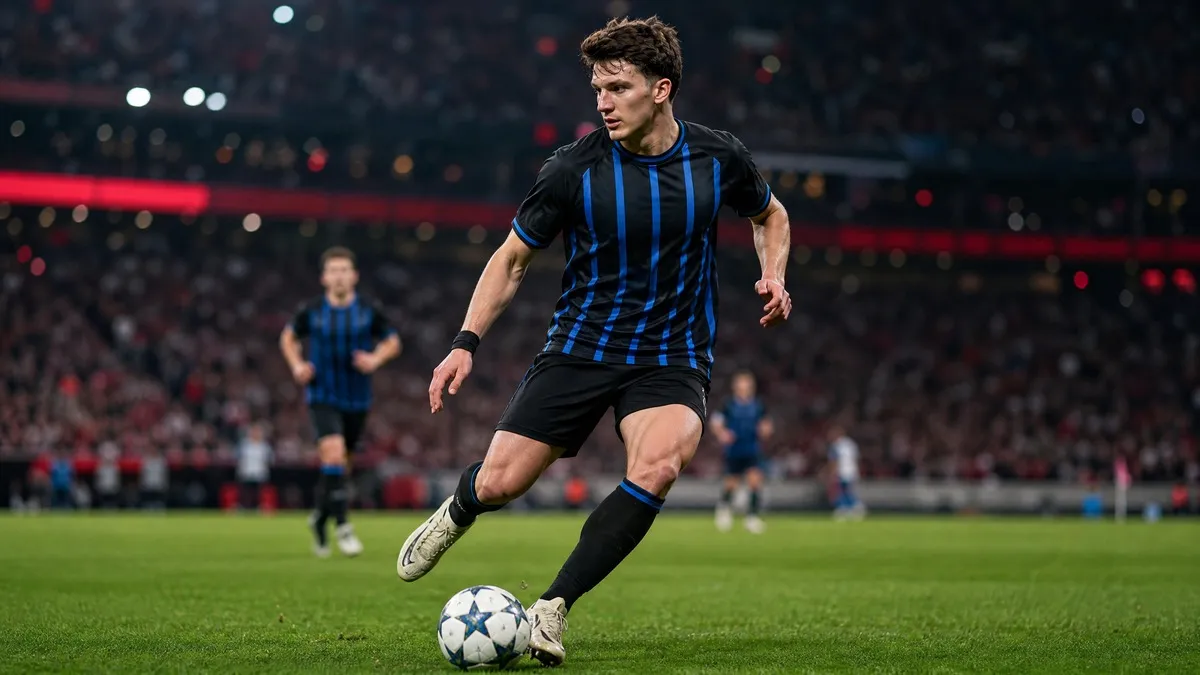
Every great European run is built on partnerships, and PSG’s most compelling one this season has been the wing-to-wing chemistry between Kvaratskhelia and Bradley Barcola. Their combined 19 goals isn’t just a stat; it’s a map of how PSG now attack—fast switches, aggressive cutbacks, and two players comfortable arriving in the box. The Khvicha Kvaratskhelia PSG commitment matters here because partnerships need time, and time is exactly what he’s promising.
What makes the duo dangerous is contrast. Barcola often threatens with straight-line acceleration and early deliveries, while Kvaratskhelia manipulates defenders with pauses, feints, and sudden changes of angle. Defenses can’t load up on one side without being punished on the other, which is why PSG Champions League hopes feel more grounded than in some previous seasons. The Khvicha Kvaratskhelia PSG commitment, then, is also a commitment to building a two-headed threat that travels in Europe.
Full-backs hate uncertainty, and PSG’s wingers manufacture it relentlessly. When Barcola holds width, Kvaratskhelia can drift inside to overload midfield; when Kvaratskhelia stays wide to isolate, Barcola can dart into the channel behind the center-back. Those alternating patterns force constant communication and often produce the half-second of hesitation that decides chances. It’s a partnership that looks coached rather than improvised, reinforcing why Khvicha Kvaratskhelia PSG commitment is a strategic win.
The headline number is 19 goals, but the hidden value is in the pressing and the recovery runs that keep PSG’s attacks alive. Both wingers sprint to counter-press after losing the ball, which pins opponents deep and increases PSG’s shot volume. That relentless cycle is a hallmark of elite knockout teams, where momentum swings quickly. In that context, the Khvicha Kvaratskhelia PSG commitment is as much about collective intensity as it is about personal form.
Premier League clubs will always test the water for players who can decide matches, and Kvaratskhelia fits the profile. Manchester United interest makes sense in a squad still searching for consistent wide production and a dependable final-third connector. Arsenal winger targets, meanwhile, often focus on players who can press, rotate, and maintain positional discipline—boxes Kvaratskhelia ticks. Yet the Khvicha Kvaratskhelia PSG commitment response suggests those approaches met a player already convinced by his current environment.
There’s also the reality that PSG can offer what United and Arsenal can’t guarantee in the same way: a yearly, credible push to win the Champions League, backed by a squad built for it. For a player entering his prime, the decision is not only financial or cultural; it’s about the probability of lifting the biggest trophies. Kvaratskhelia transfer news will keep circulating, but the Khvicha Kvaratskhelia PSG commitment stance hints he values the project’s trajectory over the league’s spotlight.
Players don’t just move for badges; they move for roles that maximize their strengths. At PSG, Kvaratskhelia has a defined place in a high-possession, high-press system that feeds him in dangerous zones. At United or Arsenal, he’d face adaptation to different rhythms, and potentially different expectations about touchline width versus central occupation. With PSG Champions League hopes rising, the Khvicha Kvaratskhelia PSG commitment is a bet on continuity and clarity.
Football decisions are often sold as purely professional, but players live in cities, not spreadsheets. Kvaratskhelia’s comments about Paris and his family’s dream give weight to the idea that he feels rooted. That kind of attachment can be rare in an era of constant movement, and it resonates with supporters desperate for symbols of loyalty. The Khvicha Kvaratskhelia PSG commitment message, therefore, isn’t just a rebuttal to rumors; it’s a declaration of identity.
PSG’s modern history is impossible to discuss without the gravitational pull of Messi, Neymar, and Mbappe. Their presence delivered unforgettable nights and global attention, but it also created a team-building logic centered on accommodating superstars. The new era is different: less about collecting icons and more about assembling a cohesive, coach-driven squad. In that context, Khvicha Kvaratskhelia PSG commitment reads like a signpost that PSG’s culture is shifting toward stability.
That shift doesn’t mean PSG have abandoned star power; it means they want stars who fit a shared plan. Kvaratskhelia is a marquee name, yet his value is amplified because he buys into collective mechanisms rather than floating above them. Fans can feel the difference when a winger tracks back, presses on triggers, and celebrates defensive stops like goals. The Khvicha Kvaratskhelia PSG commitment line is powerful because it aligns with a club narrative that finally sounds coherent.
PSG’s recruitment now appears more targeted: players who can play multiple roles, maintain intensity, and accept coaching. That’s not a rejection of flair; it’s an attempt to make flair sustainable across a season and, crucially, across two-legged ties. Kvaratskhelia embodies that balance, offering dribbling and invention without abandoning structure. The Khvicha Kvaratskhelia PSG commitment becomes a recruitment success story—proof that the new approach can attract elite talent.
Leadership at PSG used to be associated with celebrity gravity, but the current group needs leaders who set standards daily. Kvaratskhelia’s influence shows up in how PSG keep attacking after setbacks and how the front line initiates the press together. He’s not the loudest figure, yet his consistency nudges others toward professionalism. That’s why Khvicha Kvaratskhelia PSG commitment is more than a quote; it’s a behavioral contract with the dressing room.
The Champions League knockout stage is where reputations harden, especially for attackers judged on moments. PSG’s recent European story has included painful exits that exposed fragility under stress, so this season’s test is psychological as much as tactical. Kvaratskhelia enters that arena with momentum and a clear role, and his calm dismissal of transfer noise suggests focus. The Khvicha Kvaratskhelia PSG commitment angle matters because distractions can fracture teams right when margins shrink.
For PSG, the hope is that this version of the squad travels better: more compact without the ball, more patient with it, and less dependent on one savior. Kvaratskhelia and Barcola provide two sources of penetration, which makes PSG harder to cage in big European nights. If PSG Champions League hopes are to become reality, they’ll need wingers who can decide ties with both brilliance and discipline. That’s the stage where Khvicha Kvaratskhelia PSG commitment can turn from promise into legacy.
In knockouts, opponents will double up, show him down the line, and force early crosses rather than letting him cut inside. They’ll also bait him into turnovers to launch counters into the space PSG leave when full-backs push on. The response has to be variation: quick combinations, underlaps, and the occasional switch of play to punish overloads. If he adapts on the fly, the Khvicha Kvaratskhelia PSG commitment story will look like the foundation of a European breakthrough.
PSG’s great players are remembered for European nights, not just Ligue 1 weekends. A run defined by key goals, assists, or even one tie-winning performance can change how a player is perceived in Paris forever. Kvaratskhelia has the tools—close control, courage, and end product—and now he has a platform that suits him. Delivering when the pressure peaks would make Khvicha Kvaratskhelia PSG commitment feel prophetic rather than promotional.
For now, the story is refreshingly straightforward: a star winger is happy, trusted, and determined to win where he is. Kvaratskhelia transfer news will continue because that’s the sport’s background noise, and Manchester United interest or Arsenal winger targets will always be attached to elite talent. But the message coming out of Paris is consistent, and it’s backed by performances that fit a clear plan. Khvicha Kvaratskhelia PSG commitment is not a slogan; it’s a season-defining stance as PSG chase the biggest prize.

Julian Mercer is a lifelong student of the game whose passion for football was sparked at an early age, after stepping onto the grass of Camp Nou as a six-year-old — a moment that left a lasting impression and set him on a permanent path into the sport. Since then, football has been both his lens on the world and his favourite language. Blending traditional fandom with a deep interest in tactics, squad building, and long-term team development, Julian has spent decades analysing the game from every angle. His fascination with football strategy was further shaped through years of immersive play in Football Manager, a series he has followed since the mid-1990s, developing a sharp eye for patterns, player profiles, and the fine margins that define success. At My World Of Football, Julian focuses on the stories beneath the surface — from tactical evolutions and managerial philosophies to the narratives that connect clubs, players, and supporters across generations. His writing aims to balance insight with accessibility, always grounded in a genuine love for the game.
Continue reading more football news