Myworldoffootball
PSV Eindhoven Competition Challenges in Eredivisie
Huub Stevens warns PSV Eindhoven competition challenges hurt Europe. Ajax performance and Feyenoord struggles reduce pressure, fueling PSV complacency.
Huub Stevens warns PSV Eindhoven competition challenges hurt Europe. Ajax performance and Feyenoord struggles reduce pressure, fueling PSV complacency.
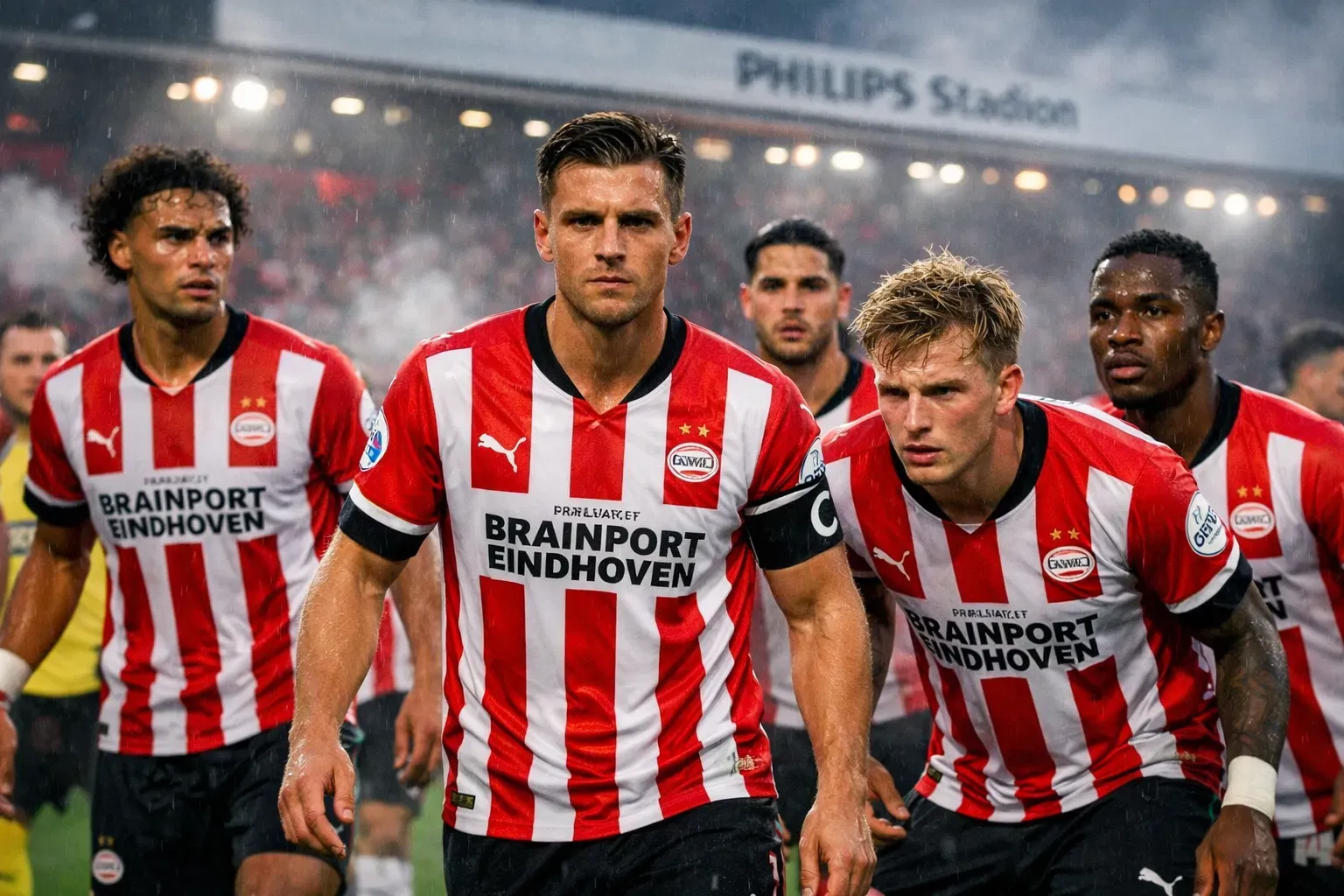
PSV Eindhoven lifted the Eredivisie title with weeks to spare again, and the celebrations were loud enough to drown out the uncomfortable questions. In a Huub Stevens interview that cut through the confetti, the veteran coach argued that dominance can be a trap when it arrives without resistance. His point wasn’t to diminish PSV’s work under Peter Bosz, but to underline PSV Eindhoven competition challenges that appear paradoxical: winning too easily at home can leave you undercooked in Europe.
Stevens’ central claim is simple and sharp: PSV Eindhoven competition challenges are rooted in an Eredivisie title race that never truly became a race. PSV can only beat what is in front of them, yet when Ajax performance dips and Feyenoord struggles to sustain pressure, the weekly edge that shapes elite habits is dulled. Stevens sees that as a structural problem, not a one-off quirk of a single season.
The detail that stings is the trend line: PSV won their title early for the third consecutive year, a statistic that should sound like glory but can also read like stagnation. When the league is effectively decided by spring, intensity becomes optional rather than essential, and training-ground standards can slip. Stevens frames PSV Eindhoven competition challenges as psychological as much as tactical, because motivation is easier to keep when the table threatens you.
Stevens is blunt that Ajax performance has not met the club’s own historical bar, and Feyenoord struggles to replicate their best stretches over a full campaign. That matters because the Dutch top three traditionally sharpen each other through relentless weekends, turning small mistakes into dropped points. Without that squeeze, PSV Eindhoven competition challenges increase because the team can win while still carrying flaws, especially in game management and concentration.
Peter Bosz has built an assertive side that wants the ball, wants territory, and wants to overwhelm opponents, and PSV deserve credit for executing that identity. Yet Stevens warns that comfort can creep into even the most ambitious project when the consequences are low. PSV Eindhoven competition challenges show up when the same patterns succeed domestically without requiring adaptation, leaving the squad less practiced at suffering, defending leads, or winning ugly.
Stevens’ most pointed observation is about timing: he senses PSV complacency in the second half of the season, precisely when champions usually harden. When the title looks inevitable, the subconscious bargains begin, a yard less sprinted here, a duel avoided there, a risk not taken because “we’ll win anyway.” Those are tiny choices, but they accumulate into PSV Eindhoven competition challenges when the calendar moves toward Europe.
It’s not that PSV stopped being good; it’s that the margin for error widened, and that changed behavior. A comfortable lead can turn matches into rehearsals rather than examinations, and rehearsals rarely reveal what breaks under pressure. Stevens is essentially arguing that PSV Eindhoven competition challenges are self-reinforcing: the less pressure you face, the less you prepare for pressure, and the more shocking pressure becomes when it finally arrives.
Calling it a dip is not an accusation of laziness, but a diagnosis of incentives. In a tight Eredivisie title race, every April fixture is a final, and the league itself becomes a conditioning tool for the mind. When that disappears, PSV complacency can look like rotation without edge or possession without bite. Stevens links PSV Eindhoven competition challenges to this missing stress test, rather than to any single tactical tweak.
In dominant teams, leadership is often measured by how players behave when no one is forcing them to behave well. That is where Stevens believes PSV must become ruthless, setting internal targets that mimic external pressure. If Ajax performance and Feyenoord struggles reduce the threat, PSV have to manufacture it through standards, competition for places, and uncomfortable conversations. Otherwise PSV Eindhoven competition challenges will persist, even while trophies keep arriving.
Stevens’ argument lands hardest when you place PSV’s domestic rhythm next to the tempo of European competitions. In the Champions League or Europa League, opponents close space faster, punish errors earlier, and turn one sloppy minute into a decisive swing. PSV Eindhoven competition challenges are magnified because the team can go weeks in the Eredivisie without facing that level of punishment. The first time it arrives is often on a cold European night with no margin.
That doesn’t mean the Eredivisie lacks quality, but it does mean the distribution of quality can be uneven in a given year. When PSV only meet truly elite resistance outside the Netherlands, the learning curve becomes steep and unforgiving. Stevens sees PSV Eindhoven competition challenges as a preparation problem: you can’t simulate the emotional and physical intensity of Europe if your domestic schedule rarely demands it, no matter how good your training is.
The best European sides arrive in knockout ties with a library of recent experiences: comebacks, late winners, frantic defending, and tactical pivots that were tested under fire. If PSV’s toughest lessons only come in Europe, they are learning in public, against opponents built to exploit inexperience. Stevens believes PSV Eindhoven competition challenges are about repetition; you need high-stakes domestic matches to normalize chaos, not treat it as an emergency.
European competitions are often decided by second balls, transitions, and the ability to stay compact when your press is bypassed. Those are habits, not slogans, and habits are forged when every league match has real jeopardy. Stevens is effectively saying PSV Eindhoven competition challenges show up in those micro-moments: a half-second late to a duel, a fullback caught high, a midfielder not tracking because the last five league games didn’t punish it.
Stevens doesn’t just complain; he offers a route forward by insisting PSV must foster competition, whether through youth players impact or new signings. If the league doesn’t always supply the pressure, the squad must. That means creating genuine battles for starting spots, not ceremonial rotation, so that every training session has consequences. In his view, PSV Eindhoven competition challenges ease when players feel replaceable, because intensity becomes non-negotiable.
The youth pathway is particularly important in the Netherlands, where development is part of identity and economics. But Stevens’ point is not to promote youngsters for romance; it’s to promote them for friction. A fearless teenager can raise the tempo of a session and force established starters to sharpen up. When done well, youth players impact becomes a competitive tool, reducing PSV Eindhoven competition challenges by turning comfort into urgency.
Bosz’s football demands movement, courage, and quick decision-making, traits that young players often bring naturally because they play without fear. Integrating them strategically can refresh the group, especially late in the season when routines become stale. Stevens would argue that youth players impact should be tied to clear performance markers, so minutes are earned and not gifted. That approach directly addresses PSV Eindhoven competition challenges by raising daily standards.
There’s a difference between adding depth and adding discomfort. Depth keeps you safe when injuries hit; discomfort forces starters to evolve because the bench is genuinely threatening. Stevens’ logic suggests PSV should recruit profiles that challenge incumbents in key roles, even if that creates difficult decisions for Bosz. If PSV Eindhoven competition challenges are partly about complacency, then recruitment should be designed to make complacency impossible.
It may sound strange, but Stevens is effectively arguing that PSV need a stronger Ajax and a stronger Feyenoord. Rivalry is not just entertainment; it’s infrastructure for excellence, because it creates weekly consequences and forces innovation. When Ajax performance collapses into inconsistency and Feyenoord struggles to sustain their best level, PSV Eindhoven competition challenges grow in the background, hidden beneath big wins and early celebrations.
This is not nostalgia for a “better old days” Eredivisie; it’s recognition that competitive ecosystems raise everyone’s ceiling. A ferocious top three pushes clubs to improve scouting, coaching, sports science, and mentality because the margin for error disappears. Stevens believes PSV Eindhoven competition challenges would shrink if the league’s elite were all functioning properly, because PSV would be compelled to keep evolving rather than simply maintaining dominance.
Fans often talk about the Eredivisie title as a narrative that peaks in May, but Stevens talks about it as a weekly exam. The best leagues force contenders to solve different problems every weekend, from low blocks to high presses to hostile away atmospheres. If Ajax performance improves and Feyenoord struggles are resolved, PSV would face more of those exams. That would reduce PSV Eindhoven competition challenges by making pressure routine.
Stevens’ broader point is cooperative even while it sounds critical: stronger rivals would benefit all Dutch clubs in European competitions. When domestic matches are intense, teams arrive in Europe already conditioned to speed, contact, and tactical variation. PSV Eindhoven competition challenges are partly the consequence of an uneven domestic landscape, and fixing that landscape lifts the entire coefficient conversation. In that sense, PSV’s rivals are also their training partners for Europe.
The most useful part of Stevens’ critique is that it can be converted into a plan. PSV can’t control Ajax performance or instantly cure Feyenoord struggles, but they can control the environment inside De Herdgang and the standards on matchday. That means treating every league fixture like a European rehearsal, with non-negotiable intensity targets and honest reviews even after comfortable wins. PSV Eindhoven competition challenges diminish when complacency is identified early and punished internally.
For Bosz, the task is to keep the attacking identity while building a team that can survive uncomfortable phases without panic. That requires tactical flexibility, but also emotional resilience, the ability to defend a lead, manage tempo, and win when rhythm disappears. Stevens is not asking PSV to become cynical; he’s asking them to become complete. In that completeness lies the solution to PSV Eindhoven competition challenges, because Europe rewards teams that can play more than one way.
One way to fight complacency is to make it visible. PSV can set benchmarks for sprints, counter-press actions, duel success, and recovery runs, then review them as seriously as goals and assists. When players know intensity is being tracked and selection depends on it, effort becomes a habit rather than a mood. Stevens’ philosophy suggests PSV Eindhoven competition challenges are best solved by accountability systems that don’t care about the scoreline.
Ultimately, Europe tests whether a team can stay itself while the match tries to take that identity away. PSV need league weeks that mimic that feeling, and if the Eredivisie can’t always provide it, the squad must. Internal competition, youth players impact, and targeted recruitment can create the friction that sharpens edges. If PSV embrace that, PSV Eindhoven competition challenges can turn into an advantage: a champion that refuses comfort becomes a contender abroad.
Stevens’ message is uncomfortable because it arrives during a party, but that’s exactly why it matters. An early Eredivisie title is proof of quality, yet it can also be a mirror reflecting what the league didn’t force you to learn. PSV Eindhoven competition challenges won’t be solved by dismissing the critique or by waiting for Ajax performance to rebound and Feyenoord struggles to vanish. They will be solved by Bosz and PSV choosing to live like they’re being chased, even when they aren’t.

Julian Mercer is a lifelong student of the game whose passion for football was sparked at an early age, after stepping onto the grass of Camp Nou as a six-year-old — a moment that left a lasting impression and set him on a permanent path into the sport. Since then, football has been both his lens on the world and his favourite language. Blending traditional fandom with a deep interest in tactics, squad building, and long-term team development, Julian has spent decades analysing the game from every angle. His fascination with football strategy was further shaped through years of immersive play in Football Manager, a series he has followed since the mid-1990s, developing a sharp eye for patterns, player profiles, and the fine margins that define success. At My World Of Football, Julian focuses on the stories beneath the surface — from tactical evolutions and managerial philosophies to the narratives that connect clubs, players, and supporters across generations. His writing aims to balance insight with accessibility, always grounded in a genuine love for the game.
Continue reading more football news