Myworldoffootball
Tottenham Hotspur Champions League hope after Anfield draw
Tottenham Hotspur snatch 1-1 at Liverpool as Richarlison rescues Igor Tudor. Now Spurs chase Tottenham Hotspur Champions League miracle vs Atletico.
Tottenham Hotspur snatch 1-1 at Liverpool as Richarlison rescues Igor Tudor. Now Spurs chase Tottenham Hotspur Champions League miracle vs Atletico.
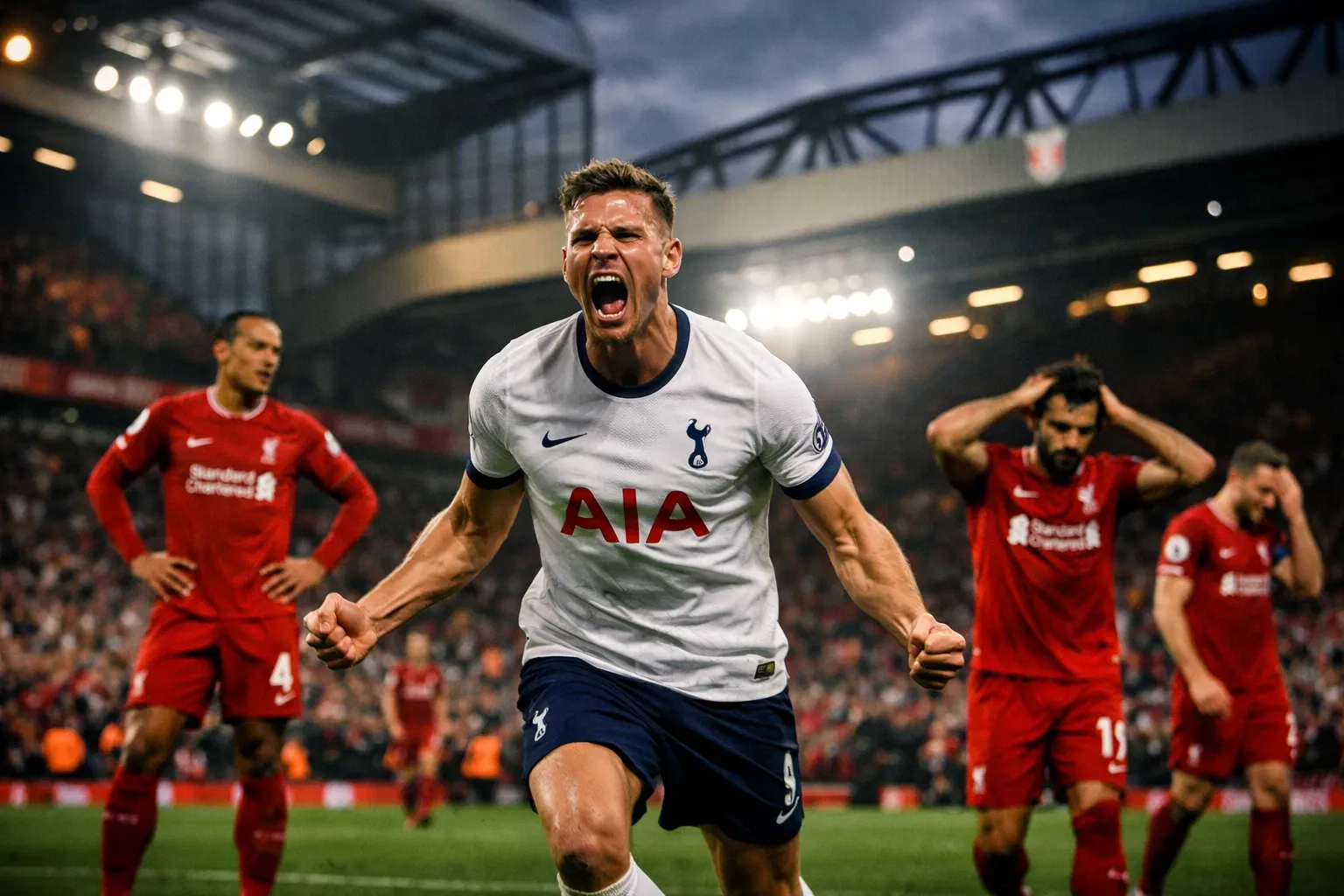
Tottenham Hotspur walked out of Anfield with a 1-1 draw that felt like a win, not because it rewrote the table overnight, but because it stopped the bleeding. Igor Tudor’s interim reign had been defined by six straight defeats, a spiral that made every fixture sound like a referendum on character. Then came the Richarlison goal in the 90th minute, a late punchline that flipped the mood in the away end. Now the Tottenham Hotspur Champions League story returns, with Atletico Madrid looming and a three-goal deficit to erase.
Liverpool controlled large stretches, pinning Spurs back with wave after wave and forcing Tottenham’s midfield to defend facing their own goal. For Tudor, the priority was survival, and you could see it in the compact lines and the reluctance to over-commit full-backs. Yet the longer Spurs stayed within touching distance, the more the match began to resemble a test of nerve rather than pure quality. That mattered, because the Tottenham Hotspur Champions League chase needs belief as much as tactics.
The equaliser arrived like a release valve, the Richarlison goal turning groans into a roar that carried all the way down the touchline. Spurs had looked short on ideas in the final third, but they kept asking the same question of Liverpool’s back line with late runs and second balls. When the moment landed, Richarlison attacked it with the hunger of a player who knows his season is measured in defining touches. In one swing, the Tottenham Hotspur Champions League conversation regained oxygen.
Ending a six-match losing streak sounds like a small thing when you’re still stuck in the churn of the Premier League, but psychologically it is massive for a squad living on thin margins. Tudor needed a result that players could point to as proof the plan works under pressure, and Anfield is as pressurised as it gets. The draw also buys him time to manage minutes and confidence ahead of the Tottenham Hotspur Champions League second leg, where panic would be fatal.
Igor Tudor’s biggest win was resisting the urge to chase the game too early, because Spurs have been punished repeatedly for losing structure. He asked his wide players to track runners and his central defenders to hold their line rather than dive into duels, a pragmatic tweak that reduced the chaos. It was not pretty, but it was purposeful, and the bench reacted like a group that finally understood the assignment. That clarity is essential if Tottenham Hotspur Champions League ambition is to coexist with Premier League survival.
The first leg in Spain was the kind of night that leaves bruises you can’t tape up, a 5-2 defeat that turned a tie into a mission. Spurs were open in transition, naive in their defensive distances, and repeatedly punished by Atletico’s timing between the lines. A three-goal deficit is not impossible, but it demands a perfect blend of early control and ruthless finishing, two things Tottenham have struggled to marry this season. Still, the Tottenham Hotspur Champions League is built on improbable swings and emotional surges.
Anfield’s draw changes the tone heading into the return leg, because it proves Spurs can withstand long spells without collapsing. The problem is Atletico are not Liverpool; they don’t just press, they suffocate rhythm and turn games into a series of traps. Spurs will need to score, but they also need to avoid the first-leg pattern where one concession became two and then three. If Tottenham Hotspur Champions League progress is to be more than a slogan, the opening 20 minutes must be controlled rather than chaotic.
To overturn a deficit like this, Spurs need more than bravery; they need sequencing, the ability to create chances without gifting Atletico the counter-attacking spaces they crave. That means set-piece discipline, rest defence, and a clear plan for how to press without being played through. Tudor has to decide whether to gamble on a high line for territory or sit deeper and trust the crowd to lift an incremental comeback. In the Tottenham Hotspur Champions League, impatience is often the hidden opponent.
Atletico Madrid will arrive expecting Spurs to overreach, and Diego Simeone’s teams are masters at turning urgency into recklessness. Every stoppage, every duel, every bit of dark arts will be designed to slow Spurs’ momentum if they score once. Tottenham must keep their heads when decisions go against them, because the tie can be lost in the reaction to a foul as easily as in open play. The Tottenham Hotspur Champions League is unforgiving, and Atletico specialise in that cruelty.
One of the defining images from the 5-2 was Antonin Kinsky being substituted early after errors that shifted the tie’s gravity. Goalkeepers can survive a mistake, but two in quick succession becomes a crisis of trust, and Spurs looked jittery in every subsequent phase. The replacement was as much about protecting the player as it was about changing the match, yet the damage was done. In the Tottenham Hotspur Champions League, confidence is contagious, and so is doubt.
Kinsky’s situation now becomes a delicate management challenge for Tudor, who must weigh development against immediate necessity. If Spurs are to chase three goals, they will take risks, and that increases the chance the goalkeeper is exposed in one-on-ones or through balls behind the line. The last thing Tottenham need is a repeat of the first-leg fragility, where a small wobble became a collapse. For Tottenham Hotspur Champions League dreams, the keeper decision might be as important as the front three.
When a goalkeeper loses trust, defenders stop taking angles that invite pressure, and midfielders drop too deep to offer safe outlets, stretching the team vertically. That makes it harder to play through Atletico’s press, because the distances become too long and the turnovers more dangerous. Spurs must be brave in their build-up, but bravery has to be paired with clear passing lanes and rehearsed patterns. Tottenham Hotspur Champions League comebacks start with clean first passes, not hopeful clearances.
Igor Tudor can protect his goalkeeper by asking for a slightly deeper line and more conservative full-back positioning, but that risks blunting the early momentum Spurs need. Alternatively, he can lean into aggression, trusting the keeper to reset mentally and trusting the crowd to carry the team through scary moments. The balance is thin, and the wrong choice can cost a tie in ten minutes. In the Tottenham Hotspur Champions League, managers are judged on these uncomfortable calls.
Atletico’s biggest headline ahead of the second leg is the absence of Jan Oblak, ruled out with a muscle strain that changes the texture of the contest. Oblak is not just a shot-stopper; he is a calming presence that allows Atletico to defend deep without panic, because everyone trusts the last line. Without him, Simeone must decide whether to keep the same low block or push the line slightly higher to reduce the volume of shots. Tottenham Hotspur Champions League hope often begins with a single crack.
Spurs should not assume an easier night simply because Oblak is missing, but they would be foolish not to target the psychological edge it creates. A backup goalkeeper can have a brilliant evening, yet he is also more likely to spill a cross or misjudge a crowded corner, and those are exactly the moments a comeback feeds on. Tottenham must flood the box with runners and test decision-making early. If the Tottenham Hotspur Champions League is to tilt, it will tilt through pressure.
With Oblak out, Spurs can be more intentional about creating shots that stress handling rather than just placement. That means low drives through bodies, cutbacks that force quick set positions, and shots across goal that invite rebounds for poachers like Richarlison. The temptation will be to shoot on sight, but quality still matters, because wasted efforts fuel Atletico’s counter-attacks. Tottenham Hotspur Champions League scenarios reward teams who turn pressure into repeatable, high-value chances.
Simeone’s most natural reaction is to protect his goalkeeper with an even denser defensive shell, reducing the space for Spurs’ creative players to operate. That could mean narrower midfield lines, fewer full-back adventures, and a willingness to concede territory while defending the box like a fortress. For Tottenham, that raises the importance of quick switches and well-timed overlaps to stretch the block. The Tottenham Hotspur Champions League comeback equation is simple: make Atletico move, then make them decide.
The uncomfortable truth is that Tottenham’s season is being played on two fronts that pull in opposite directions, because the Premier League fight to avoid relegation drains energy and patience. With key players sidelined, including Conor Gallagher and James Maddison, Spurs lack both running power and creative certainty. Those absences force Tudor into compromises, asking some players to do jobs that don’t suit them and leaning heavily on moments rather than patterns. In the Tottenham Hotspur Champions League, thin squads are exposed brutally.
Rotating is not a luxury when you’re chasing a three-goal deficit, but it is also a risk when every league point feels like a lifeline. Tudor must decide where to place his strongest XI, knowing that one poor domestic result can reignite anxiety that bleeds into Europe. The draw at Liverpool helped, but it didn’t solve the deeper issue of physical and mental fatigue. Tottenham Hotspur Champions League nights can inspire, yet they can also punish legs that are already heavy.
Without James Maddison, Spurs lose a player who can slow the game down, draw fouls, and pick the pass that changes a defensive shape. That means more responsibility for wide creators and for midfielders arriving late, but it also increases the importance of set pieces as a source of controlled chances. Against Atletico, Spurs may need to manufacture creativity through movement rather than through one magician’s touch. The Tottenham Hotspur Champions League is often decided by who can create under stress, not who can create in comfort.
Conor Gallagher’s energy would be tailor-made for the kind of second-leg chaos Spurs are trying to generate, because he compresses space and turns loose balls into attacks. Without him, Tudor has to decide whether to press less and keep the team connected, or press with different personnel and accept a higher risk of being played through. Atletico will bait that press, then spring forward into the channels. In the Tottenham Hotspur Champions League, the wrong pressing trigger can become a concession in seconds.
If Spurs are serious about turning this tie, they need a clear script that players can follow when the crowd noise and adrenaline spike. The first objective is an early goal, not through reckless numbers forward, but through coordinated pressure and fast ball circulation that forces Atletico into clearances. The second is emotional management, because a comeback is a marathon of moments, not a single surge. Tottenham Hotspur Champions League history is full of teams who scored once and then forgot to defend.
Richarlison’s Anfield equaliser should be framed as evidence that Spurs can find a decisive moment even when the performance is imperfect. That matters because perfection is unlikely with injuries, fatigue, and the weight of the first-leg scoreline. Spurs must embrace the idea of winning small phases: the next corner, the next duel, the next five-minute spell of territory. Build enough of those phases and the stadium begins to believe, and belief is the true currency of the Tottenham Hotspur Champions League.
Against Atletico, open-play chances can be rationed, so Spurs have to treat dead balls as a primary weapon rather than a bonus. Deliveries must be consistent, runners must be rehearsed, and the second ball must be attacked with conviction, because that is where panic begins in a deep block. A scruffy goal counts the same as a thunderbolt, and it can change the tie’s psychology instantly. Tottenham Hotspur Champions League comebacks are rarely clean; they are usually relentless.
Richarlison is at his best when matches become uncomfortable, when defenders are forced to make repeated decisions under pressure and the box turns into a crowd. His movement is not always elegant, but it is aggressive, and it creates the kind of disorder that can unsettle a goalkeeper, especially one stepping in for Oblak. Spurs should feed him early crosses, cutbacks, and rebounds, then trust his instincts. Another Richarlison goal could be the spark that makes the Tottenham Hotspur Champions League feel possible again.
Whatever happens against Atletico Madrid, Tottenham’s draw at Liverpool already altered the narrative from resignation to resistance, and that matters in a season balanced on a knife edge. Igor Tudor has a dressing room that finally has a reference point for grit, thanks to a last-gasp Richarlison goal and a performance that refused to fold. Now Spurs must carry that stubbornness into the Tottenham Hotspur Champions League, where a three-goal deficit demands both daring and discipline. If they can marry urgency with structure, the night can become unforgettable, even if the odds say otherwise.

Julian Mercer is a lifelong student of the game whose passion for football was sparked at an early age, after stepping onto the grass of Camp Nou as a six-year-old — a moment that left a lasting impression and set him on a permanent path into the sport. Since then, football has been both his lens on the world and his favourite language. Blending traditional fandom with a deep interest in tactics, squad building, and long-term team development, Julian has spent decades analysing the game from every angle. His fascination with football strategy was further shaped through years of immersive play in Football Manager, a series he has followed since the mid-1990s, developing a sharp eye for patterns, player profiles, and the fine margins that define success. At My World Of Football, Julian focuses on the stories beneath the surface — from tactical evolutions and managerial philosophies to the narratives that connect clubs, players, and supporters across generations. His writing aims to balance insight with accessibility, always grounded in a genuine love for the game.
Continue reading more football news