Introduction: Atlético Madrid’s development model
Atlético Madrid are often portrayed as football’s ultimate disruptor — a club built on intensity, defensive structure and the leadership of Diego Simeone. Yet behind that identity lies a recruitment model that has quietly driven both sporting success and financial stability over the past two decades.
Unlike FC Barcelona or Real Madrid, Atlético’s system is not centred on academy production. Instead, the club has built a hybrid model in which value is created primarily through the transfer market, supported by a smaller but functional academy pipeline.
Using the same analytical framework applied to La Masia, this article examines how Atlético Madrid’s recruitment strategy has functioned from 2005 to 2025 — and why transfer efficiency has become the club’s defining economic feature.
Atlético Madrid’s Financial Reset Explained
Atlético Madrid’s modern era can be understood as a series of controlled financial cycles rather than a single long-term build.
Following financial instability in the early 2000s, the club gradually transitioned into a model built on disciplined recruitment and reinvestment. The arrival of Diego Simeone in 2011 marked a structural shift, aligning recruitment with a clearly defined tactical identity.
Rather than competing through spending, Atlético began to compete through efficiency. High-value player sales were not signs of decline, but integral parts of the model. Each major exit created the financial space for the next cycle of recruitment.
This approach allowed Atlético to remain competitive in La Liga despite operating with fewer financial resources than its main rivals.
Methodology: How the Analysis Was Conducted
This analysis covers the period from approximately 2005/06 to 2024/25 and uses publicly available data from Transfermarkt.
The dataset includes permanent transfers with reported fees. Loan fees, wages, bonuses and agent commissions are excluded to isolate transfer-market performance.
Gross transfer profit is calculated as sale fee minus purchase fee. Academy players are treated as having a zero acquisition cost, allowing direct comparison between internally developed players and externally acquired players.
Squad value figures are based on Transfermarkt market value estimates, used as a proxy for overall squad quality and asset value.
Why Atlético’s Academy and the Transfer Market Are Not Economically Equal
From a financial standpoint, the difference between academy players and transfer signings is structural.
A homegrown player represents a low-risk asset. If the player succeeds, Atlético benefit on the pitch. If not, any sale fee still represents profit.
A transferred player, by contrast, must retain or increase value to avoid losses. Performance, injuries and tactical fit all introduce risk.
However, Atlético’s model differs from FC Barcelona’s or Real Madrid’s in one key way. The club does not rely on academy volume to offset this risk. Instead, it reduces risk at the recruitment stage by targeting players who already fit the system.
This shifts the balance of the model away from production and towards optimisation.
Atlético’s Academy: Limited Profit With Strategic Value
Atlético Madrid’s academy has produced important first-team players, but not at scale.
Players such as Koke and Saúl Ñíguez have played central roles in the club’s success, yet the academy has not functioned as a high-volume transfer-profit engine.
Recruitment Model | Sales Revenue | Purchase Cost | Gross Result |
|---|
Academy (2005–2025) | €120M–€180M | €0 | +€120M–€180M |
The academy’s contribution is therefore strategic rather than financial. It provides continuity, identity and squad depth, but does not generate the same level of recurring transfer income as systems like La Masia or La Fábrica.
The Transfer Market: Efficiency Over Volatility
Atlético Madrid’s primary value creation occurs in the transfer market.
Over the last 20 years, the club has combined significant spending with consistent player sales, creating a controlled reinvestment cycle.
Metric | Value |
|---|
Total Sales (2005–2025) | €1,402.9M |
Total Purchases (2005–2025) | €1,672.3M |
Gross Transfer Result | −€269.4M |
While the overall balance is negative, this does not reflect inefficiency. Instead, it reflects a model in which investment is periodically reset through major sales.
Transfer Market Dynamics: High Spending, Controlled Risk
Atlético’s transfer activity is best understood through individual cycles rather than aggregate totals.
Season | Sales (€m) | Purchases (€m) | Net Result (€m) |
|---|
2013/14 | 70.7 | 36.1 | +34.6 |
2015/16 | 152.0 | 119.0 | +33.0 |
2018/19 | 57.9 | 168.0 | −110.1 |
2019/20 | 316.3 | 247.3 | +68.9 |
2023/24 | 103.1 | 56.5 | +46.6 |
These cycles demonstrate a key feature of Atlético’s model. High-spending phases are consistently followed by high-revenue phases, allowing the club to rebalance financially without structural decline.
Atlético vs Transfers: The Numbers Side by Side
When academy output and transfer activity are compared directly, the structure of Atlético’s model becomes clear.
Recruitment Model | Sales Revenue | Purchase Cost | Gross Result |
|---|
Academy | €120M–€180M | €0 | +€120M–€180M |
Transfers | €1.4B | €1.67B | −€269M |
The contrast highlights a fundamental difference from FC Barcelona. Atlético do not rely on internal production to generate profit. Instead, they rely on transfer efficiency to manage financial cycles.
How Transfer Decisions Affected Atlético Madrid’s Squad Value
Transfer profits alone do not fully capture the impact of recruitment decisions. To understand the sporting consequences, it is useful to examine how transfer outcomes align with changes in squad market value.
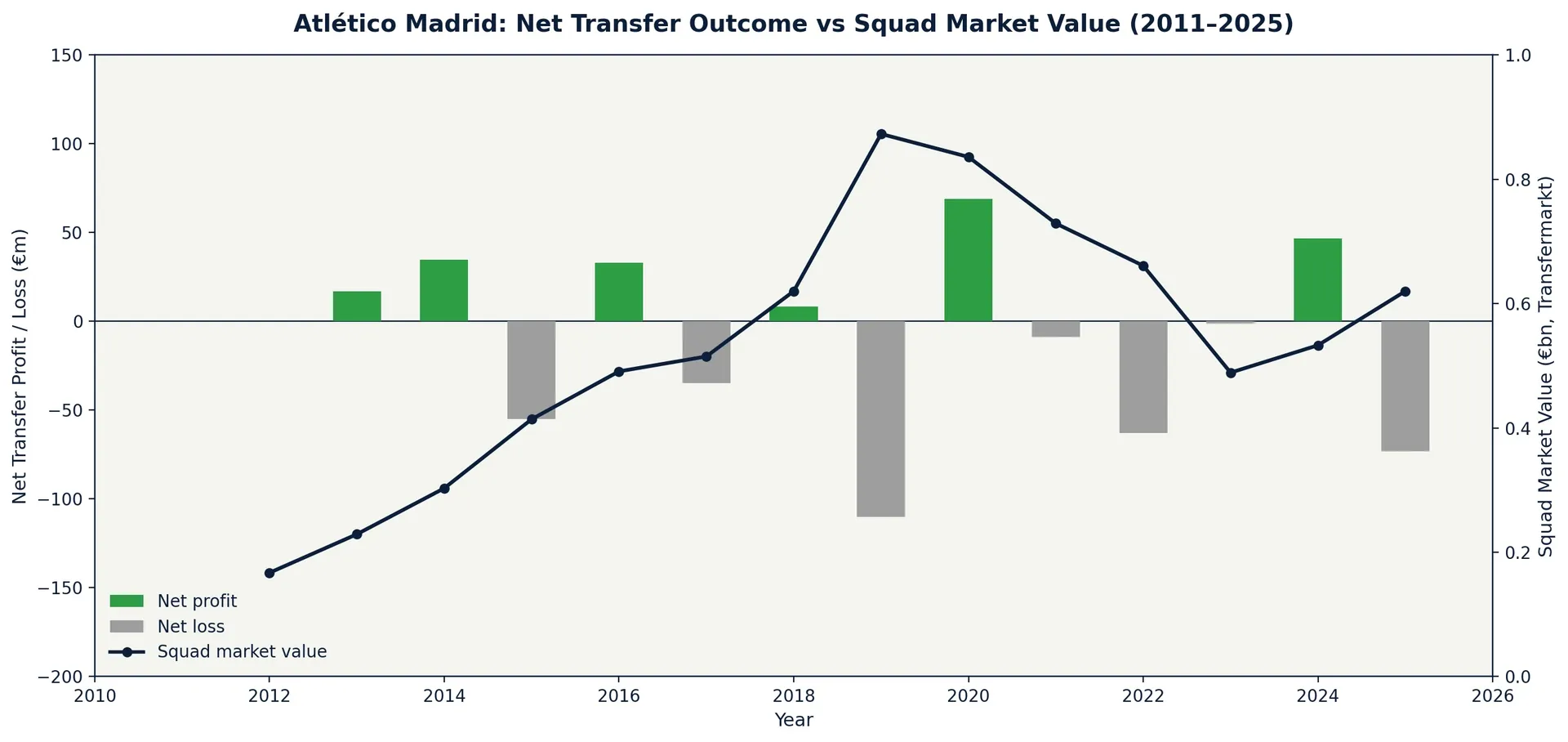
Figure: Net Transfer Outcome vs Squad Market Value (2011–2025)
How to read the chart
Green bars: net transfer profit years
Grey bars: net transfer loss years
Line: squad market value (Transfermarkt estimate)
Atlético Madrid's version of this story is typically more “boom-and-bust” than Real Madrid, but the mechanisms are similar:
When Atlético Madrid combine strong internal development with efficient recruitment, squad value rises.
When expensive signings lose availability, decline in performance, or fail to match tactical needs, squad value can fall sharply—even if short-term results remain competitive.
One practical reason is that Atlético Madrid's reduced reliance on academy depth during this period limited their ability to cushion transfer-market volatility, making the squad more exposed to the downside risk of high-cost signings.
Producing the Extra Value: Atlético’s Impact on the First Team
Over the past 20 years, Atlético Madrid’s value creation has followed a different pattern from both FC Barcelona and Real Madrid.
Where La Masia produces entire generations of first-team players, Atlético rely on transforming recruited players into high-performing assets within a structured system.
Only a limited number of academy players establish themselves as long-term starters. Instead, the club’s core is built through external recruitment, with players reaching peak performance after joining.
The model can therefore be summarised clearly:
The academy supports identity and continuity, while the first team is built through system-driven recruitment.
Key Takeaways for Modern Football Economics
Atlético Madrid’s model highlights three key principles.
The first is that transfer efficiency can replace academy volume as a source of sustainability. The second is that risk can be reduced at the recruitment stage rather than offset later. The third is that tactical consistency can enhance player value over time.
Together, these elements create a system that is both competitive and financially resilient.
Conclusion: Atlético Madrid’s model as a financial system
From a football finance perspective, Atlético Madrid represent a third model in elite football.
Where FC Barcelona rely on academy production and Real Madrid combine internal development with global recruitment, Atlético operate through controlled transfer efficiency.
Their model is not built on producing the most players or spending the most money, but on making consistently effective decisions within a defined system.
In modern football, that may be the most sustainable advantage of all.
Related La Liga History & Analysis