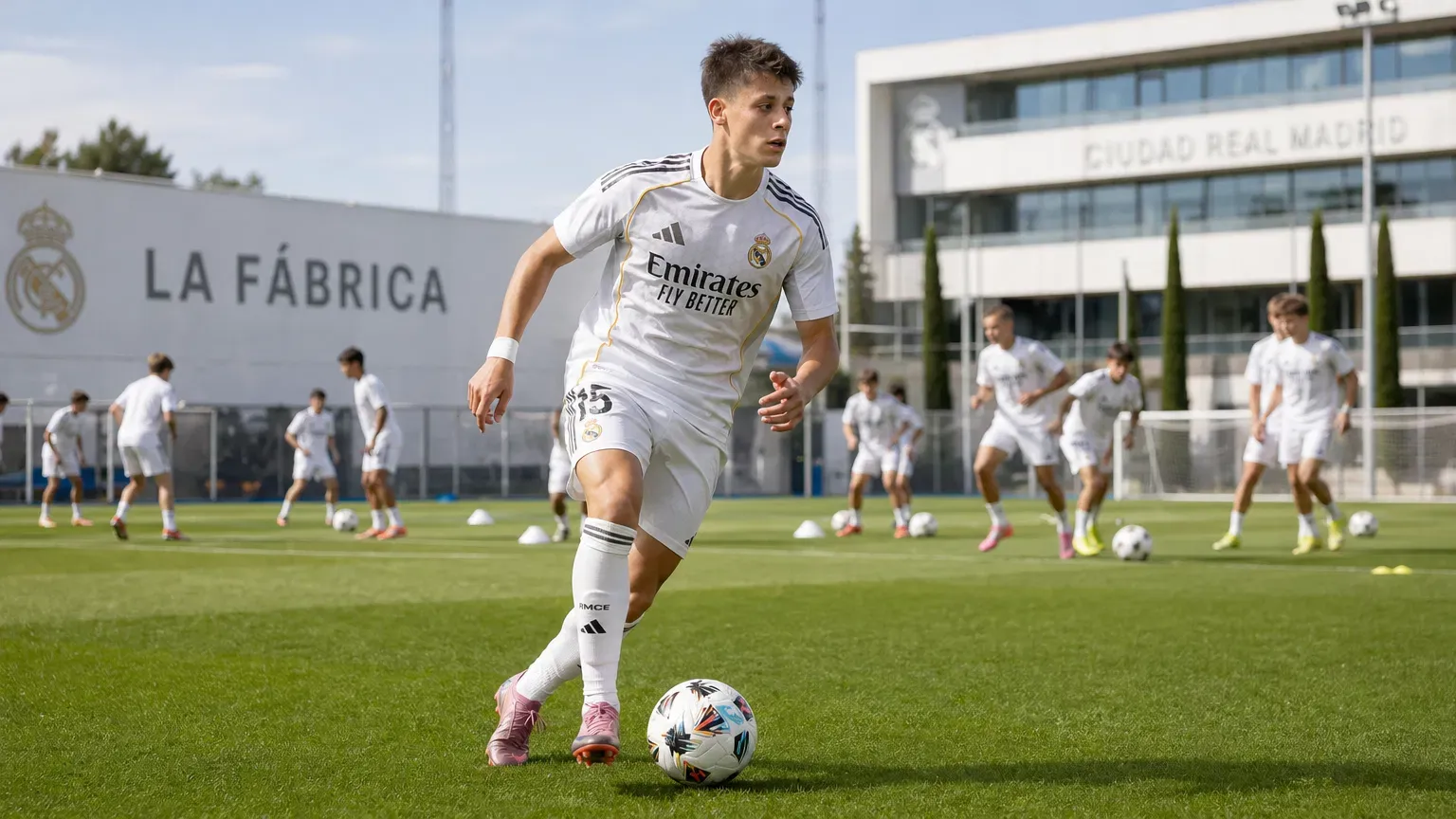
Introduction: La Fábrica and Real Madrid’s squad-building cycle explained
Real Madrid’s academy success is closely tied to the club’s domestic dominance. Over the decades, academy graduates have contributed to multiple championship campaigns in Spain’s top division. You can explore the complete La Liga winners list (1929–2026) to see how Real Madrid’s titles fit into the broader history of Spanish football.
Real Madrid are usually framed as the ultimate “buy the best” club—and historically, that’s true. But in the last two decades, their strategy has evolved into a layered model:
Elite signings to keep a Champions League–level ceiling.
Selective “value youth” signings (often bought young, developed internally, then either retained or sold).
A high-volume academy pipeline that (a) supplies squad depth and (b) generates frequent, medium-to-large sales.
The key difference from many rivals is that Real Madrid have turned Valdebebas into a repeatable sales machine. One major Spanish analysis reported €445m in academy-player sales over the last 20 years—an astonishing figure for a club whose brand is not primarily “selling club.” (Diario AS)
So how does that academy profitability compare to the “normal” transfer market (buying players, then selling later)? And what does it imply about Real Madrid’s real transfer strategy?
Using Transfermarkt transfer-fee and squad-value data, this article analyses Real Madrid’s transfer profitability and academy contribution from 2005 to 2025, mirroring the same approach used in the Barcelona/La Masia analysis.
Methodology: how the analysis was conducted
This analysis covers approximately the 2005/06 to 2024/25 seasons and uses publicly available data from Transfermarkt, one of the most widely cited football finance databases. (Transfermarkt)
Included
Permanent transfers with reported fees
Excluded
Loan fees
Wages and bonuses
Agent commissions
Accounting amortisation
Any overhead and exploitation of the grounds and trainer/management fees
Key metrics
Gross transfer profit/loss: sale fee minus purchase fee
Squad market value: Transfermarkt’s estimated value of the playing squad
Players developed at La Fábrica are treated as having a zero acquisition cost, allowing a direct comparison between homegrown players and those bought on the open market.
Why La Fábrica and the transfer market are not economically equal
From a financial standpoint, the difference between academy players and bought players is structural.
A homegrown player represents a low-risk asset. If the player succeeds, Real Madrid benefit on the pitch. If not, any sale fee still represents pure transfer profit.
A bought player, by contrast, must be sold for more than the original purchase price to avoid a loss. Injuries, tactical mismatches, declining form, or contracts running down frequently prevent that from happening. Over time, this creates asymmetric downside risk.
That distinction underpins Madrid’s long-term story: La Fábrica creates repeated “free options,” while the transfer market contains expensive write-off risk.
La Fábrica: consistent transfer profit with minimal risk
Key finding: La Fábrica has generated reliable, recurring transfer profit over the last 20 years.
A major AS analysis estimated that Real Madrid have generated €445 million from selling academy players over the last two decades. (Diario AS)
And El País described the same dynamic more narrowly since 2013: €404m in sales vs €89m invested (a +€315m balance)—a clear statement of how the academy is treated as a profit center. (El País)
Importantly, this profitability is not just one mega-sale. It’s the accumulation of many mid-to-high exits, often with Madrid also keeping sell-on clauses or buy-backs.
Below are examples (Transfermarkt fees) that illustrate the pattern:
(Fees shown in Transfermarkt’s Real Madrid transfers overview; academy players treated as €0 acquisition.) (Transfermarkt)
Total gross transfer profit from La Fábrica sales (reported estimate): €445 million (Diario AS)
These figures exclude numerous smaller academy exits, meaning the true total may vary depending on inclusion rules and reporting—but the key point is consistency: La Fábrica produces value repeatedly and with minimal downside risk.
The transfer market: high spending, high volatility, net losses
Real Madrid’s transfer-market record (buying players, then later selling them) is far more volatile.
Yes, Madrid have executed some outstanding value trades (buy, develop, sell high). But they’ve also taken some of the biggest “capital losses” in modern football when expensive signings left for nothing.
Using a matched sample of major bought-player transactions where Transfermarkt lists both the purchase fee and the eventual exit fee (including free exits), the pattern looks like this:
| | | | | PlayerSeason SoldBuying ClubSale Fee (€m)Purchase Fee (€m)Gross P/L (€m) |
Cristiano Ronaldo | 2018 | Juventus | 117.0 | 94.0 | +23.0 |
Ángel Di María | 2014 | Man United | 75.0 | 33.0 | +42.0 |
Mesut Özil | 2013 | Arsenal | 47.0 | 18.0 | +29.0 |
Casemiro | 2022 | Man United | 70.65 | 6.0 | +64.65 |
Mateo Kovačić | 2019 | Chelsea | 45.0 | 38.0 | +7.0 |
Robinho | 2008 | Man City | 43.0 | 24.0 | +19.0 |
Gareth Bale | 2022 | LAFC | 0.0 | 101.0 | −101.0 |
Eden Hazard | 2023 | Without Club | 0.0 | 120.8 | −120.8 |
Luka Jović | 2022 | Fiorentina | 0.0 | 63.0 | −63.0 |
Kaká | 2013 | AC Milan | 0.0 | 67.0 | −67.0 |
James Rodríguez | 2020 | Everton | 0.0 | 75.0 | −75.0 |
(Fees shown in Transfermarkt’s Real Madrid “All transfers” overview; free exits treated as €0 sale fee.) (Transfermarkt)
Total gross transfer result from this bought-player sample (not exhaustive): −€242.2 million
Sample sales revenue: €397.7m
Sample purchase cost: €639.8m
The point isn’t that Madrid “can’t sell”—they clearly can. The point is that one or two elite-level transfer failures can wipe out the profits from multiple smart trades, which is exactly why academy production is such a stabiliser.
La Fábrica vs transfers: the numbers side by side
| | | Recruitment ModelSales RevenuePurchase CostGross Result |
La Fábrica | €445.0M | €0 | +€445.0M |
Bought Players (sample) | €397.7M | €639.8M | −€242.2M |
La Fábrica total is the reported 20-year academy-sales estimate. (Diario AS)
Bought-player totals are from the matched sample table above (Transfermarkt fees). (Transfermarkt)
The contrast is clear:
Academy sales are structurally “low downside.”
Transfer-market activity is structurally “high upside, high downside,” and the downside can dominate.
How transfer decisions affected Real Madrid’s squad value
Transfer profits alone do not fully capture the impact of recruitment decisions. To understand the sporting consequences, it is useful to examine how transfer outcomes align with changes in squad market value.

Figure: Net Transfer Outcome vs Squad Market Value (2011–2025)
How to read the chart
Green bars: net transfer profit years
Grey bars: net transfer loss years
Line: squad market value (Transfermarkt estimate)
Real Madrid’s version of this story is typically less “collapse-and-rebuild” than Barcelona’s, but the mechanisms are similar:
When Madrid hit on young elite signings and retain core players, squad value rises.
When expensive signings lose availability/market demand (or contracts run down), squad value growth can flatten—even if on-pitch performance remains strong.
One practical reason: Madrid can cushion transfer-market volatility by keeping squad quality high via a steady flow of academy depth and saleable prospects (even if many do not become starters).
Producing the extra value: La Fábrica's impact on the first team
Over the past 20 years, Real Madrid’s reliance on La Fábrica has followed a different cycle than Barcelona’s. La Fábrica produces many top-league professionals, but—because Madrid’s “starting XI bar” is extremely high—only a small number consolidate as long-term starters.
El País highlighted this directly: despite the academy’s profitability, few academy players become first-team regulars, citing recent exceptions such as Dani Carvajal, Nacho, and Lucas Vázquez, while the club’s core has often been built around external elite or “pre-elite” acquisitions. (El País)
That’s the Madrid model in a nutshell:
La Fábrica feeds the ecosystem (sales + depth + occasional star),
while the first team is usually finished with high-ceiling purchases.
The economic logic remains powerful: even if only a few academy players “make it,” the academy can still be the club’s most reliable transfer-profit engine.

Key takeaways for modern football economics
Three conclusions stand out.
La Fábrica is economically efficient
The academy produces steady transfer value with minimal downside risk. Over 20 years, reported academy sales reach €445m. (Diario AS)
The transfer market is structurally risky
Even well-run clubs can suffer major losses when high-fee players leave for nothing (or close to it). Transfer success is real, but write-offs are expensive and lumpy. (Transfermarkt)
Real Madrid’s “best-in-world” version of sustainability is hybrid
Madrid’s sustainable edge isn’t “academy-only” or “galácticos-only.” It’s the combination:
academy profit and depth,
plus selective, high-impact spending and youth recruitment,
plus the discipline to sell at the right time when markets are strong.
Conclusion: La Fábrica as a financial asset, not a symbol
From a football finance perspective, the data points in one direction:
La Fábrica has consistently created value.
The transfer market, even with major wins, carries enough downside risk that a handful of failed high-fee deals can erase years of smart trading.
Real Madrid’s academy is not just a development pathway—it’s a recurring economic engine that:
funds parts of the squad cycle,
reduces reliance on risky “must-work” transfers,
and keeps the club structurally resilient even when individual signings fail.
While Real Madrid’s academy has delivered long-term financial and sporting returns, Barcelona’s La Masia has also played a pivotal role in shaping Spanish football. Comparing the two academies offers deeper insight into how youth development influences the broader competitive balance of La Liga.
In an era of tighter financial regulation and rising costs, the lesson is the same one Barcelona learned—but expressed in Madrid’s own language:
Developing players is no longer just tradition, it is economic necessity. (Diario AS)
Related La Liga Analysis