Introduction: La Masia
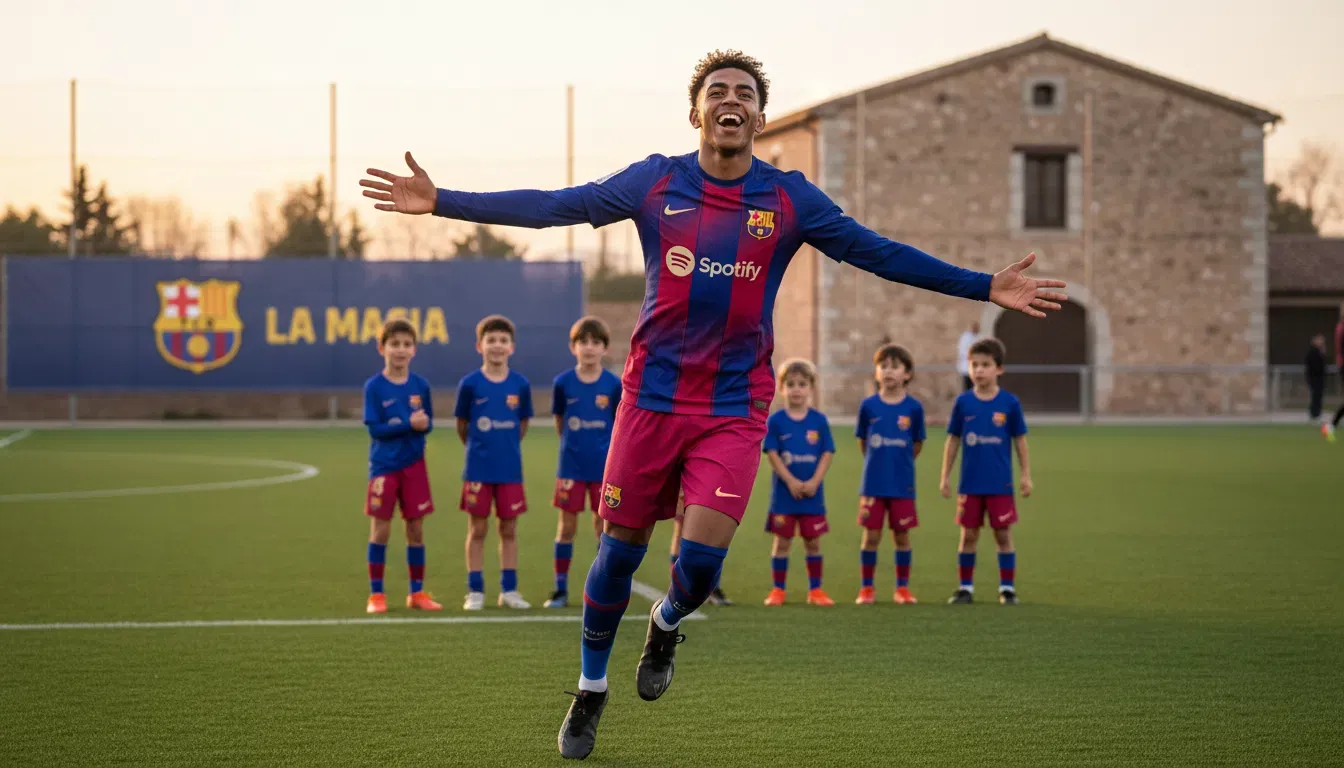
La Masia’s influence extends far beyond individual player development. Many academy graduates have played decisive roles in Barcelona’s championship campaigns, helping the club secure multiple domestic titles. For a full breakdown of every champion in Spain’s top division, explore the complete La Liga winners list (1929–2026) and see how Barcelona’s golden generations shaped modern football history.
Barcelona’s Financial Reset Explained
FC Barcelona’s financial struggles over the past decade have become one of the defining stories in modern football. Rising wage bills, aggressive transfer spending, and poor resale outcomes left the club with limited financial flexibility and forced a strategic reset.
In response, Barcelona has increasingly moved away from expensive, peak-age signings and toward a hybrid squad-building model. The club now relies even more on La Masia graduates, supported by experienced players signed on free transfers or low fees—players who still have one to three competitive seasons left but do not represent long-term financial risk.
Recent examples such as Robert Lewandowski, Wojciech Szczęsny, İlkay Gündoğan, and Marcos Alonso highlight this approach. These signings are not designed to generate future transfer profits. Instead, they provide stability, leadership, and short-term performance while allowing younger players to develop in a controlled environment.
But how effective has Barcelona’s academy really been from a financial perspective? And how does it compare to the club’s transfer-market activity over the last two decades?
Using Transfermarkt transfer-fee and squad-value data, this article analyses FC Barcelona’s transfer profitability and squad value evolution from 2005 to 2025, revealing a clear and consistent pattern.
Methodology: How the Analysis Was Conducted
This analysis covers approximately the 2005/06 to 2024/25 seasons and uses publicly available data from Transfermarkt, one of the most widely cited football finance databases.
Included
Permanent transfers with reported fees
Excluded
Loan fees
Wages and bonuses
Agent commissions
Accounting amortisation
Any overhead and exploitation of the grounds and trainer/management fees
Key metrics
Gross transfer profit/loss: sale fee minus purchase fee
Squad market value: Transfermarkt’s estimated value of the playing squad
Players developed at La Masia are treated as having a zero acquisition cost, allowing a direct comparison between homegrown players and those bought on the open market.
Why La Masia and the Transfer Market Are Not Economically Equal
From a financial standpoint, the difference between academy players and bought players is structural.
A homegrown player represents a low-risk asset. If the player succeeds, Barcelona benefits on the pitch. If not, any sale fee still represents pure transfer profit.
A bought player, by contrast, must be sold for more than the original purchase price to avoid a loss. Injuries, tactical mismatches, declining form, or contracts running down frequently prevent that from happening. Over time, this creates asymmetric downside risk.
That distinction underpins Barcelona’s long-term financial story.
La Masia: Consistent Transfer Profit With Minimal Risk
Key finding: La Masia has generated reliable, recurring transfer profit over the last 20 years.
Academy graduates such as Thiago Alcântara, Pedro Rodríguez, Cesc Fàbregas, Ilaix Moriba, Nico González, Marc Guiu, and Abde Ezzalzouli were developed internally and later sold for significant fees. Because their acquisition cost was zero, nearly every euro earned translated directly into profit.
Total gross transfer profit from La Masia sales: €187.3 million
Importantly, these profits were not dependent on a single blockbuster sale. Instead, value was created steadily through multiple medium-sized exits, with virtually no catastrophic downside.
Player | Season Sold | Buying Club | Sale Fee (€m) | Purchase Fee (€m) | Gross Profit (€m) |
Thiago Alcântara | 2013 | Bayern Munich | 25.0 | 0 | +25.0 |
Pedro Rodríguez | 2015 | Chelsea | 27.0 | 0 | +27.0 |
Bojan Krkić | 2011 | Roma | 12.0 | 0 | +12.0 |
Cesc Fàbregas* | 2014 | Chelsea | 33.0 | 0 | +33.0 |
Gerard Deulofeu | 2017 | Everton | 12.0 | 0 | +12.0 |
Marc Cucurella | 2018 | Eibar | 4.0 | 0 | +4.0 |
Ilaix Moriba | 2021 | RB Leipzig | 16.0 | 0 | +16.0 |
Nico González (incl. sell-on) | 2023–25 | Porto | 21.8 | 0 | +21.8 |
Abde Ezzalzouli | 2024 | Betis | 7.5 | 0 | +7.5 |
Marc Guiu | 2024 | Chelsea | 6.0 | 0 | +6.0 |
Chadi Riad | 2024 | Betis | 9.0 | 0 | +9.0 |
*Developed at La Masia despite later return.
Total La Masia gross transfer profit: +€187.3M
These figures exclude numerous smaller academy exits, meaning the true total is likely higher. The key point is consistency: La Masia produces value repeatedly and with minimal downside risk.
The Transfer Market: High Spending, High Volatility, Net Losses
Barcelona’s transfer-market record tells a very different story.
While there were notable successes—most famously the Neymar sale to Paris Saint-Germain—the overall outcome of buying and later selling players has been strongly negative.
High-fee signings such as Philippe Coutinho, Antoine Griezmann, Ousmane Dembélé, Miralem Pjanić, and others depreciated sharply or left on free transfers, crystallising substantial losses.
Total gross transfer result from bought players: −€253.9 million
The data shows that exceptional wins were outweighed by cumulative losses caused by injuries, contract mismanagement, and declining market value.
Player | Season Sold | Buying Club | Sale Fee (€m) | Purchase Fee (€m) | Gross P/L (€m) |
Neymar Jr. | 2017 | PSG | 222.0 | 88.0 | +134.0 |
Arthur Melo | 2020 | Juventus | 80.6 | 31.0 | +49.6 |
Paulinho | 2018 | Guangzhou | 42.0 | 40.0 | +2.0 |
Malcom | 2019 | Zenit | 41.5 | 41.0 | +0.5 |
Jasper Cillessen | 2019 | Valencia | 35.0 | 35.0 | 0.0 |
André Gomes | 2018 | Everton | 25.0 | 35.0 | −10.0 |
Alex Song | 2016 | Rubin Kazan | 0.0 | 19.0 | −19.0 |
Samuel Umtiti | 2023 | Lecce | 0.0 | 25.0 | −25.0 |
Sergiño Dest | 2024 | PSV | 0.0 | 26.0 | −26.0 |
Clément Lenglet | 2024 | Atlético | 0.0 | 36.0 | −36.0 |
Miralem Pjanić | 2022 | Sharjah | 0.0 | 60.0 | −60.0 |
Ousmane Dembélé | 2023 | PSG | 50.0 | 135.0 | −85.0 |
Antoine Griezmann | 2021 | Atlético | 22.0 | 120.0 | −98.0 |
Philippe Coutinho | 2022 | Aston Villa | 20.0 | 135.0 | −115.0 |
Total bought-player gross transfer result: −€253.9M
While the Neymar sale stands out as a major success, it is an exception. Most high-fee purchases failed to retain value and, in several cases, left the club for little or no compensation.
La Masia vs Transfers: The Numbers Side by Side
Recruitment Model | Sales Revenue | Purchase Cost | Gross Result |
La Masia | €187.3M | €0 | +€187.3M |
Bought Players | €537.1M | €791.0M | −€253.9M |
The contrast is clear. One model consistently creates value. The other introduces volatility and long-term risk.
Beyond transfer profits and global branding, La Masia’s greatest value lies in sustaining Barcelona’s domestic dominance. Comparing their success across decades reveals how youth development has influenced Barcelona’s La Liga title history and championship record.
How Transfer Decisions Affected Barcelona’s Squad Value
Transfer profits alone do not fully capture the impact of recruitment decisions. To understand the sporting consequences, it is useful to examine how transfer outcomes align with changes in squad market value.

Figure: Net Transfer Outcome vs Squad Market Value (2011–2025)
How to read the chart
Green bars: net transfer profit years
Grey bars: net transfer loss years
Line: squad market value (Transfermarkt estimate)
The relationship is striking.
Barcelona’s squad value peaked around 2018, following years of heavy investment in the transfer market. As those players aged, depreciated, or exited without compensation, the squad’s market value declined sharply.
The lowest points in squad valuation coincide with periods of sustained transfer losses.
More recently, squad value has begun to recover. This recovery aligns with:
increased reliance on La Masia graduates
shorter contracts
reduced exposure to high-fee transfers
While veteran free agents do not increase squad value directly, they protect performance levels and create space for young players—who do carry future value—to develop.
Producing the extra value: La Masia's impact on the first team
Over the past 20 years, FC Barcelona’s reliance on La Masia has followed a clear cycle that mirrors the club’s sporting and financial health. Academy representation steadily increased from the mid-2000s and peaked between 2009 and 2012, when more than half of the first-team squad consisted of homegrown players — an unprecedented level among Europe’s elite and the foundation of Barcelona’s most dominant era. This trend reversed sharply in the following decade as external recruitment intensified, with La Masia’s share falling to just 20% by 2018/19. Since 2021, however, the curve has turned upward again. Financial pressure and a strong new generation have pushed Barcelona back toward its roots, with academy players now accounting for around half of the first team. The data reinforces a simple conclusion: Barcelona’s most sustainable periods, both sporting and economic, coincide with its strongest commitment to La Masia.

The chart above visualises this long-term trend, showing the percentage of La Masia graduates in the first-team squad by season (2005/06–2024/25) and clearly illustrating the rise, decline, and resurgence of Barcelona’s academy model.
Key Takeaways for Modern Football Economics
Three conclusions stand out.
1. La Masia is economically efficient
The academy produces steady transfer value with minimal downside risk.
2. The transfer market is structurally risky
Large wins are rare, while losses accumulate quickly.
3. Barcelona’s current strategy reflects hard financial lessons
By combining youth development with short-term veteran signings, the club has reduced risk while rebuilding squad value.
Conclusion: La Masia as a Financial Asset, Not a Symbol
From a football finance perspective, the data is unambiguous:
La Masia has consistently created value.
The transfer market, in aggregate, has destroyed it.
Barcelona’s academy is more than a cultural identity or sporting philosophy. It is the club’s most reliable economic engine—one that not only generates transfer profit but also underpins the long-term value of the squad itself.
While Barcelona’s academy has been central to its identity, Real Madrid’s La Fábrica has followed a different development model focused on both talent promotion and strategic sales.
In an era of tighter financial regulation and rising costs, the lesson for Barcelona—and for elite clubs across Europe—is clear:
Developing players is no longer just tradition, it is economic necessity.
Related La Liga History & Analysis