From its 1957 construction and ballooning original budget to the €1.45bn Espai Barça rebuild, this is the full story of Camp Nou — the scale, the cost, the politics and the legacy of football’s most iconic stadium.
Share
Few stadiums in world football feel alive in the way Camp Nou does.
It does not simply host matches. It absorbs them. It remembers them. It echoes them back to future generations.
For nearly seven decades, Camp Nou has stood not just as the home of FC Barcelona, but as one of football’s defining theatres — a place where politics, identity, tactical revolutions and generational talent have unfolded before almost 100,000 voices.
Quick facts: Camp Nou build, capacity and renovation cost
How much did Camp Nou cost to build originally?
The final construction cost of Camp Nou reached approximately 288 million pesetas, far exceeding the original estimate of 66 million. The significant budget increase placed financial pressure on FC Barcelona for years, but the investment created one of Europe’s largest and most iconic football stadiums when it opened in 1957.
What is the Camp Nou renovation cost?
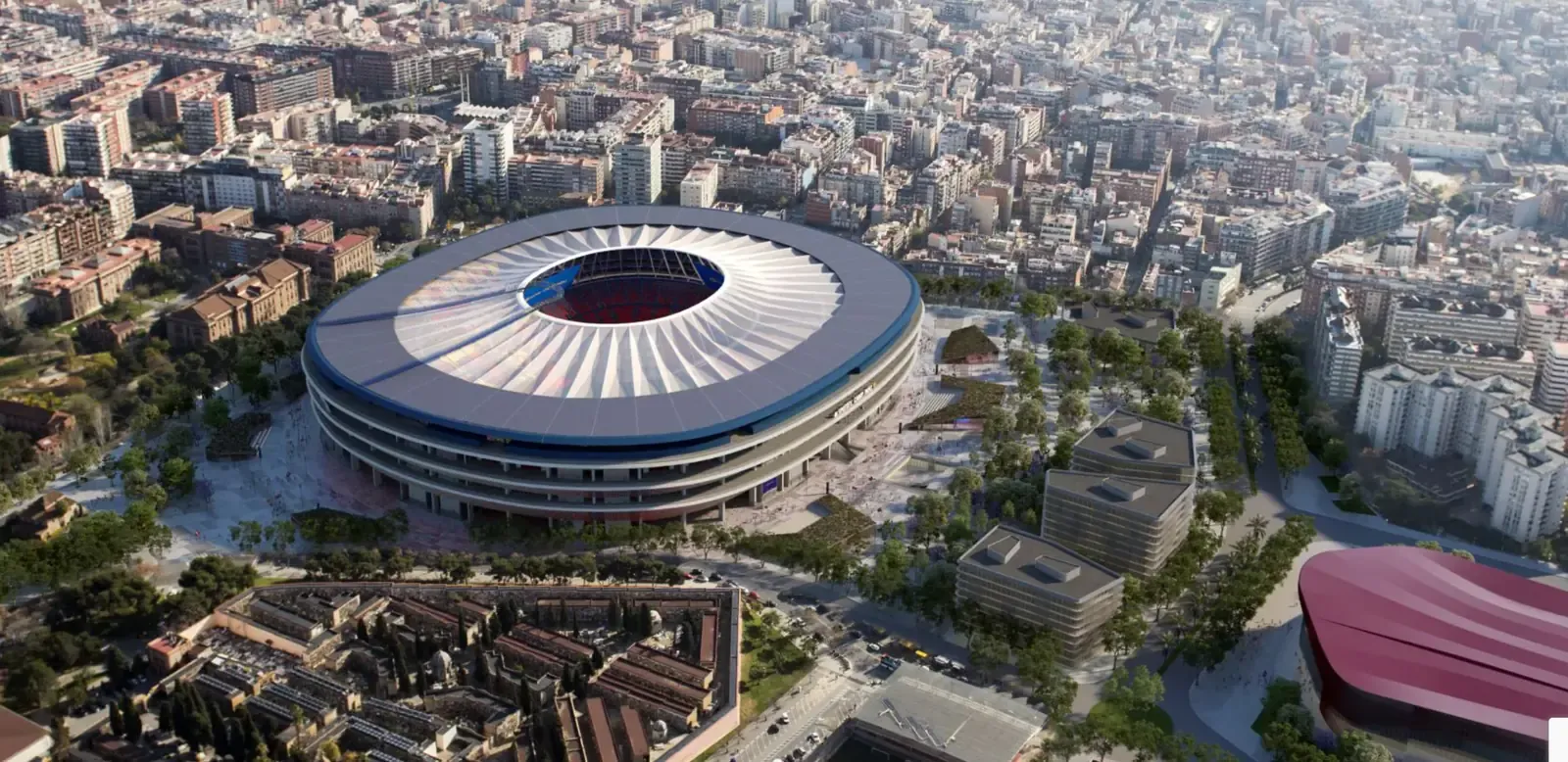
The Camp Nou renovation cost is part of the wider Espai Barça redevelopment project, which secured approximately €1.45 billion in financing. This package covers the structural transformation of the stadium, infrastructure upgrades and surrounding facilities as FC Barcelona modernises its historic home.
When will the Camp Nou rebuild be finished?
The Camp Nou rebuild began in 2023 under the Espai Barça project. Full completion is targeted for 2026, although reopening will occur in phases as construction progresses. Timelines may shift depending on permits, logistics and final construction milestones.
Camp Nou key facts Opened: 24 September 1957 Construction started: 28 March 1954 Original cost: ~288 million pesetas (final) Renovation: Espai Barça (construction from 2023) Renovation financing: €1.45bn package (Espai Barça) Planned capacity after rebuild: ~105,000
From Les Corts to Camp Nou: why Barcelona needed a bigger home
By the early 1950s, Barcelona had outgrown Les Corts. The club’s rising popularity, fuelled by the brilliance of László Kubala, had created crowds too large for its existing home. Expansion was not a luxury. It was survival.
On 28 March 1954, construction began on what would become Camp Nou. The scale of the project was extraordinary for post-war Spain. Over the course of just over three years, an estimated 2,000 to 3,000 workers took part in the build. The stadium officially opened on 24 September 1957.
The original projected budget was 66 million pesetas. By completion, the final cost had surged to approximately 288 million pesetas, more than four times the initial estimate. The financial strain was significant. Loans were taken. Assets were leveraged. It was a gamble that could have destabilised the club.
Instead, it reshaped it.
Designed by architects Francesc Mitjans and Josep Soteras, Camp Nou prioritised scale over ornamentation. Its sweeping concrete tiers rose steeply into the Catalan sky, forming a bowl that felt less like a sports ground and more like a monumental amphitheatre. At opening, it held around 93,000 spectators, instantly becoming one of Europe’s largest arenas.
Spain at the time was under Franco’s dictatorship, and Catalan cultural expression faced restriction. Yet inside this new stadium, collective identity found space. The arena quickly became more than infrastructure. It became a gathering point and, in subtle ways, a sanctuary — a theme explored more deeply in our look at the making of “Més que un club” in FC Barcelona's history and identity.
How Camp Nou evolved: expansion and pressure
As FC Barcelona grew in stature, so too did its stadium. Ahead of the 1982 FIFA World Cup, Camp Nou underwent major redevelopment. Additional tiers increased capacity to roughly 120,000, making it the largest stadium in Europe at the time.
Later, evolving safety regulations required all-seater stadiums, reducing capacity to just under 100,000. Even then, it remained the largest club stadium in European football for decades.
Opponents travelling to face Barcelona in Spain’s top flight, La Liga, often described the psychological weight of the ground. The sheer openness of the bowl, the steep walls of supporters, the acoustics of expectation — it was not simply noise. It was pressure, engineered in concrete.
Within those walls unfolded defining chapters of football history. Tactical revolutions, European nights, and domestic dominance turned Camp Nou into more than a venue. It became a stage.
Camp Nou renovation cost: Espai Barça financing, budget and timeline
The most dramatic transformation in the stadium’s history began in 2023 under the Espai Barça project.
FC Barcelona secured approximately €1.45 billion in financing tied to the wider redevelopment plan, which includes the complete structural transformation of Camp Nou. The rebuild is being carried out by Turkish construction firm Limak, with thousands of workers involved across different phases of construction.
The project is designed as a phased redevelopment, with completion targeted for 2026, although construction timelines depend on permitting and build progression. Once finished, capacity is expected to rise to around 105,000, once again making it the largest stadium in Europe.
The redevelopment includes a fully covered roof, enhanced hospitality areas, advanced digital integration and sustainability features aligned with modern environmental standards.
For the first time since 1957, Barcelona temporarily relocated during construction. The absence underscored something that decades of football had already made clear: club and stadium are inseparable.
What the rebuilt Camp Nou is designed to become
The new stadium will retain the iconic bowl shape while introducing modern structural reinforcement, improved sightlines and a roof that encloses the atmosphere rather than allowing it to escape into the Barcelona sky.
It aims to blend history and innovation — preserving the emotional architecture of the original while updating its physical reality for a new era of global sport.
And just as previous generations emerged onto its pitch through Barcelona’s academy system — detailed in our examination of La Masia’s global impact — the rebuilt arena is expected to host the next chapter of homegrown excellence.
Why Camp Nou still matters
In an era of corporate naming rights and interchangeable arenas, Camp Nou’s endurance feels rare.
It has been a political echo chamber, a developmental runway, a tactical laboratory and a fortress of domestic dominance in La Liga. For supporters of FC Barcelona it is home. For observers of European football, it is one of the sport’s defining landmarks.
Concrete can age. Steel can be replaced. Seats can be modernised.
But memory, once embedded, does not fade.
Camp Nou remains football’s grand cathedral not because of its size, but because of everything it has carried — and everything it still promises.
Camp Nou FAQs
When did Camp Nou open?
Camp Nou officially opened on 24 September 1957 after construction began in March 1954. It replaced Barcelona’s former stadium, Les Corts, and immediately became one of the largest football stadiums in Europe.
How long did it take to build Camp Nou?
Construction of Camp Nou lasted just over three years. Work started on 28 March 1954 and the stadium opened on 24 September 1957, an impressive timeline given its scale and capacity.
How many workers built Camp Nou?
An estimated 2,000 to 3,000 workers were involved in building Camp Nou during its original construction phase between 1954 and 1957. The project was one of the largest sporting infrastructure developments in Spain at the time.
What will the capacity be after the Camp Nou rebuild?
After the Espai Barça redevelopment is completed, Camp Nou is expected to hold approximately 105,000 spectators, making it the largest stadium in Europe once again.
Why is Camp Nou being renovated?
Camp Nou is being renovated as part of the Espai Barça project to modernise facilities, improve sustainability, increase revenue potential and enhance the matchday experience. The redevelopment includes structural upgrades, a covered roof and expanded hospitality areas.
Who is building the new Camp Nou?
The Camp Nou redevelopment is being carried out by Turkish construction company Limak, which was awarded the contract to oversee the stadium’s large-scale structural transformation.