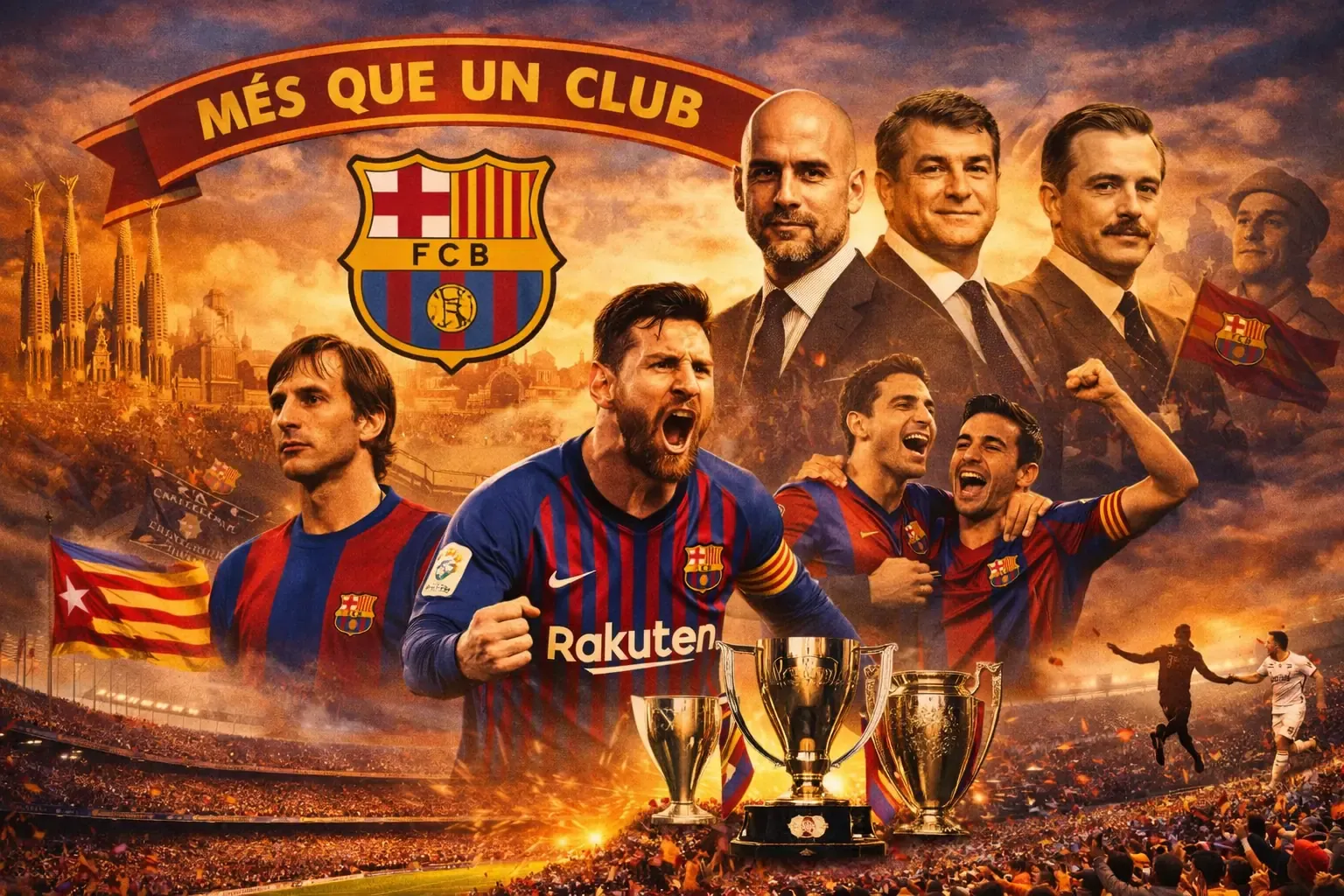
FC Barcelona is more than a football club. Founded in 1899, the Catalan giants have shaped La Liga history through political symbolism, tactical revolutions and academy excellence. From Cruyff’s Dream Team and Guardiola’s tiki-taka era to Lionel Messi’s dominance and modern rebuilding, Barcelona’s legacy is one of identity, innovation and sustained championship ambition.
Share
FC Barcelona is one of the most influential institutions in world football. Founded in 1899 by Joan Gamper, the club has grown into a global powerhouse defined not only by trophies but by cultural identity, political symbolism and tactical innovation. Over more than a century, FC Barcelona has embodied the idea of being “Més Que Un Club” — more than a club.
This documentary offers a detailed look at FC Barcelona’s historical evolution, highlighting its political identity, tactical revolutions and enduring influence on La Liga and European football.
The foundation of FC Barcelona (1899–1929)
FC Barcelona was established in 1899 and quickly became a central sporting institution in Catalonia. Founded by Joan Gamper alongside a group of local and foreign football enthusiasts, the club emerged at a time when organized football in Spain was still developing. From its earliest years, FC Barcelona represented more than sporting ambition; it embodied civic pride and community identity in a rapidly modernizing Catalonia.
In its early decades, the club won regional competitions such as the Campionat de Catalunya and established itself as one of Spain’s most competitive sides. These formative years were critical not only for building a winning mentality but for creating the structural framework that would later sustain long-term dominance.
When La Liga was officially formed in 1929, FC Barcelona claimed the very first championship. That victory did more than add a trophy to the cabinet — it anchored the club in Spanish football history from the outset. Across nearly a century of competition, FC Barcelona has remained one of the most decorated teams in Spain, consistently appearing in the all-time La Liga title rankings alongside its historic rivals. The foundation years laid the cultural and competitive DNA that continues to define the club today.
“Més Que Un Club”: politics and Catalan identity
FC Barcelona's identity extends far beyond football. The phrase “Més Que Un Club” captures a deeper institutional meaning rooted in Catalan history, culture and political expression. For supporters, FC Barcelona represents a collective identity that transcends the pitch.
The Franco era and cultural resistance
During Francisco Franco’s dictatorship, Catalan language and cultural symbols were suppressed. Public expressions of Catalan identity were restricted, and institutions were closely monitored. In this context, FC Barcelona became a subtle yet powerful vehicle for cultural resistance. Camp Nou transformed into a gathering space where Catalan flags, language and pride could be expressed within the relatively protected sphere of sport.
Supporting FC Barcelona during that era was not merely about results or trophies. It became an affirmation of identity and autonomy. The club’s victories were interpreted symbolically, reinforcing its stature as an institution representing more than athletic achievement.
The Catalonia independence debate
Even today, FC Barcelona remains intertwined with political discourse surrounding Catalonia’s independence from Spain. The club has often navigated a delicate balance between institutional neutrality and cultural representation. Its symbolism continues to resonate globally, reinforcing why FC Barcelona’s legacy cannot be reduced to championships alone. “Més Que Un Club” remains an active philosophy, not a historical slogan.
Camp Nou: a monument to ambition
Opened in 1957, Camp Nou quickly became a defining symbol of FC Barcelona’s ambition and scale. As the largest stadium in Europe for decades, it represented not only architectural magnitude but institutional confidence. Its construction signaled that FC Barcelona was not content with regional relevance; it aimed to become a continental powerhouse.
Camp Nou has hosted European finals, historic El Clásico encounters, league title celebrations and moments that shaped football history. The stadium became a theatre for generational icons and a pilgrimage site for supporters from across the world. It amplified FC Barcelona’s global reach and solidified its commercial and cultural expansion.
FC Barcelona’s recent return to Camp Nou following extensive renovation represents more than modernization. It symbolizes renewal — a physical reflection of institutional rebuilding. As the club seeks to compete again at the highest level of La Liga and European football, the stadium remains a bridge between heritage and future ambition.
The Johan Cruyff revolution
Few figures have influenced FC Barcelona as profoundly as Johan Cruyff. Arriving first as a player and later as a manager, Cruyff redefined how the club understood football. His ideas extended beyond formations; they reshaped recruitment, youth development and institutional philosophy.
The dream team era
Between 1991 and 1994, Cruyff’s “Dream Team” secured four consecutive La Liga titles and delivered FC Barcelona’s first European Cup. These achievements marked the club’s transition from domestic contender to European force. The team’s fluid positional play, technical confidence and attacking boldness became hallmarks of FC Barcelona’s style.
A lasting philosophical legacy
Cruyff’s influence extended far beyond silverware. His insistence on positional intelligence and youth integration laid the groundwork for La Masia’s prominence. The tactical blueprint he introduced would later be perfected in the Guardiola era. Cruyff did not simply win titles; he altered the structural identity of the club, embedding principles that continue to guide Barcelona’s long-term direction.
La Masia: the academy that built an era
No element of Barcelona’s history is more influential than La Masia. The academy system became the structural engine behind the club’s most dominant periods, reinforcing both sporting and financial sustainability.
The golden generation
La Masia produced Xavi, Andrés Iniesta, Carles Puyol, Sergio Busquets and Lionel Messi — players who not only excelled individually but embodied a shared footballing language. Their tactical education allowed seamless integration into the first team, preserving stylistic continuity.
These academy graduates were central to multiple league triumphs documented in the La Liga winners list (1929–2025). Their collective understanding of positional play made FC Barcelona uniquely cohesive during its golden era.
Between 2008 and 2012, FC Barcelona reached unprecedented levels of global dominance under Pep Guardiola. Building on Cruyff’s philosophy, Guardiola refined positional play into a near-perfect strategic framework.
Tactical innovation
The tiki-taka system emphasized spatial control, ball retention and intelligent pressing. Rather than relying on physical dominance, FC Barcelona overwhelmed opponents through structure and movement. The team controlled matches by controlling space and tempo.
This tactical analysis of Guardiola’s strategic framework shows how positional discipline and collective organization drove one of the most dominant periods in La Liga history. FC Barcelona did not merely win — it reshaped modern tactical thought.
Domestic and European success
During this era, FC Barcelona secured multiple La Liga titles and two Champions League trophies. The club strengthened its position in the all-time La Liga title rankings, reinforcing its status as one of Spain’s most successful institutions.
The Lionel Messi era
Lionel Messi became the defining figure of FC Barcelona’s modern identity. His evolution from La Masia prospect to global icon symbolized the club’s developmental philosophy.
Record-breaking achievements
Messi’s 50-goal La Liga season in 2011–12 remains one of the most extraordinary individual campaigns in European football history. Over more than a decade, he powered FC Barcelona through domestic dominance and continental triumphs.
System and individual brilliance
Messi thrived within FC Barcelona’s positional framework while elevating it through individual genius. His partnership with Xavi and Iniesta epitomized harmony between academy education and elite execution. The era stands as one of the most successful chapters in La Liga history.
This official video series captures Lionel Messi’s defining years at FC Barcelona, documenting the moments, milestones and performances that shaped one of the most dominant eras in La Liga history.
Championships and the rivalry with Real Madrid
FC Barcelona’s more than 28 La Liga titles position the club among Spain’s most decorated institutions. However, its legacy is inseparable from its rivalry with Real Madrid. El Clásico has consistently shaped the competitive narrative of Spanish football.
Each title race intensified the historical comparison between the two giants. For a comprehensive overview of their relative achievements, the all-time ranking of La Liga champions highlights how FC Barcelona’s sustained excellence continues to define the league’s competitive balance.
Financial crisis and modern rebuilding
Recent seasons have required structural recalibration. Financial instability and wage constraints forced FC Barcelona to reassess recruitment and long-term planning.
Financial constraints and strategic planning
Debt restructuring and transfer limitations reshaped decision-making processes. Sustainability became a central theme, aligning financial prudence with competitive ambition. Strategic discipline now complements sporting philosophy.
Tactical evolution in the modern era
Under new managerial leadership, FC Barcelona have adjusted tactically while attempting to preserve their core identity. This transition is analyzed in FC Barcelona’s tactical evolution under Hansi Flick, highlighting how the club balances tradition with adaptation.
Recruitment debates, including discussions around short-term reinforcements versus youth integration, reflect a broader institutional tension explored in FC Barcelona’s forward strategy and recruitment debate.
Competing in a league defined by history
FC Barcelona’s story remains inseparable from the broader evolution of Spanish football. As documented in the complete La Liga winners list (1929–2025), sustained dominance requires structural coherence across generations.
Real Madrid’s historical success continues to drive FC Barcelona’s ambition. The rivalry compels reinvention while preserving identity. Competing at the highest level of La Liga demands more than talent; it requires institutional clarity.
Why FC Barcelona will endure forever
FC Barcelona is not simply a football club. It is a cultural institution, a political symbol and a tactical innovator whose influence extends beyond trophies.
From Cruyff’s revolution to Guardiola’s positional mastery, from La Masia’s golden generation to Messi’s record-breaking dominance, FC Barcelona has repeatedly reinvented itself while preserving its philosophical core. Financial challenges and structural transitions have tested the institution, yet its identity remains intact.
In a league shaped by nearly a century of champions, few institutions have influenced football as profoundly as FC Barcelona— and few possess the structural resilience to endure across eras.