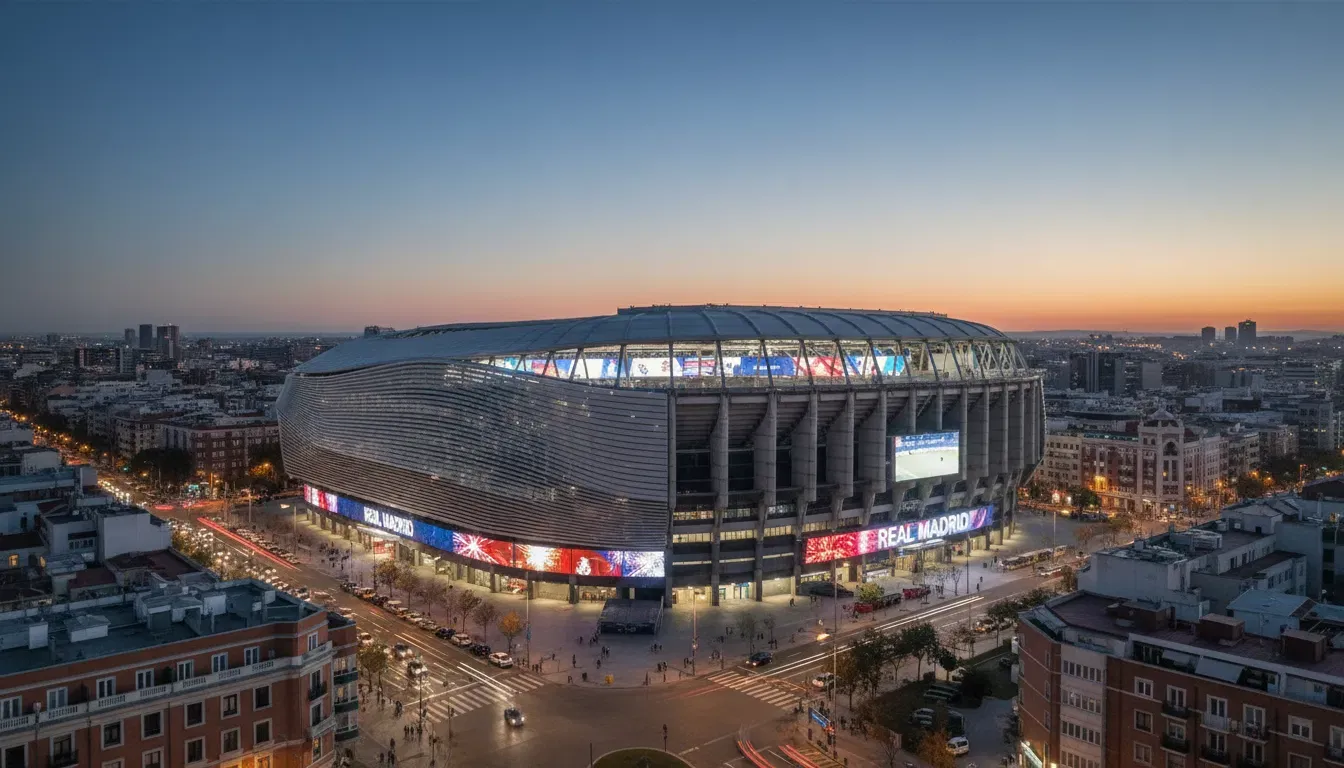
Introduction: the Santiago Bernabéu
The Santiago Bernabéu Stadium has always been more than just the home of Real Madrid. Since its opening in 1947, it has stood as a symbol of ambition, prestige and competitive dominance, hosting European finals, historic matches and generations of elite players.
But in modern football, identity alone is no longer enough. As the economics of the game have shifted—driven by broadcast growth, commercial expansion and escalating player costs—the role of the stadium has fundamentally changed. The Bernabéu is no longer just a venue for football. It is becoming a central pillar of Real Madrid’s financial model.
The recent redevelopment represents one of the most ambitious stadium transformations in world sport, not simply modernising infrastructure but redefining how a football club generates revenue.
Share
Real Madrid’s financial reset explained
Unlike many clubs that rely on external ownership or state-backed investment, Real Madrid operate under a member-owned structure. This makes long-term financial sustainability not just desirable, but essential.
By the late 2000s and early 2010s, it became clear that traditional revenue streams—matchday income, broadcasting and sponsorship—would not be sufficient to maintain competitive advantage indefinitely. At the same time, rivals across Europe were increasing investment levels, either through private ownership or structural innovation.
The club’s response was not immediate spending, but long-term planning. Rather than building a new stadium, Real Madrid chose to transform the existing Bernabéu into a modern, multifunctional asset capable of generating revenue beyond football.
This marked a strategic shift. The stadium would no longer simply support the team. It would actively finance it.
Methodology: how the analysis was conducted
This analysis draws on publicly available financial reports, club disclosures and industry estimates relating to the Bernabéu redevelopment.
The focus is on understanding the economic logic of the project rather than providing precise accounting figures. Key areas include total construction cost, financing structure, timeline of redevelopment and the projected impact on revenue streams.
By comparing pre- and post-redevelopment dynamics, it becomes possible to assess how the Bernabéu fits into Real Madrid’s broader financial model.
Why the Bernabéu project is not economically comparable to traditional stadium upgrades
From a financial perspective, the Bernabéu redevelopment differs significantly from conventional stadium modernisation projects.
A typical stadium renovation focuses on improving fan experience and increasing matchday capacity. While these factors are present, they are not the primary objective in Madrid’s case.
Instead, the project is built around revenue diversification. The stadium is designed to operate as a year-round venue, capable of hosting concerts, events, corporate functions and tourism at a scale that was previously impossible.
This fundamentally changes the economic profile of the stadium. Rather than generating income primarily on matchdays, it becomes a continuous source of revenue, reducing reliance on sporting performance alone.
The Bernabéu: consistent revenue growth with minimal dependency risk
One of the key advantages of the redevelopment is its ability to create stable, recurring income streams.
Historically, stadium revenue has been volatile, closely linked to team performance and attendance levels. By expanding into non-football events and premium experiences, Real Madrid are reducing that volatility.
The introduction of a retractable pitch and adaptable interior allows the stadium to host events without disrupting the football calendar. This increases utilisation while preserving the quality of the playing surface.
Over time, this creates a more predictable revenue base, which can support long-term financial planning.
The transfer market: high spending, high expectations, but now supported structurally
Real Madrid have long been associated with high-profile transfers and significant investment in players. While this approach has delivered success, it also introduces financial risk, particularly when large signings fail to retain value.
The Bernabéu project alters this dynamic. By increasing non-football revenue, the club gains additional financial flexibility, reducing the pressure on transfer success alone to sustain competitiveness.
In this sense, the stadium acts as a buffer. It does not replace the need for effective recruitment, but it reduces the consequences of individual transfer outcomes.
The Bernabéu vs traditional revenue models: the numbers side by side
Before the redevelopment, Real Madrid’s stadium income was largely concentrated around matchdays and limited additional activities. Post-redevelopment, the structure becomes significantly broader.
Revenue stream diversification is expected to increase overall income while reducing dependence on any single source. This aligns with broader trends in sports business, where venues are increasingly treated as multi-use assets rather than single-purpose facilities.
How the redevelopment affected Real Madrid’s financial trajectory
The timing of the Bernabéu redevelopment coincided with a period of structural change in football, including the financial impact of the COVID-19 pandemic.
Despite short-term disruptions, the long-term trajectory remains consistent. Investment in the stadium is designed to generate returns over decades rather than seasons.
This approach reflects a different kind of financial planning. Instead of reacting to immediate pressures, Real Madrid are positioning themselves for sustained competitiveness in a changing economic landscape.
Producing the extra value: the Bernabéu’s impact on the first team
Over the past two decades, Real Madrid’s success has been driven by a combination of recruitment, academy production and commercial strength. The redevelopment of the Bernabéu adds a new layer to this model.
Where traditional revenue streams support football operations, the new stadium actively enhances them. Increased income allows for greater investment in players, infrastructure and long-term planning.
This creates a feedback loop in which financial strength supports sporting success, which in turn reinforces the club’s global appeal and commercial potential.
In this system, the stadium is no longer a passive asset. It becomes an active driver of value creation.
Key takeaways for modern football economics
The Bernabéu project highlights several broader trends in football finance. Stadiums are evolving into multifunctional assets, revenue diversification is becoming essential, and long-term planning is increasingly replacing short-term decision-making.
Real Madrid’s approach reflects a recognition that success in modern football depends not only on performance on the pitch, but on the strength of the underlying financial structure.
Conclusion: the Bernabéu as a financial asset, not just a symbol
The Santiago Bernabéu has always been a symbol of Real Madrid’s identity. With its redevelopment, it becomes something more.
It is no longer just a stage for football, but a central component of the club’s economic model. By transforming the stadium into a year-round revenue generator, Real Madrid are reducing financial volatility and increasing long-term sustainability.
In an era where competitive advantage is increasingly defined by financial strength, the Bernabéu represents a strategic shift.
It is not simply a renovation.
It is a redefinition of how a football club generates value.